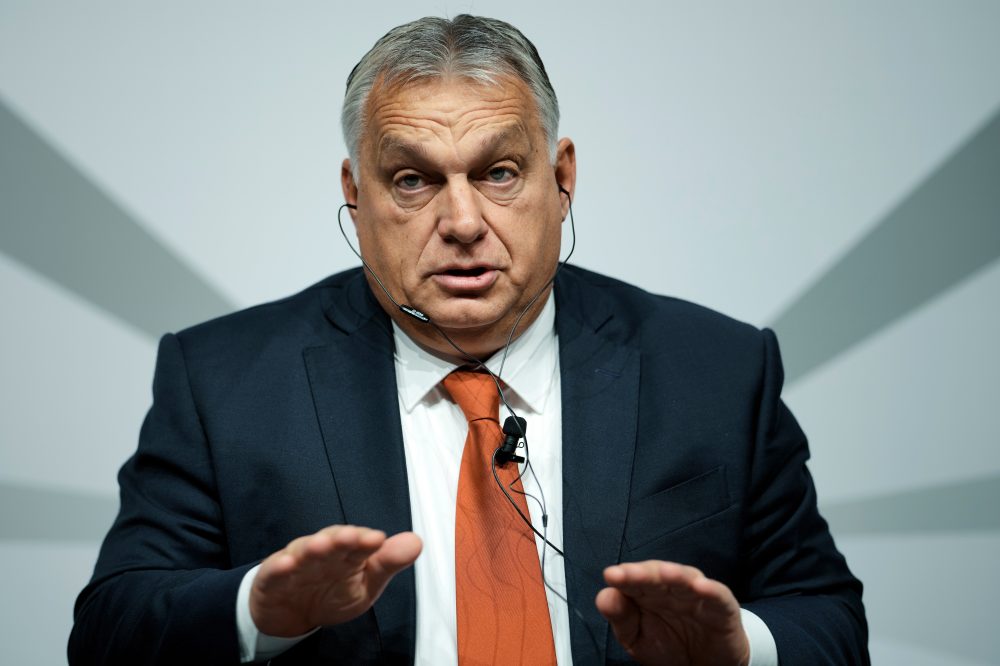

BUDAPEST, Hungary — Viktor Orbán, who has controlled Hungarian politics for over twenty years, faces a critical election Sunday that could end his remarkable transformation from young democracy advocate to authoritarian strongman.
The 62-year-old leader, who currently serves as the European Union’s most enduring prime minister and frequent critic, trails significantly in polling data despite receiving a campaign boost from a recent visit by U.S. Vice President JD Vance.
Orbán’s challenger comes from the center-right Tisza party, led by the increasingly popular Péter Magyar. In response to this threat, the incumbent has launched misleading information campaigns, artificial intelligence-created attack advertisements, and apocalyptic warnings that economic collapse and military conflict would devastate Hungary under new leadership.
The current prime minister’s journey began in 1963 in the small village of Felcsút, located roughly 20 miles from the capital. As an academically gifted youth with a passion for soccer, he pursued legal studies before attending Oxford University on a scholarship from George Soros’s foundation — ironically, the same billionaire Orbán would later vilify as a national threat.
Orbán helped establish Fidesz in 1988 as a liberal organization opposing communist rule. One year later, the 26-year-old law student delivered a passionate address to massive crowds, boldly calling for Soviet military withdrawal from Hungarian territory during the communist system’s final phase.
Following his 1990 parliamentary debut as Fidesz’s leader, he achieved the distinction of becoming Europe’s youngest prime minister when voters elected him in 1998 at age 35. However, as Hungary’s political landscape evolved and competing liberal movements gained ground, he gradually repositioned Fidesz toward conservative nationalism.
Political analysts often point to his 2002 electoral loss to the Socialist party as the moment that fundamentally altered Orbán’s governing philosophy. Addressing party members following that defeat, he outlined his strategy for future dominance.
“We’ve only got to win once, but we’ve got to win big,” he said.
That decisive victory materialized eight years later. Capitalizing on public frustration over the 2008 financial crisis and Socialist government scandals, Orbán reclaimed the prime minister’s office in 2010 with Fidesz securing a parliamentary supermajority.
This overwhelming mandate enabled sweeping institutional changes. Fidesz unilaterally drafted a new constitution, restructured election laws, and installed loyalists throughout the judiciary.
Simultaneously, Orbán directed European Union-funded government contracts toward allied businesses. These supporters subsequently acquired hundreds of media companies while forcing others to shut down. By decade’s end, analysts estimated that Fidesz-aligned entities controlled approximately 80% of Hungary’s private media landscape.
Leveraging state resources, Orbán converted public broadcasting into a party propaganda tool and invested billions in government-sponsored messaging through billboards, advertisements, and direct mail campaigns. The organization Reporters Without Borders has labeled him a press freedom “predator.”
While EU officials and international monitoring groups have raised alarms — with the European Parliament designating Hungary an “electoral autocracy” in 2022 — Orbán’s base celebrates him as a champion of Christian principles and national independence against globalization, mass immigration, and what he characterizes as EU oppression.
Seemingly energized by disrupting European Union consensus, Orbán constructed border barriers and implemented strict immigration policies, portraying migrants and asylum seekers as instruments of a globalist conspiracy to “replace” Europe’s white majority.
At a 2022 party event in Romania, he declared: “we do not want to become peoples of mixed-race.”
His administration has repeatedly confronted Brussels over corruption allegations, media freedom restrictions, judicial independence, and anti-LGBTQ+ laws. Most recently, it has blocked EU initiatives supporting Ukraine and imposing sanctions on Russia following its comprehensive invasion.
The European bloc has suspended billions in Hungarian funding due to rule-of-law violations. Orbán has responded by intensifying anti-EU rhetoric, drawing comparisons between Brussels and the Soviet system that controlled Hungary for over four decades.
The Hungarian leader has also developed strong relationships with ideologically similar figures including U.S. President Donald Trump and Russian President Vladimir Putin. He has aligned with Euroskeptic, far-right movements while forecasting a “patriotic” conquest of EU institutions.
His independent foreign policy approach, which contradicts Western consensus, has prompted allegations that he serves Moscow’s interests.
As Sunday’s election nears, media investigations have indicated Russian intelligence services may be interfering to support Orbán’s campaign, claims Russia has rejected. Additional reporting revealed that Orbán’s foreign minister routinely disclosed confidential EU meeting information to his Russian counterpart.
Opposition candidate Magyar has highlighted the prime minister’s Moscow connections, with rally attendees chanting: “Russians go home!”
Magyar, whose victory remains uncertain, describes Sunday’s vote as a choice between Hungary’s continued slide toward authoritarianism or its return to European democratic norms.