
American conservative leaders are keeping a close eye on Hungary’s upcoming parliamentary election on April 12, where Prime Minister Viktor Orban faces his most challenging political fight in over a decade.
For years, U.S. conservatives have held up Orban as an example of how Western politicians can implement strict immigration controls, challenge international organizations, and combat what they call “woke” ideology while maintaining electoral success.
However, polling data indicates that after 16 years in office, Orban’s Fidesz party is struggling against center-right challenger Peter Magyar and his Tisza party. Most independent surveys show Magyar holding a lead over the incumbent prime minister.
A potential loss for Orban would send shockwaves beyond Hungary’s borders, undermining a governing model characterized by strong nationalism and weakened democratic oversight that some American conservatives have promoted as a template for Western nations.
Magyar, age 45, has campaigned across hundreds of Hungarian communities, frequently delivering speeches from a truck decorated with the country’s national colors. The lawyer and European Parliament member has focused his message on economic concerns including stagnant wages, increasing food costs, and declining public services while promising to address corruption and restore democratic institutions.
His campaign has resonated particularly well with younger Hungarian voters, who appreciate his focused messaging and effective use of social media platforms.
Orban, 62, has characterized his opponent as an unreliable choice who would submit to European Union pressure and involve Hungary in the conflict in Ukraine. The longtime leader maintains friendly relations with Russia and opposes providing aid to Ukraine. Campaign materials throughout Budapest promote Fidesz as “The Safe Choice.”
Five political experts believe that even prominent American support, including Donald Trump’s endorsement and a scheduled visit from Vice President J.D. Vance on April 7-8, will have minimal impact on the election outcome since voters are primarily concerned with domestic economic issues.
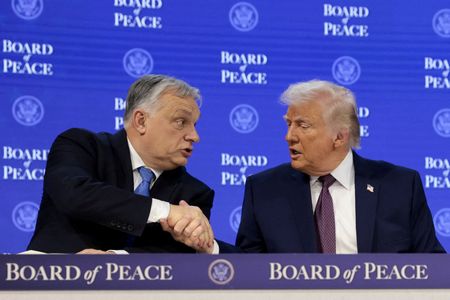
Trump has described Orban as “a truly strong and powerful leader,” and Budapest has hosted conferences where American conservative figures study his political strategies.
The Hungarian leader’s approach to governance, which he calls “illiberal democracy,” shares similarities with Trump-era policies including strict immigration enforcement, rejection of liberal institutions, opposition to global organizations, and criticism of media outlets, universities, and advocacy groups. Orban became the first European leader to support Trump’s 2016 presidential campaign.
During Barack Obama’s presidency, Washington frequently criticized Orban’s government for undermining democratic principles, including judicial independence and media freedoms, but such criticism diminished after Trump took office.
Orban’s willingness to oppose the European Union has also attracted American conservative supporters. He has consistently challenged the bloc, particularly by opposing Ukraine’s membership application and maintaining ties with Russia. Magyar has promised to distance Hungary from Moscow and strengthen Western relationships.
In a previous Reuters interview, Magyar stated that voters must decide between “Europe and development, or a continuation of ’16 years of decline.’”
On his Truth Social platform, Trump has praised Orban for helping achieve “new heights of cooperation and spectacular achievement” between the United States and Hungary. A White House spokesperson confirmed that Trump considers Orban “a close partner, respected leader, and a winner for the people of Hungary – a great ally to the United States.”
Despite this praise, the Trump administration has not provided Orban with the same level of economic support given to other allies like Argentine President Javier Milei, who received billions in U.S. assistance last year.
Following a November White House meeting, Orban claimed he had secured a U.S. “financial shield” for Hungary’s economy, but Trump later denied making such an offer. Secretary of State Marco Rubio’s February 16 visit to Budapest yielded only vague promises about “finding ways to provide assistance” if needed.
“We’re hitting a ceiling (on) what the Americans are willing to really offer,” said Zsuzsanna Vegh, a political analyst at the German Marshall Fund of the United States. “That may signal a level of uncertainty about whether Orban will really win. Trump might not want to be seen supporting a loser.”
International observers from the Organization for Security and Cooperation in Europe found Hungary’s 2022 general election, which Orban won decisively, to be free but not fair due to extensive state-funded advertising and media bias favoring Fidesz. Changes to election laws under Orban’s leadership have enabled his party to secure supermajorities with less than half the popular vote.
Vance’s upcoming visit demonstrates Orban’s position within Trump’s global conservative network, highlighted by two March conferences in Budapest featuring right-wing politicians and activists from multiple countries.
Even Orban supporters question whether international endorsements will influence voters. “Domestic issues will determine voter intentions,” said Zoltan Kiszelly, a political analyst at the pro-Orban think tank Szazadveg.
A March 21 CPAC Hungary conference included Argentine President Milei, German far-right leader Alice Weidel, and Republican congressmen Russ Fulcher of Idaho and Andy Harris of Maryland. During the event, conservative media personality Dave Rubin acknowledged feeling “trepidation” among attendees, while Harris warned of “vandals” threatening Christian values and urged Hungarians to “throw the vandals out and shut the gate,” declaring that “the future of Western, Christian, free civilization depends on it.”
Harris told Reuters that Orban’s leadership “led the way for the victory of many right-of-center leaders in Europe. Of course, that put a political target on him.”
Two days later, Orban met with leaders from at least 10 European far-right parties, including France’s Marine Le Pen and the Netherlands’ Geert Wilders. Their alliance, Patriots for Europe, established by Orban and allies in 2024, now ranks as the third-largest group in the European Parliament.
Kiszelly suggested his American conservative contacts remain confident despite polling challenges, drawing lessons from Trump’s 2024 victory about the unreliability of surveys. He attributed Orban’s apparent deficit to “pro-opposition pollsters” and cited polling by McLaughlin & Associates, a firm associated with Trump, showing Fidesz leading Tisza by six points.
According to Kiszelly, such a margin would allow Fidesz to govern independently or with support from the far-right Our Homeland party. “The opposition has no chance,” he stated.
However, most polling suggests a different outcome, favoring a challenger who appeals to voters in areas traditionally dominated by Fidesz.
Magyar represents a departure from typical liberal opposition figures. Campaigning with the motto “Now or never,” his party supports strict immigration controls, traditional family values, and nationalism – positions historically associated with Orban’s platform. Notably, his surname translates to “Hungarian.”
Signs of electoral pressure have emerged on the campaign trail. Orban faced heckling at a recent rally in Gyor, an unusual occurrence for a leader whose events are typically carefully managed. Appearing unsettled by the disruption, he accused the protesters of “not standing with Hungarians.”