
Yemen’s Iran-backed Houthi rebels announced early Thursday that they had targeted two Saudi oil tankers sailing through the Red Sea, while the U.S. military confirmed it had conducted a 12th straight night of airstrikes against Iran as both nations compete for dominance over critical global shipping routes.
The Houthi assault raised fears of a new front opening in a conflict that has already rattled the global economy, driving up the cost of fuel and other goods worldwide. With tensions in the Gulf showing no sign of easing, diplomatic channels aimed at resolving the crisis appeared to be going nowhere.
U.S. Central Command stated that its strikes were intended to “further degrade Iran’s ability to threaten civilian mariners and commercial vessels transiting regional waters,” as American forces work to reclaim control of the Strait of Hormuz and restore normal international shipping operations.
Earlier on Wednesday, President Donald Trump issued a stark warning that the U.S. would destroy one bridge or power plant each time Iran fires on a ship in the strait. Both parties have ramped up threats targeting civilian infrastructure, a practice that is broadly prohibited under international law unless that infrastructure is being used for military purposes.
“From this point forward, any time the Islamic Republic of Iran shoots at a ship in the Strait of Hormuz, whether it be by Missile, Rocket, Drone, or any other device or weapon, the United States will bomb and destroy ONE BRIDGE OR POWER PLANT,” Trump wrote on social media.
The Houthis claimed responsibility for hitting two tankers identified as the Encelia and the Layla, saying fires broke out on both ships. This would mark their first reported attack on a vessel since they declared a blockade of Saudi-linked shipping through the Bab el-Mandeb Strait earlier this week. That blockade was announced in retaliation for Saudi Arabia’s blockade on Yemen and a recent strike on the international airport in Sanaa, the rebel-controlled Yemeni capital.
Bab el-Mandeb sits at the southern end of the Arabian Peninsula and serves as a key chokepoint linking the Red Sea to the Gulf of Aden. Roughly 12% of global trade — including about a quarter of all container shipping — moves through that narrow passage as cargo travels between Europe and Asia via Egypt’s Suez Canal.
Saudi state media reported that the Encelia caught fire after being struck while traveling overnight through the Red Sea, citing an unnamed source from the General Authority of Transport. The Saudi Press Agency said a strike ignited a fire at the front of the vessel but that no one was injured. No mention was made of the Layla.
The United Kingdom Maritime Trade Operations Center, known as UKMTO, reported receiving notice that a tanker had been hit by “an unknown projectile” approximately 70 nautical miles — or 80 miles, 130 kilometers — southwest of Al Shuqaiq, Saudi Arabia, in the Red Sea. The center said no casualties had been reported.
The ongoing U.S. airstrikes come as both sides have hardened their positions over the Strait of Hormuz, a waterway vital to global energy supplies that has remained largely shut down. Before the conflict, roughly one-fifth of the world’s traded oil and gas flowed through the strait. Its closure has sent shockwaves through the global economy well beyond the Middle East.
Iran has asserted the right to manage traffic through the strait and potentially collect fees, despite the waterway previously being open and toll-free to all. Tehran has attacked ships using a route through the strait that is under U.S. oversight and was designed to operate outside Iranian control.
In response to those attacks, the U.S. reinstated a blockade on Iranian ports and expanded its airstrike campaign across the country. On Tuesday, Trump hinted that American forces could soon strike an Iranian nuclear facility still under construction and buried deep beneath a mountain.
Iran’s parliament speaker, Mohammad Bagher Qalibaf, who has been leading negotiations with the U.S., appeared to dismiss Trump’s warnings, writing on social media: “We have repeatedly said that the situation of the strait will not return to prewar conditions.”
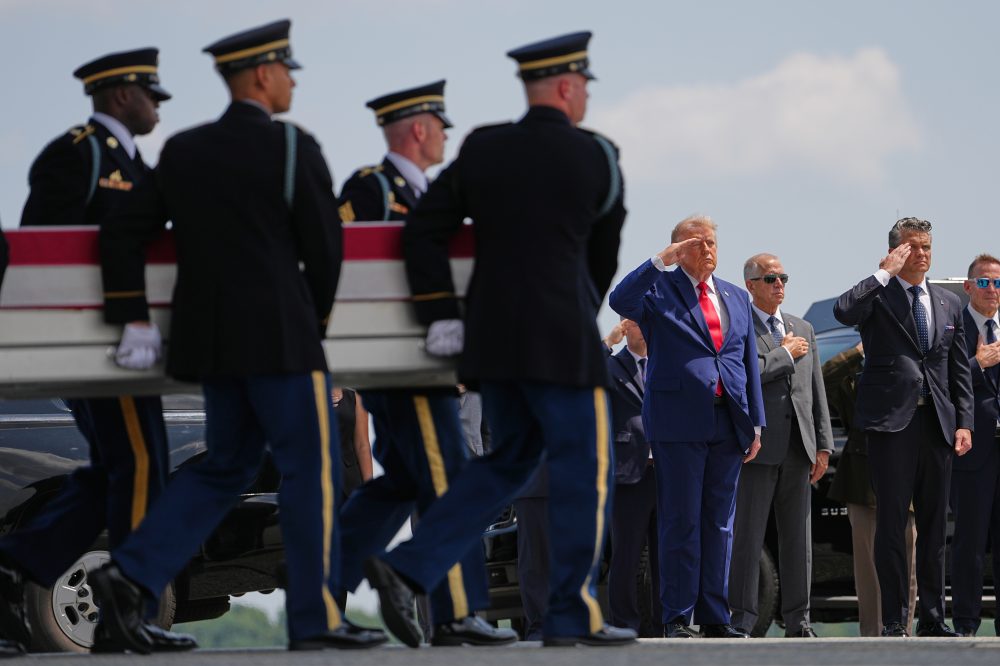
Trump visited Dover Air Force Base on Wednesday to receive the remains of four U.S. service members. The day before, Defense Secretary Pete Hegseth told a Senate hearing that the United States has spent an estimated $37.5 billion on the war so far.
Iranian state media reported that U.S. missiles struck areas near the cities of Ahvaz, Ramshir, and Andimeshk in western Iran overnight, and that two people were killed in a missile strike in the border town of Shalamcheh near Iraq.
Iran has retaliated against U.S. strikes by hitting energy facilities and desalination plants that supply drinking water to neighboring Gulf nations. Military officials in Kuwait announced on social media that their air defenses were “confronting attacks by hostile drones, following the sinful Iranian aggression.”
Iran’s Foreign Minister Seyed Abbas Araghchi declared that Tehran would respond with an “eye for an eye” approach, posting Wednesday on X: “Any aggression against Iran, including our infrastructure, will compel a powerful and decisive response.”
Iran’s Interior Minister Eskandar Momeni recently held meetings in Pakistan, which has been acting as a key mediator in the conflict, in an effort to revive diplomacy. However, it remained unclear what kind of deal could bring the fighting to an end. Iran’s Interior Ministry spokesperson Ali Zeinivand told state media that “diplomacy isn’t called off” and that messages were still being exchanged, though he provided no further details.
An Arab diplomat, speaking anonymously given the sensitivity of the matter, said Gulf states are growing increasingly pessimistic about finding a way to de-escalate the conflict and are especially alarmed by the latest round of threats. The diplomat said nations in the region, along with Pakistan and Turkey, continue to push for calm, but that the prospects for improvement look dim.
At a regional summit held in the Philippines, U.S. Secretary of State Marco Rubio said Washington remains willing to negotiate with Iran, adding, “but right now they don’t seem to be serious about that” — so the current priority is protecting shipping lanes.