
The Japanese automotive giant Honda announced Thursday it suffered a historic annual deficit of 423.9 billion yen ($2.7 billion), marking the company’s first full-year financial loss in its history due to substantial expenses tied to its electric vehicle initiatives influenced by President Donald Trump’s America-first policies.
The automaker revealed that expenses connected to its electric vehicle operations are projected to reach 2.5 trillion yen ($16 billion), with most of these costs occurring during the recently concluded fiscal year and the ongoing fiscal period.
Industry experts suggest Honda Motor Co. may have pursued overly aggressive expansion when consumer markets weren’t prepared for such rapid changes. Consequently, Honda scrapped numerous electric vehicle projects, including collaborative efforts with Sony Corp.
“EV demand has declined considerably, due to the rollback of environmental regulations in the U.S. and other factors,” Honda said in a statement.
The Trump administration has scaled back financial incentives for electric vehicles and restricted funding to states seeking to expand EV charging infrastructure, while gasoline costs have increased due to conflict in Iran.
Trump also prevented California’s strict electric vehicle requirements from taking effect last year, reversing momentum toward environmentally friendly automotive options.
Trump’s import duties on foreign automobiles and automotive components, though reduced to 15% from an original 25%, also contributed to Honda’s reduced earnings.
The Tokyo-headquartered company’s financial position received support from its robust motorcycle division, which helped Honda’s total revenue for the fiscal year ending in March increase 0.5% to 21.8 trillion yen ($138 billion).
Honda, manufacturer of the Accord sedan and Super Cub motorcycles, delivered 3.4 million automobiles globally during the fiscal year through March, a decrease from 3.7 million in the prior year.
The company sold 22.1 million motorcycles, an increase from 20 million the previous year. Honda maintains market leadership in motorcycles across several regions, including India.
Honda projects a return to profitability for the fiscal year concluding March 2027, estimating earnings of 260 billion yen ($1.7 billion).
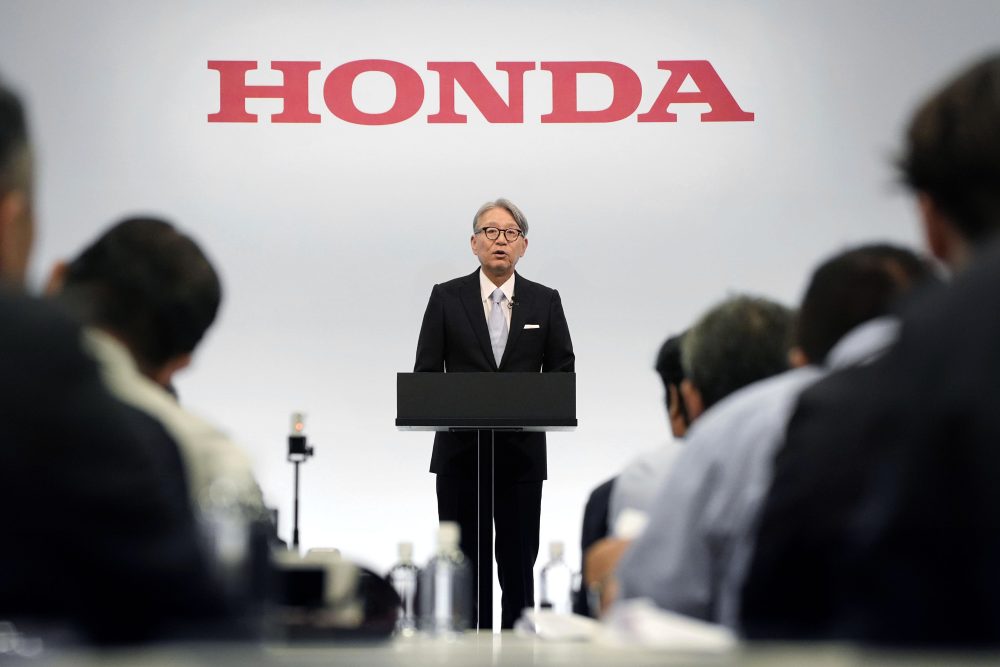
Chief Executive Toshihiro Mibe presented a revised growth plan that maintains commitment to achieving carbon neutrality. However, he recognized the importance of developing hybrid and conventional gasoline-powered vehicles alongside electric options.
When a reporter questioned whether he might resign to accept accountability for the poor financial performance, a traditional practice in Japan, Mibe stated he preferred to implement the recovery strategy first.
“We will continue our research to develop future technologies including electric vehicle batteries,” he said. “We will get back on a growth track.”