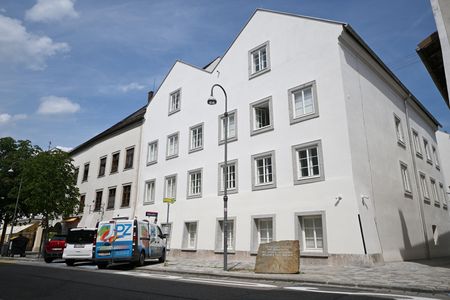

BRAUNAU AM INN, Austria — The building where Adolf Hitler entered the world near the Austrian-German border has officially taken on a new identity, opening its doors as a police station on Wednesday. The Austrian government’s goal is straightforward: make the site less appealing as a gathering point for neo-Nazi sympathizers.
The large, traditional terraced house in the town of Braunau am Inn had a complicated history before this transformation. Once privately owned and later used to house a charity serving people with disabilities, the Austrian government stepped in with a compulsory purchase in 2017. Two years later, officials announced the structure would be renovated and repurposed as a police station.
The building’s exterior offers little hint of its dark historical significance. A stone from the Mauthausen concentration camp sits on the sidewalk bearing the inscription “Never again fascism” — though it makes no direct mention of Hitler. That stone remains. The only new addition to the white exterior is a sign reading “Police.”
Stephan Mlczoch, who heads the Austrian interior ministry’s history department, explained the thinking behind the redesign during a media tour of the building. “The aim was to prevent any association with Adolf Hitler, so as to strip it of that mystique,” he said.
That mystique has deep roots. Under Nazi rule, the site was celebrated as the “Fuehrer birth house” and operated as an art museum. However, Mlczoch noted that Hitler himself only lived there for a matter of weeks in 1889 before his family relocated.
People still stop to photograph the building, though their motivations are generally unknown. Local officials say incidents involving visitors have dropped, describing them now as only “isolated.” It’s worth noting that the Hitler salute and Nazi symbols are illegal in Austria.
Mayor Johannes Waidbacher shared his read on how residents feel about the change. “I think on the whole the people of Braunau have accepted it and can live with it,” he told reporters. Waidbacher had previously served on a commission that recommended the building be used for either a charitable or official administrative function. He explained that keeping a charity there would have made the space too open to the general public.
“I think it isn’t a bad approach but whether it works as we all hope and expect, we’ll have to wait and see,” the mayor added.
Not everyone is on board with the decision. The Mauthausen Committee, Austria’s primary organization representing Holocaust survivors, has raised objections — arguing that a police station is an unsuitable use and that the country should be doing more to highlight Hitler’s crimes rather than minimize the site’s visibility.
Robert Eiter, who represents both the Mauthausen Committee and the Network Against Racism and Right-Wing Extremism, put it bluntly: “Every year at the Mauthausen concentration camp memorial there’s a ceremony to say: never again. And in Braunau they’re saying: let’s forget as soon as possible.”
Eiter also pushed back on the idea that converting the building will reduce its notoriety. “The world won’t forget where the worst mass murderer in history was born. Wikipedia won’t change its entries,” he said, warning that neo-Nazis will continue making “the pilgrimage to Braunau” regardless.
Austria spent decades positioning itself as National Socialism’s first victim, having been annexed by Hitler’s Germany in 1938. The country now acknowledges that Austrians were also among the perpetrators, though it rarely expands on that admission.
Opinions among local residents were mixed. A 74-year-old woman named Irene said she would have preferred the charity remain in the building. “I would have preferred if they had done something else but it is what it is,” she said.
Others were more enthusiastic. Thomas Spreitz, a local estate agent, called it a welcome change. “It’s great and a good idea,” he said. “Every now and then there are (neo-Nazi) groups there, and now that’s history.”