
NEW YORK (AP) — A Manhattan museum’s confirmation of a historic Underground Railroad tunnel has sparked a preservation battle against a planned high-rise development that threatens the rare discovery.
The Merchant’s House Museum in Manhattan’s NoHo neighborhood announced last month that researchers have confirmed the historical significance of a hidden passageway within the 1832 wealthy family residence. The breakthrough came after historians learned the property’s first owner, Joseph Brewster, was an abolitionist who aided freedom seekers.
Experts are calling this the first complete Underground Railroad location uncovered in New York in more than 160 years, and the revelation has dramatically increased visitor interest while intensifying opposition to a planned nine-story mixed-use structure on the adjacent lot.
“What our engineers are saying is that there really is no way that a building of that size is built immediately next door to the museum without causing significant structural damage to our historic building,” said Emily Hill-Wright, the museum’s director of operations.
The New York City Landmarks Preservation Commission continues deliberating the development proposal, while project consultants and architects maintain the museum would face minimal impact from construction.
This discovery emerges during a period when President Donald Trump’s executive order aims to eliminate slavery-related content and images from federal museums, parks and historical sites.
Civil rights leader Al Sharpton, based in New York, has framed the museum’s situation as a crucial battle for preserving African American and national heritage.
“When engineers tell me that an African American heritage site is in danger of structural compromise or any other sort of irreversible damage, I listen,” Sharpton said in a statement last week.
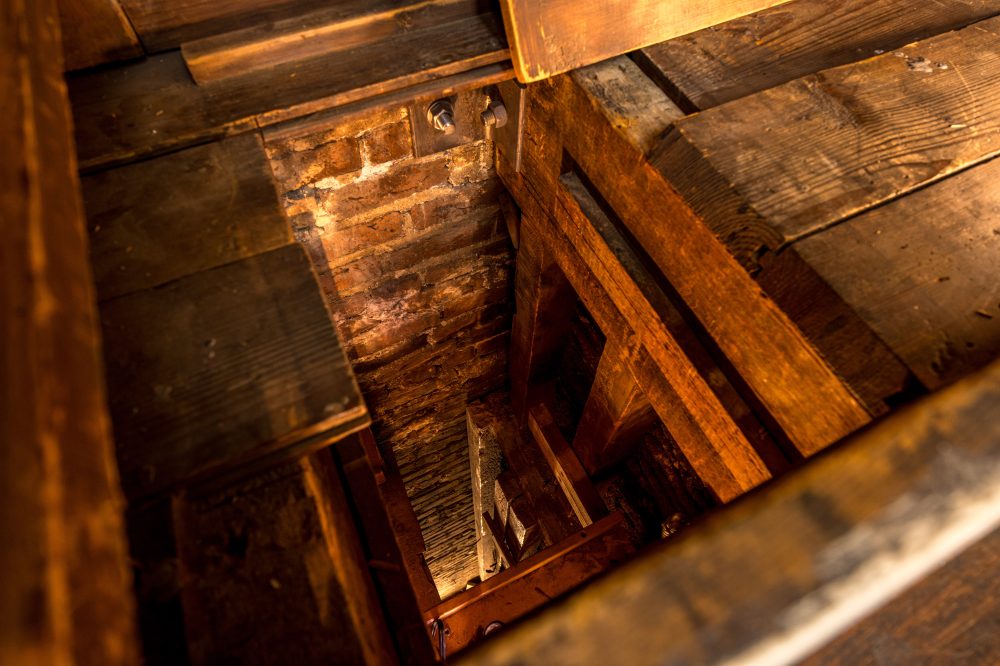
The concealed Underground Railroad route sits behind a 2-foot-by-2-foot wooden panel tucked beneath a dresser drawer on the building’s second floor. The pathway descends 15 feet through a shaft equipped with built-in ladder rungs. While workers discovered the passage during the 1930s museum conversion, only in 2024 did researchers establish that original owner Joseph Brewster supported the abolitionist cause.
“It’s not a dumbwaiter. It’s not a laundry chute,” Hill-Wright said. “We’re able to sort of cross off all of these other theories about what this might have possibly been used for.”
The confirmation has attracted preservationists, history enthusiasts and curious visitors from across the region.
“February was our highest month for visitors in over a year,” Hill-Wright said. “You almost get choked up because it is a very visceral experience to see it with your own eyes.”
Harriet Tubman established the Underground Railroad network after her own escape from bondage in 1849, eventually settling in Philadelphia. The secret operation helped countless enslaved African Americans reach freedom, and Tubman later served as a scout, spy and nurse for Union forces during the Civil War, personally leading 150 Black soldiers during a South Carolina gunboat mission.
When the Brewster residence was constructed, helping Underground Railroad participants violated New York City law and carried harsh consequences, according to Jacob Morris, director of the Harlem Historical Society. Historical records document attacks on abolitionists who sheltered escaped slaves.
“Bounty hunters were all over the place in New York City. They made their living on catching freedom-seeking Blacks,” Morris said. “If you got caught helping Blacks escape from slavery, a mob could come and burn down your house and beat you up. And maybe even tar and feather you or worse.”