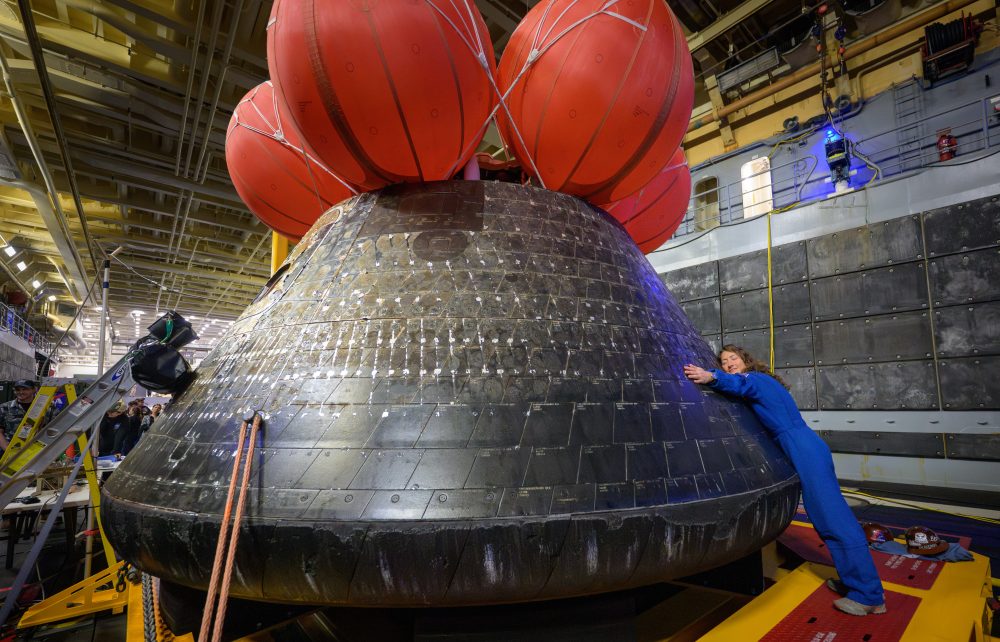

CAPE CANAVERAL, Fla. — The vessel that transported four crew members on a historic lunar journey has arrived back at its starting point in Florida.
On Tuesday, NASA’s Artemis II spacecraft made its way back to Kennedy Space Center, nearly four weeks after launching on mankind’s initial moon voyage in more than five decades.
After touching down in Pacific waters on April 10, the Orion vessel was transported by truck from San Diego to Cape Canaveral. Technical teams will conduct thorough inspections of the craft’s thermal protection system and all other components as they prepare for the upcoming Artemis III orbital docking demonstration around Earth next year. The spacecraft’s electronic systems and scientific instruments will be extracted and repurposed.
The crew from the United States and Canada named their vessel Integrity, and it transported astronauts farther from Earth than any human has previously ventured. Apart from some issues with the restroom facilities, the spacecraft functioned effectively throughout the mission lasting nearly ten days, NASA reported.
Mission Commander Reid Wiseman, pilot Victor Glover, Christina Koch, and Canada’s Jeremy Hansen are finally taking time to rest following extensive medical evaluations and additional testing after completing their mission.
“Been waiting for this moment,” Wiseman posted on X recently, sharing footage of himself enjoying time at the beach. “There is a lot in my head that I must process and very little has to do with leaving the planet. Today is my first step. I have never in my life felt peace like this.”
Before the Artemis II mission, no astronauts had journeyed to the moon since the Apollo 17 expedition in 1972.
The upcoming Artemis III mission will utilize a new spacecraft and different crew members. They will conduct orbital operations around Earth, practicing docking procedures with moon landing vehicles currently being developed by SpaceX and Blue Origin. This preparation will pave the way for a lunar surface mission involving two additional astronauts, potentially as soon as 2028.