
MILTON, Mass. — Each morning, Matthew Douglas ascends a narrow staircase to emerge through a rooftop hatch, where a glass orb housed in metal framework has etched a delicate line across a paper strip, documenting yesterday’s sunshine hours.
This daily ritual represents part of an unbroken tradition at Blue Hill Observatory and Science Center, located 15 miles south of Boston, where weather watchers have maintained identical procedures for 141 consecutive years. Through virtually unchanged analog equipment, they’ve compiled an uninterrupted database of temperature readings, moisture levels, rainfall amounts, wind measurements and additional atmospheric data that supports forecasting models and scientific studies.
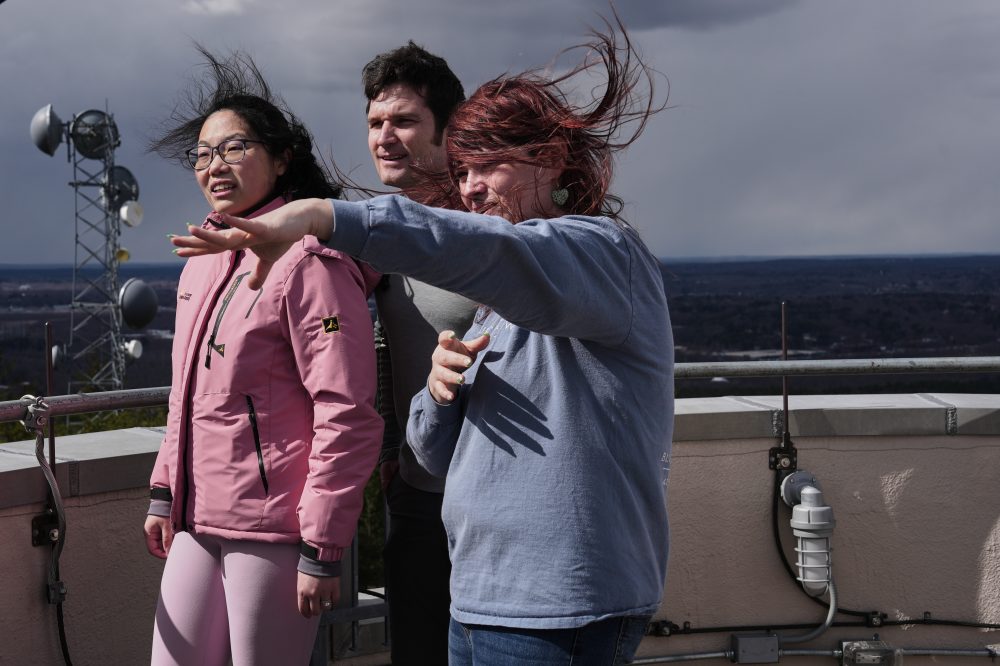
“My routine is the same every day,” said chief weather observer Douglas, who has worked there since 1997, sporting a dark blue sweatshirt with the name of the observatory on the front. “The only thing that changes are the numbers and the weather itself.”
According to executive director Alex Evans, Blue Hill stands as America’s longest continuously functioning weather observatory. Since 1885, employees and volunteers have depended on identical instruments, including mercury and alcohol-based thermometers, moisture-detecting devices that utilize human hair strands, and the rooftop glass sphere that tracks bright sunshine periods.
Maintaining identical equipment in the same location for nearly 150 years, Douglas explained, ensures that any detected shifts in weather patterns represent genuine changes rather than variations caused by different instruments producing altered measurements compared to previous equipment. Possessing such a “tried and true database” as a baseline proves invaluable for climate studies, he emphasized.
While climate science faces challenges from political opposition, budget reductions and staff cuts have affected federal weather agencies since 2025. Blue Hill, operating as a private nonprofit organization, has largely escaped this turbulence. Nevertheless, its continued operations remain uncertain, as funding sources are scarce in the current political climate, Evans noted.
Blue Hill’s mission extends beyond maintaining weather records to bridging the gap between ordinary citizens and climate science, despite appearing outdated compared to modern technology.
Very few American weather observatories match Blue Hill’s age, and even fewer maintain manual data collection methods. While volunteer networks across the nation still employ similar techniques to supply information to the National Weather Service, weather stations — both private facilities and those connected to the National Oceanic and Atmospheric Administration — have transitioned to automated digital systems since the 1990s.
Blue Hill transmits daily observation summaries to the National Weather Service, which chief scientist Michael Iacono says may influence weather predictions under certain conditions, plus monthly reports to the National Centers for Environmental Information for distribution to climate researchers. Local television meteorologists also receive daily summaries and occasionally incorporate these observations into their broadcasts, he added.
Within Blue Hill’s circular three-story tower, crowned with castle-style battlements, weather observers Douglas and Amanda Joly occupy an office surrounded by evidence of their daily efforts. Wall-mounted boxes contain sunshine recording cards, wind velocity charts printed on EKG paper fill filing cabinets, and computer systems house spreadsheets where Douglas and Joly carefully document temperature and humidity readings.
Records spanning more than a century “is really unique,” according to Chris Fiebrich, a University of Oklahoma meteorologist. This “dataset is golden,” he explained, because climate change involves gradual trends that “you can only see that clearly if you have measurements that go way back, from before we had satellites” and other contemporary equipment.
Blue Hill’s documentation reveals, for instance, a 5-degree Fahrenheit (approximately 2.8-degree Celsius) rise in average yearly temperatures at the observatory since 1885, plus local ponds now freeze for nearly three weeks less during winter compared to that era.
Observers can also identify the effects of environmental policies. Since the 1990s, Blue Hill has documented increased bright sunshine duration following a low point during the 1980s. Since airborne pollutants like particulate matter block sunlight, cleaner air produces more sunshine, making this improvement partially attributable to the Clean Air Act — federal legislation enacted in 1970 and revised in 1990 to enhance air quality through reduced pollutant emissions.
One-third of Americans believe climate scientists comprehend “not too well” or “not at all well” whether climate change occurs, based on a 2023 Pew Research Center survey. Trump labeled climate change “the greatest con job ever perpetrated on the world” during a United Nations General Assembly address last September, while attempting to undermine climate science.
During times when “the word ‘climate’ is politically demonized in some circles,” stated Alan Sealls, American Meteorological Society president, locations like Blue Hill can serve as “a small part of many possible solutions” to make weather and climate science accessible to people, including young audiences.
The pathway to Blue Hill Observatory follows a curving asphalt route threading through woodland and alongside a ski lift; drivers must carefully navigate around hikers and dog walkers. At the summit, guests can appreciate westward views above the forest canopy or enter through an open archway into the observatory’s courtyard.
Annie Hayes, a Milton resident who toured Blue Hill in mid-March with her spouse and two children, explained that witnessing how observers gather data creates stronger confidence in the science, which otherwise might seem “a little bit of a mystery.”
The mercury barometers in the observers’ workspace — including one the observatory considers the oldest such device in active daily operation within the United States — exemplify this principle. “If somebody’s standing there seeing it while you’re explaining it to them … it becomes a little less scary,” noted chief scientist Iacono.
Blue Hill’s atmospheric pressure instruments consist of glass tubes and small mercury containers — a lustrous, silver-white liquid — mounted within wooden wall cases. When air pressure pushes down on exposed mercury, it rises through the tubes, with the distance traveled indicating atmospheric pressure changes. This mechanism explains the pressure measurement “inches of mercury.”
Another visitor favorite is the Campbell-Stokes recorder, designed to measure bright sunshine hours. Its glass sphere, positioned within a curved metal mount, functions as a magnifying lens, concentrating sunlight onto a paper card and burning a streak as the sun travels across the sky.
While indicating the glass sphere displayed in the history room, Amanda Joly, Blue Hill’s deputy chief observer, described how this recorder, dating to 1898, was stolen in 1993 and subsequently recovered. The theft’s silver lining is that while a modern replacement handles rooftop duties, visitors can now handle the original sphere — something children especially enjoy — without observers worrying about measurement interference.
Hayes’ family, local residents, was examining rain gauges in the gift shop when facilities director Don McCasland described a new Blue Hill citizen science initiative, enabling residents to collect and contribute weather data to a central database. The family intends to begin using their rain gauge this summer.
It’s “a great way to involve the kids and get them excited,” Hayes said. “And who knows? Maybe they’ll find an interest and want to pursue it on their own, too.”