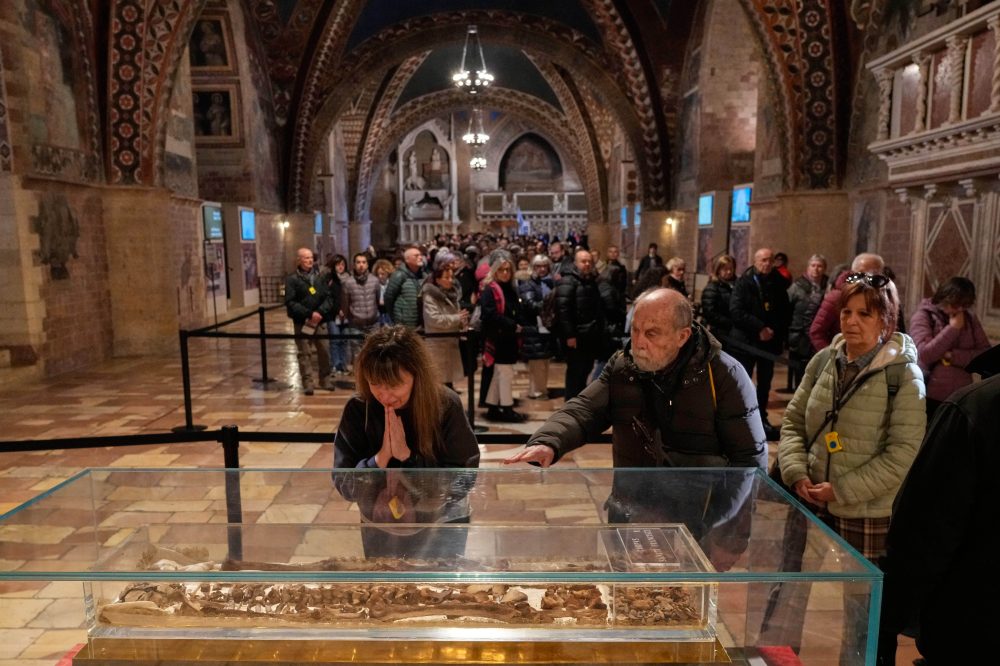

ASSISI, Italy — In an unprecedented religious event, the skeletal remains of St. Francis of Assisi were unveiled to the public for the first time on Sunday, marking the end of an eight-century mystery surrounding his physical remains and demonstrating the continued significance of sacred relics among Christians worldwide.
Close to 400,000 individuals pre-registered for the opportunity to view these bone fragments, which are housed within a thin, bulletproof Plexiglas container located in the lower section of the Basilica of St. Francis in this hilltop Umbrian community that the medieval monk helped make renowned.
The Franciscan order chose to showcase these remains for a month-long period, concluding March 22, in recognition of the 800th anniversary of St. Francis’ passing in 1226. Their goal is to reinvigorate his teachings of peace and brotherhood that established him as among Christianity’s most cherished saints and motivated Pope Francis to adopt his name, becoming the first pontiff to do so.
The public presentation of his physical remains is especially significant considering the complex history surrounding St. Francis’ body. Born in 1182 as the son of a prosperous merchant, he abandoned all worldly goods to embrace the life of a begging friar.
Near his life’s end, St. Francis’ body reportedly developed the stigmata, marking the first recorded instance of a saint receiving Christ’s crucifixion wounds.
Following his death, his body disappeared for centuries after being secretly interred by a devoted follower who worried it might be taken during the medieval period’s widespread competition for sacred relics.
This historical account is detailed in an exhibit housed within the Franciscan monastery, located next to the basilica, which visitors can explore as part of their scheduled viewing of the remains.
Brother Giulio Cesareo, the Franciscan spokesperson in Assisi, emphasized that this display wasn’t a morbid celebration of death. Instead, he explained, it continues the longstanding Christian practice of honoring saints’ physical remains to connect with the spirit that once inhabited them.
“It is not so much about venerating Francis, but rather encountering Francis by venerating the Holy Spirit who filled that humanity and made it capable of giving itself,” he said. “And it is, at least for a believer, a way to renew oneself in this one life.”
Throughout history, the attraction to relics has certainly resulted in misconduct, including theft, counterfeiting, and currently online commerce, all forming part of their legacy. However, this doesn’t reduce their influence on believers, according to Sean Pilcher, who operates Sacra: Relics of the Saints, offering consultation and verification services to the Catholic Church.
If saints represent our spiritual siblings in heaven, “then it makes sense that we’re going to have things that we hold on to,” he said. “And what the church does is just take this natural desire that we all have for connection and belonging and direct it in a way that leads us toward Christ.”
What strikes contemporary observers is St. Francis’ small physical size: Known for experiencing poor health and inadequate nutrition, the fragile, delicate skeletal structure appears to validate his petite build.
For Fiorella Farina, a resident from northern Reggio Emilia whose devotion to St. Francis led her to purchase a countryside home in Assisi and name her children Francesco and Francesca, this exhibition represents an extraordinary opportunity.
“Just talking about it gives me goosebumps,” she said outside the basilica. “It’s an event I couldn’t miss.”
St. Francis, she explained, challenged all social conventions to live according to the Gospel’s message of peace, caring for the impoverished and protecting the environment.
“In this historic moment, we need him,” she said.
Security measures were extensive yet unobtrusive on Sunday morning as initial pilgrims passed through metal detection systems before entering the basilica. Law enforcement officials declined to share specifics but confirmed that additional officers, detection dogs, undercover personnel, surveillance cameras, and other protective protocols were implemented to safeguard the relics.
Considering St. Francis’ body’s history, such precautions appear entirely justified.
Even prior to his death, St. Francis had developed such a reputation for holiness that he required armed protection during his final journey back to Assisi, according to Brother William Short, professor of Christian spirituality at the Franciscan School of Theology at the University of San Diego.
Contemporary records also describe people attempting to grab pieces of his robe as he passed by on horseback, believing his relics possessed healing powers or could ward off disaster, Short explained during an interview at the Franciscan residence in Rome, where he leads an international Franciscan research center.
When St. Francis passed away on October 3, 1226, he was first interred in a modest Assisi church called San Giorgio. Within two years, Pope Gregory IX had declared him a saint and established the foundation for a basilica to contain his burial site.
However, on the night before the planned transfer, St. Francis’ loyal assistant, Brother Elias, removed the body and secretly buried it within the basilica, concerned about potential theft, Short noted. The body stayed there, concealed within a column without identification, until 1818. At that time, excavation work uncovered the remains, and Pope Pius VII verified the bones as belonging to St. Francis.
“It was a matter of safety and economics,” Short explained. “If you have a big saint, a new saint — and this guy had the potential to be a really big saint — whoever gets the body gets the pilgrims.”
And Assisi currently has numerous visitors.
Some individuals registered to view the relics when the exhibition was initially announced in October, receiving assigned time slots of 10 minutes beginning Sunday morning.
Silvanella Tamos journeyed to Assisi from Pordenone, located north of Venice, accompanied by a group of 54 people from her diocese. They secured one of the earliest appointments on Sunday at 9:30 a.m.
“It’s a body that’s alive,” she said. “It’s not a dead body. He still has a lot to tell us today,” she said.