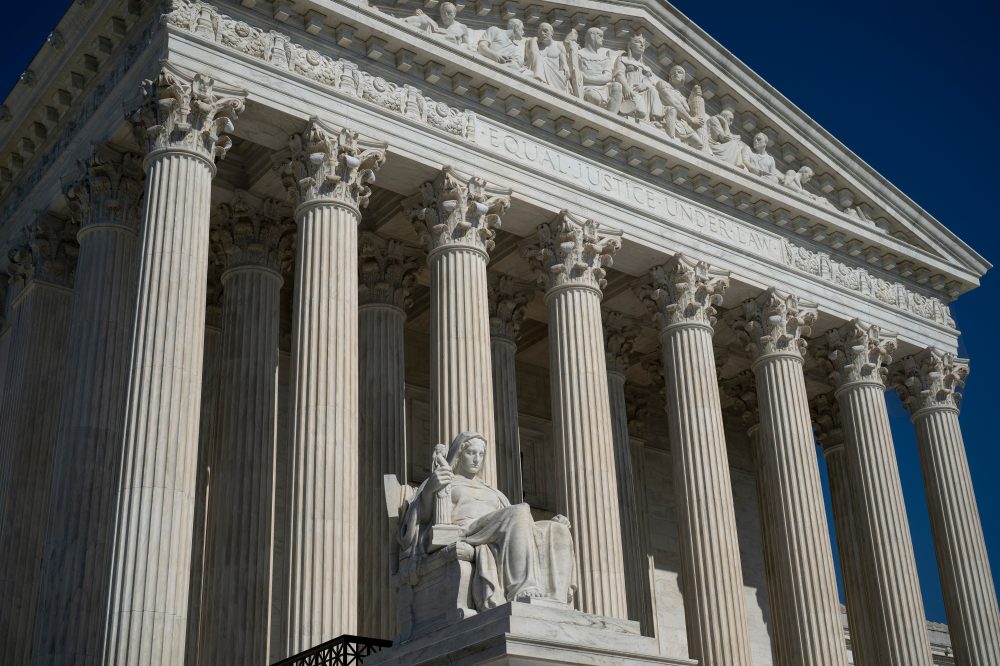

WASHINGTON — The nation’s highest court ruled Tuesday that Alabama may proceed with congressional district boundaries that benefit Republican candidates in upcoming elections, overruling a lower court decision that found the redistricting plan deliberately discriminates against Black voters.
The court’s decision grants the state’s urgent request to implement district maps created three years ago, which include only one congressional district out of seven with a Black majority population. Three liberal justices opposed the ruling.
This latest court action represents another chapter in ongoing redistricting battles connected to President Donald Trump’s efforts to maintain Republicans’ narrow House majority heading into November elections. The timing is significant, coming just before a crucial deadline that the state’s Republican governor had previously pushed back to accommodate using these maps for special primary contests scheduled for August.
Alabama’s Republican officials petitioned the high court last week, one day after a three-judge panel denied the state permission to use its chosen district map.
The judicial panel had directed Alabama to utilize the same court-created map from the 2024 elections, which resulted in two Black Democrats winning congressional seats. Under that arrangement, Black voters formed a majority or near-majority in two of the state’s seven congressional districts.
“The Supreme Court’s decision gives cover to Alabama and others to deliberately and openly discriminate against Black voters without fear of any consequence. The Court’s shameless decision to reinstate an intentionally racially discriminatory map defies any thoughtful or consistent application of the law,” said Deuel Ross, director of litigation for the NAACP Legal Defense Fund, on Tuesday evening.
Ross pledged that his organization will “continue to throw all of our resources into the fight to ensure that Alabama voters have the fair representation that they deserve.”
The state’s attorney general argued before the court that Alabama did not deliberately discriminate against Black citizens and should be permitted to conduct this year’s elections using maps selected by elected officials rather than judges.
This legal challenge stems from recent fallout following last month’s high court decision that eliminated a Black-majority district in Louisiana and reduced protections under federal voting rights legislation. That precedent has encouraged Republicans across multiple Southern states, including Alabama, to pursue changes to voting districts with substantial minority populations that typically elect Democratic candidates.
The Alabama legal battle spans several years. In 2023, the three-judge panel determined that maps created by Republican state legislators intentionally weakened Black citizens’ voting influence. The court noted that the state, where approximately 27% of residents are Black, should maintain two districts where Black voters comprise a majority or near-majority.
Following the recent Louisiana decision, Alabama officials sought to put the 2023 state-created map into effect. The high court’s conservative members agreed to remove the legal block preventing the map’s implementation and returned the matter to the three-judge panel for fresh consideration based on the Louisiana precedent.
During this period, Alabama voters participated in primary elections on May 19, and the governor scheduled new special primaries for August 11 in four congressional districts impacted by the map change.
After reviewing the case again, the judicial panel maintained its original conclusion that “undisputed evidence” demonstrated intentional racial discrimination.
The panel determined that the special congressional primaries should move forward using the previously court-approved districts instead.
The high court’s conservative majority disagreed with this assessment, writing in an unsigned decision that the lower court “did not heed the presumption of legislative good faith.”
In her dissenting opinion, Justice Sonia Sotomayor criticized her colleagues for allowing what she described as “a chaotic election, held under a never-before-used congressional map that intentionally discriminates against Black Alabamians.”
The court-mandated map enabled the 2024 election victory of U.S. Rep. Shomari Figures, a Black Democrat. The district boundaries established by Tuesday’s ruling provide Republicans with a chance to regain the south Alabama congressional seat.