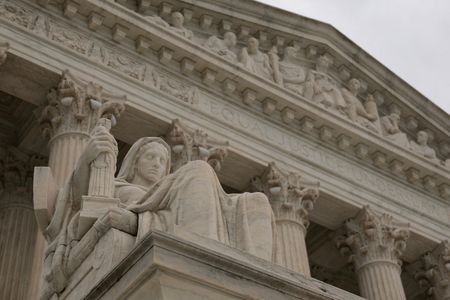

The nation’s highest court delivered a victory to President Donald Trump’s administration on Tuesday in a legal battle over restrictions limiting public statements by federal immigration judges.
In an unsigned decision, the justices overturned a lower court ruling and sent the matter back for additional proceedings. The court’s decision did not examine whether the speech limitations, which were put in place during Trump’s previous presidency, violate constitutional protections.
The Trump administration had asked the Supreme Court to intervene after a lower court required findings about whether Trump’s dismissals of agency leaders handling federal employee grievances had compromised the independence from executive branch influence that Congress intended. The lower court indicated such a determination could allow the immigration judges to pursue their case in court.
An organization representing the immigration judges had also challenged the lower court’s ruling that their speech restriction case should go before the agencies – provided they remain operational – rather than through the court system. The Supreme Court rejected that challenge on Tuesday.
Under the disputed rule, immigration judges must obtain advance permission for any “official” public speaking. These events include situations where a judge “is invited to participate in an event because of their official position, is expected to discuss agency policies, programs or a subject matter that directly relates to their official duties or otherwise appear on behalf of the agency,” court documents show.
The Executive Office for Immigration Review, which employs approximately 750 immigration judges and manages the country’s immigration court system, implemented this rule during Trump’s first presidency. Democratic President Joe Biden’s administration reviewed but kept the policy in place, and Trump’s current administration has continued it.
The National Association of Immigration Judges filed suit in 2020 seeking to halt the policy, claiming it breached First Amendment free speech protections guaranteed by the Constitution.
A federal judge in Virginia dismissed the court challenge in 2023, determining that a 1978 law known as the Civil Service Reform Act required the complaint to go through independent federal agencies that handle federal worker grievances instead of the courts. This law directs certain federal employee complaints to the Office of Special Counsel, which determines whether to present the case to the Merit Systems Protection Board for resolution.
However, the 4th U.S. Circuit Court of Appeals based in Richmond ruled in June 2025 that Trump’s removal of these agency heads created significant concerns about whether immigration judges could receive fair treatment from the agencies. The appeals court directed the lower court to investigate this issue, leading to the Trump administration’s Supreme Court appeal.
On Tuesday, the justices criticized the 4th Circuit for making its decision based on reasoning that neither side in the case had presented.
Trump has dismissed many independent agency leaders despite laws designed to protect these officials from arbitrary removal.
In a related case, the Supreme Court is anticipated to decide by late June whether the Trump administration’s position that such removal protections unconstitutionally limit presidential authority is correct.
The immigration judges’ association contended in its appeal that challenges to speech restrictions should be permitted in court regardless of whether federal agencies face operational difficulties.
Since Trump returned to office, the Supreme Court has supported his administration in multiple immigration-related emergency rulings, including permitting deportations to countries other than migrants’ home nations and allowing the cancellation of temporary legal status for hundreds of thousands of Venezuelan immigrants.
The court is also expected to rule by the end of June on Trump’s order to limit birthright citizenship in the United States and the administration’s effort to end temporary legal protections for more than 350,000 Haitians and approximately 6,100 Syrians residing in the United States.