
HONOLULU (AP) — Visitors to Hawaii might be surprised to learn that the vibrant purple lei they received as a welcome gift likely contains flowers that never grew on Hawaiian soil.
The majority of these scentless orchid garlands are crafted using blooms shipped from Thailand, where cultivation and assembly costs are significantly lower than producing the flower necklaces that have become emblematic of Hawaiian heritage.
Several Hawaii state legislators believe more should be done to support makers of lei using locally cultivated, aromatic flowers. Proposed solutions include mandatory labeling that would distinguish Hawaii-produced garlands and banning government agencies from purchasing foreign-made lei, although some vendors express concern these regulations could price the garlands beyond reach.
“You don’t come to Hawaii and not at least have a flower or a lei,” explained Kuhio Lewis, CEO of the Hawaiian Council, a nonprofit organization dedicated to advancing Native Hawaiian culture and commerce. “For us to now be importing is not good. It’s actually embarrassing.”
The tradition of presenting and wearing lei crafted from flowers, foliage, seeds or shells has long been connected to Hawaiian people, who view these garlands as symbols of affection or the “aloha” spirit. According to a 2002 University of Hawaii publication, they served not only ceremonial purposes but were part of daily attire for everyone from tribal leaders to young children.
Currently, Hawaii residents exchange lei for numerous occasions, from birthday parties to job promotions. Graduating students from elementary through college levels receive lei stacked so high they nearly obscure their faces behind towering walls of blossoms. Legislative session opening days see lawmakers experience similar floral coverage. Expectant mothers receive open-ended strands instead of closed loops, following a belief that circular lei symbolize umbilical cords endangering unborn babies.
“We always are looking for ways that we can honor people through our Indigenous cultures, which is giving lei,” stated state Rep. Darius Kila, who is Native Hawaiian.
Given lei-giving’s deep roots in Hawaiian society, legislators frequently purchase and distribute them — during groundbreaking ceremonies, to recognize community members or volunteers, or for staff birthday celebrations.
This year, Kila championed legislation requested by the Hawaiian Council that would have mandated a specific portion of lei bought by state officials contain in-state grown flowers. The proposal also called for lei labeling informing buyers about flower origins.
While that legislation didn’t pass, a companion Senate measure continues advancing. It would establish a working committee to examine whether local flower producers and lei creators can satisfy growing garland demand, while developing recommendations to safeguard the domestic industry.
“The growing commercialization of lei and lei materials has led to increased use of imported plant materials and manufactured components that are marketed using Hawaiian language, imagery, and place names,” the Senate legislation declares. This practice “may mislead consumers and undermine local growers, lei makers, and cultural practitioners.”
When Hawaii’s population and visitor numbers surged during the 1900s, lei manufacturers began incorporating non-indigenous ornamental plants like carnations and jasmine to satisfy escalating demand, and these varieties remain widely popular today.
Kila, a Democratic representative from western Oahu, maintains a personal policy for himself and his team: “I really try not for us to give out orchid lei, specifically the purple Thailand orchid lei.”
During a recent lei shopping trip through Honolulu’s Chinatown, where numerous lei vendors and flower retailers cluster together, Kila searched for puakenikeni — nicknamed the “10-cent flower,” allegedly referencing times when lei sold for ten cents — along with ginger and tuberose varieties. These non-native blossoms produce varying intensities of jasmine-scented sweetness.
“People want pikake” — a jasmine variety, noted Francis Wong, proprietor of the established Chinatown business Jenny’s Lei and Flowers. “That’s the top flower in Hawaii.”
Wong typically obtains the fragrant white blossoms from a Nanakuli farm, close to Kila’s community. However, winter months bring seasonal supply shortages, he mentioned.
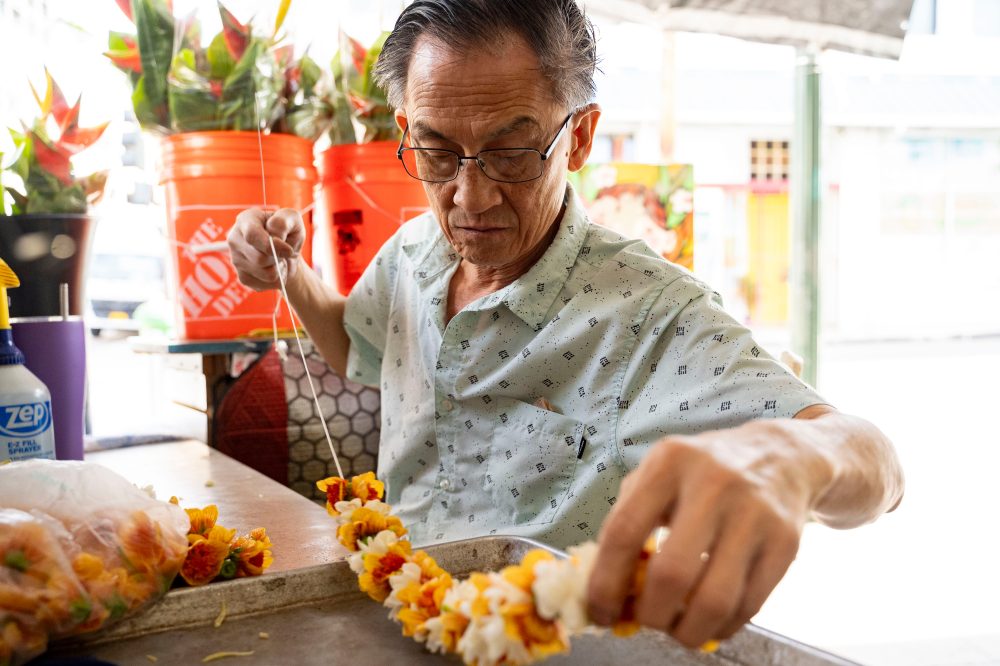
Wong and his spouse Pickoun Wong, who assembles flowers in the shop’s rear area, have operated the business for 18 years. They offer Thailand orchids to provide customers more affordable alternatives, particularly when local flower availability is restricted.
Local residents consistently choose local flowers, according to Monty Pereira, general manager at Watanabe Floral. However, imported blooms help extend scarce local inventory, he noted. One favored lei combines Hawaii-grown tuberose with imported carnations.
The Thailand-cultivated orchids also satisfy lei demand beyond Hawaii, frequently from former residents now living in other states, he added.
Watanabe Floral ranks as Hawaii’s largest florist operation. It distributes approximately 250,000 lei annually, representing roughly 25% of total business volume, Pereira reported.
He filed testimony opposing Kila’s proposed state agency purchasing restrictions, arguing it might inadvertently decrease overall lei consumption rather than bolster the industry.
Limiting imported flowers could inflate lei prices, he explained during an interview.
“If like 30 lei stands and florists are fighting for the same lei, that’s when lei is going to start to be $100, $150, $200,” he warned. During the previous Mother’s Day, a three-strand pikake lei commanded $150.
Additionally, Trump administration tariffs have raised Thailand orchid costs to nearly match some local flower prices, he observed.
Pereira, who is Native Hawaiian, expresses concern about people increasingly choosing lei made from candy or ribbons instead of flowers, a trend particularly common at graduation events.
“The bigger threat is making it so expensive that the people of Hawaii cannot afford to enjoy something that’s culturally significant to us,” he concluded.