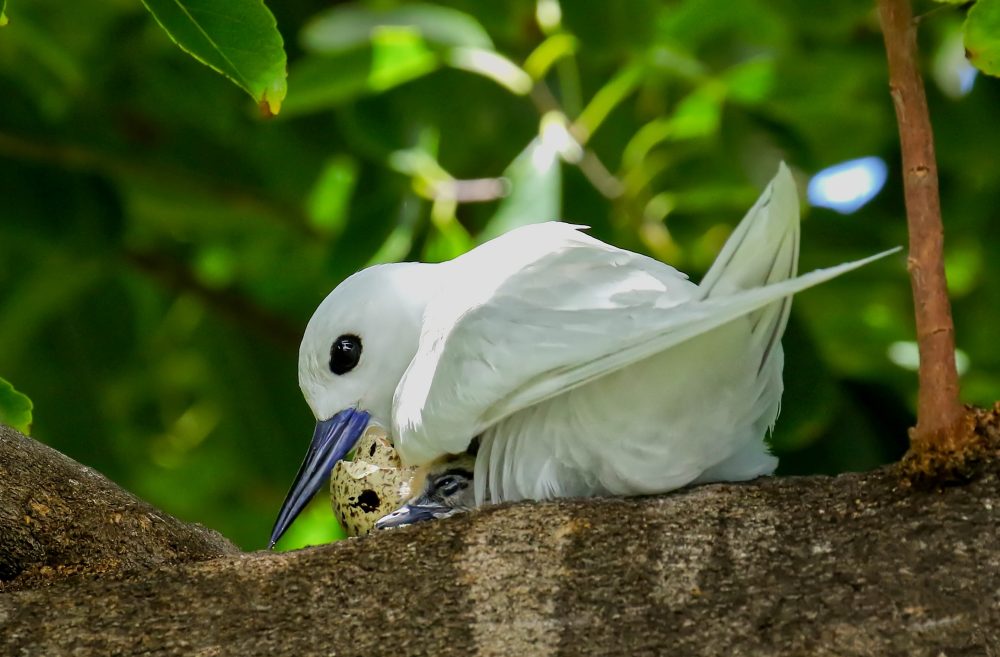

HONOLULU (AP) — Traditional navigator Kaʻiulani Murphy easily recognizes white terns soaring overhead while she steers Polynesian voyaging vessels through Pacific waters.
These seabirds feed in ocean waters but return to shore for nesting, making their appearance a reliable indicator for navigators who rely on celestial bodies, ocean swells and natural signs to chart their course that dry land lies ahead.
Modern-day sailors approaching Honolulu now encounter more white terns than any previous generation has witnessed. Recent research reveals their population has increased by more than 50% over the last ten years — showing these ocean birds are flourishing among skyscrapers, busy streets and resort hotels in Hawaii’s most populated city.
Their success stands in sharp contrast to numerous other indigenous Hawaiian birds, which face population crashes due to illness and non-native predatory species that have invaded the island chain.
“This is our big city,” said Murphy, who has navigated canoes to Tahiti, Japan and Rapa Nui. “It’s crazy to me that they’re getting to such a big population within Honolulu.”
Current counts show 691 eggs and chicks occupying Honolulu’s trees this week, according to Rich Downs, who coordinates the volunteer group Hui Manu-o-Kū.
The organization takes its name from the Hawaiian term for white terns, translating to “bird of Kū,” referencing the war deity.
Manu-o-Kū reproduce throughout the year, though peak breeding occurs from winter through early spring months. Unlike other seabirds that construct nests, they place their eggs directly onto exposed tree limbs, rocky ledges or building windowsills. Once hatched, offspring perch on branches until developing flight capabilities, using powerful talons to maintain their grip during severe weather.
While these birds inhabit warm-water island regions globally, within Hawaii they primarily occupy distant, mostly unpopulated northwestern atolls. Among the archipelago’s main populated islands, only Oahu — housing 1 million residents — hosts established breeding colonies.
Researchers remain uncertain about the factors driving the birds’ urban success. The metropolitan environment may benefit them because human activity has diminished predator populations like rats and cats near commercial establishments and structures. Heavy traffic may also discourage predators, while barn owls and mongoose — other species that prey on terns — rarely venture into the city center.
“All the lights and the noise, the commotion of people and traffic, and things like that, doesn’t seem to bother them,” said Eric VanderWerf, the executive director of Pacific Rim Conservation, a nonprofit that supports native birds in Hawaii and the Pacific.
Urban tree maintenance creates ideal nesting conditions. Pruning cuts that heal into cup-shaped formations provide perfect egg placement sites, meaning well-maintained city trees generate abundant breeding opportunities.
The latest population assessment, completed by Hui Manu-o-Kū in 2023 but released publicly now, documented Oahu’s breeding adult population climbing 1.5 times to 3,600 since 2016 measurements.
This growth contrasts dramatically with Hawaii’s remaining native bird species. Human settlement has led to the extinction of 71 out of 113 bird species unique to the islands. Surviving species typically carry threatened or endangered designations and exist in limited numbers within high-altitude forest habitats.
Though indigenous to the islands, manu-o-Kū breeding activity wasn’t documented on Oahu until 1961, when researchers observed an adult pair tending a single egg.
Following decades of population growth, Honolulu designated manu-o-Kū as its official municipal bird in 2007. Local students learn songs about the species, and an annual celebration honors them each May.
Hui Manu-o-Kū volunteers attach blue plastic ribbons to tree trunks containing eggs and chicks, warning maintenance crews to avoid those areas. The markers also assist birdwatchers in locating white terns, supplemented by an online tracking map.
For eight years, photographer Joyce Hsieh has documented the birds during incubation, feeding and chick-rearing activities. She frequently visits a Target parking structure, driving to the third level to photograph birds at eye level in surrounding trees.
White terns match pigeons in body size but possess greater wingspans. They travel roughly 120 miles from shore to hunt small fish and squid driven to surface waters by larger predatory fish like tuna.
Murphy, the traditional navigator who is Native Hawaiian, draws connections between Hawaii’s birds and her own people.
European-introduced diseases devastated Native Hawaiian populations during the 1800s. However, Hawaiians — demonstrating resilience and adaptability similar to manu-o-Kū — have persevered, and their community continues expanding.
When she spots the birds during ocean approaches to Oahu, she experiences recognition similar to greeting familiar companions.
“It’s just a special feeling,” she said.