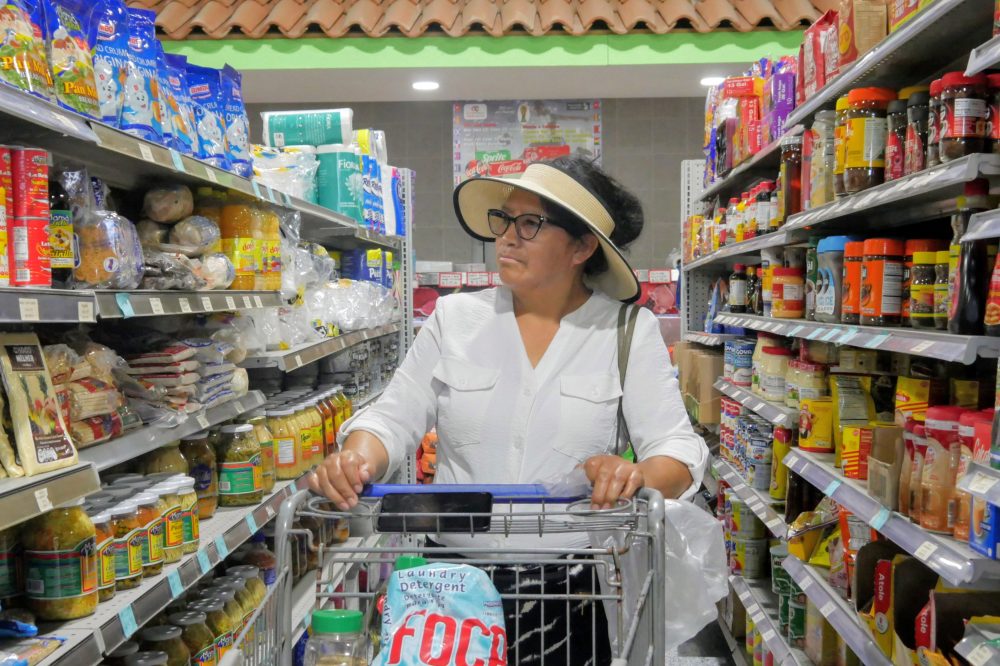

Dinner at Apral Jack’s home these days comes down to one simple question: what’s on sale?
Before heading to the grocery store, Jack checks a smartphone app for deals at her nearby supermarket. Once inside, she picks up the weekly circular to catch any coupons she may have overlooked online. If the prices on the shelves seem too steep, she crosses items off her list or heads somewhere else to find a better deal.
“The apples went up here, the ones I eat, so now I’m not going to get them here. I’ll go to Market Basket, where I can get them cheaper,” said Jack, 50, as she pushed her cart into a Stop & Shop near her home in Lexington, Massachusetts.
Jack is far from alone. Millions of Americans are now couponing, comparing prices across stores, and giving up foods they once bought without a second thought — all in response to the steepest rise in grocery prices the country has seen in half a century. Since the start of 2019, the cost of food eaten at home has jumped 33% in U.S. cities, according to government data. In the seven and a half years before that, prices had risen just 6.4%.
Several forces drove this historic increase. The COVID-19 pandemic disrupted supply chains and pushed up labor and transportation costs. Droughts, hurricanes, and outbreaks of diseases like bird flu cut into food production. Tariffs made imported goods like coffee, tomatoes, and chocolate more expensive. And Russia’s continuing war in Ukraine threw oil and fertilizer markets into turmoil.
A new conflict in the Middle East has added more fuel to food price inflation this year, making the cost of stocking a refrigerator, freezer, and pantry a growing source of frustration — and a key issue heading into the fall midterm elections.
By some measures, Americans have slightly more financial cushion to absorb these higher prices. Average weekly earnings for full-time workers have risen a bit faster than grocery costs since 2019, according to the U.S. Bureau of Labor Statistics.
But food shoppers tend to have long memories, and they know their money doesn’t stretch as far as it once did, said Jared Bernstein, a senior policy fellow at the Stanford Institute for Economic Policy.
Before the pandemic, wages were growing much faster than grocery prices, Bernstein noted. Even if paychecks still edge out supermarket bills by a slim margin, people feel the strain because other costs — housing and electricity, for example — have also climbed sharply.
“People have a well-honed sense of those prices, just as much as gas and maybe more so,” said Bernstein, who served as chair of the Council of Economic Advisers under former President Joe Biden. “You need groceries to live.”
A figure like median wages also doesn’t tell the whole story of how families are managing. Americans spent an average of 12.9% of their pre-tax income on food — both at home and at restaurants — in 2024. But for the one-fifth of U.S. households with the lowest incomes, that share was 33%, according to the U.S. Department of Agriculture.
Prices also differ significantly depending on where you live. In St. Louis, the cost of food for home use was up 2% in June compared to the previous year. In San Francisco, the increase was 6%, according to the consumer price index.
Residents of four cities where food price inflation has outpaced the national average described how they’ve had to adapt. Their stories include hunting for discounts, trading name brands for generics, and relying on food banks to get by. Some have cut back on extras like coffee to go. Others are buying less meat — or less food overall.
“It’s almost like a strategy, a household strategy, where financial pressure just hasn’t disappeared, so consumers are really developing their own playbook on how to navigate it,” said Sally Lyons Wyatt, a global executive vice president at market research company Circana.
For many Americans, beef has become the symbol of runaway grocery prices. Ground beef hit $6.82 per pound in June — a 79% increase from the beginning of 2019 — driven by a shrinking U.S. cattle herd, drought in the West, and higher feed and fuel costs, according to Bureau of Labor Statistics data. Demand for ground beef is now falling, market research company NielsenIQ reports.
Ada Torres, 60, is one of the shoppers who has stopped buying it. With five pounds of ground beef running nearly $20, meat has become a luxury for her family of five, she said. Torres lives in Cleveland, Texas, about 45 miles northeast of Houston, where she shares a home with her 36-year-old daughter and three grandchildren. Her daughter, who works for a mobile car-washing service, is the household’s primary earner. Torres handles the cooking and grocery shopping.
“Prices are sky-high. One hundred dollars’ worth of groceries these days is nothing. Maybe you can bring home seven family-size items, if you manage to find a good deal,” she said.
To save money, Torres has swapped Goya canned beans and Hunt’s tomato sauce for Walmart’s Great Value store brand. Chicken and cold cuts have become the family’s main sources of protein. She worries, though, that too much deli meat isn’t healthy for her grandchildren, who are 12, 15, and 16. They miss beef dishes that used to be regulars on the dinner table — lasagna with ground beef, beef fajitas, and steak with plantain chips.
When the rainy season slows her daughter’s work, the family can only afford one full meal a day. Breakfast and dinner become simple: eggs and store-brand cereal.
Apral Jack used to shop at Whole Foods regularly. With her three daughters now grown and out of the house, she has fewer people to feed and no longer needs to stock up in bulk at warehouse stores.
“I don’t have to worry about buying for them anymore,” she said with a smile, adding that her Costco and BJ’s Wholesale Club days are behind her.
Still, she spends more carefully than before. Steak only makes it into her cart if it’s marked down. Her meal planning begins at home, with an app that shows her what’s on sale and available digital coupons. She builds her weekly menu around the deals.
“Typically, I’ll try to pick the meals based on that. So like chicken fajitas: there was a three-day sale on chicken. I’ll sauté chicken with vegetables and rice,” Jack said.
Her shopping list has gotten shorter. Canned goods appear less often. Nabisco’s Ginger Snaps and Nilla Wafers have been cut entirely — she thinks they cost too much, and she won’t buy the store-brand versions because she doesn’t think they taste the same.
Matt Hamory, who leads the global grocery practice at consulting firm AlixPartners, said most shoppers have a mental budget for food each week. When prices drop, they might treat themselves or shop at a pricier store. But when prices feel unreasonable or the economy looks shaky, they look for cheaper options or simply buy less.
“I’m going to spend $250 a week, so if I’m shopping at Stop & Shop and they’re getting more expensive, then I’ll start splitting my trips with cheaper places and eventually maybe I’ll lose Stop & Shop entirely,” Hamory said.
San Francisco has a reputation as a food lover’s paradise, but for 33-year-old Jack Chang, food is a source of financial stress. The self-employed barber has three young children and a partner who is currently out of work. The income from cutting hair five or six days a week sometimes isn’t enough.
“Since I have five mouths I have to feed, basically — and then sometimes my mom, too — it’s a lot on me financially,” Chang said.
His family skips pricey treats like boba milk teas or artisanal ice cream, common indulgences in San Francisco. Instead, they visit a Japanese entertainment center called Round 1 Bowling & Arcade, where ice cream cones cost $1.
The past year has brought rising costs from all directions. His barbershop rent went up 10% at the same time he was losing clients who had been laid off from tech jobs. He also bought a used minivan, adding a monthly car payment to his expenses.
“I look at my credit card every month and I’m like, ‘Wow, how am I going to pay this?’ So I’m a little behind on bills, honestly,” Chang said.
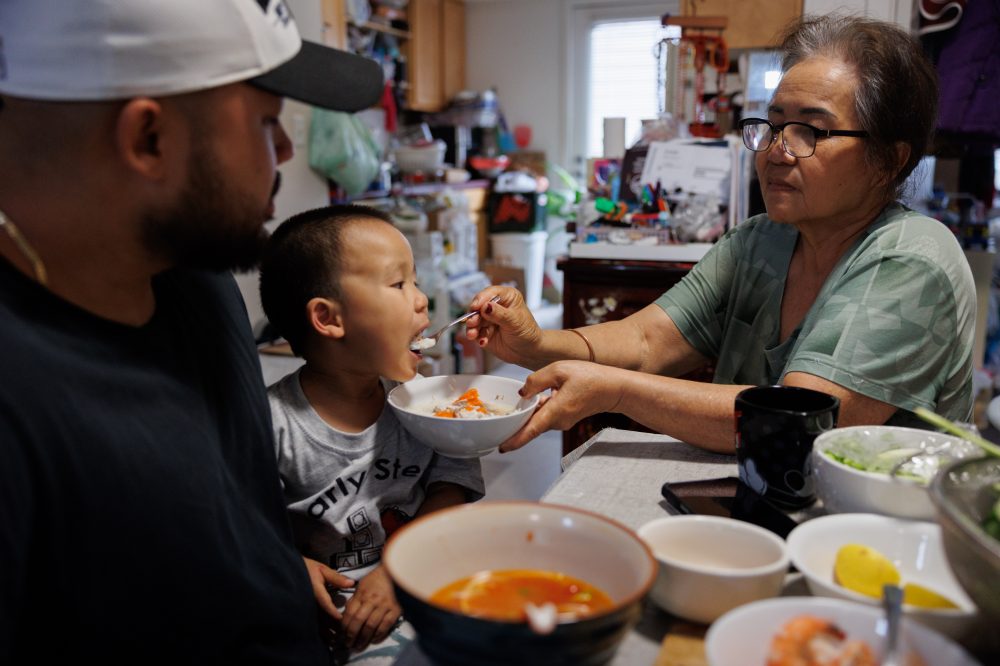
Chang and his partner, Tina Chhous, cut costs by choosing generic brands for food and medicine. They buy organic milk but otherwise opt for conventional products. When their 4-year-old daughter’s preschool has leftover food — meat or bread — Chhous asks to take it home. The family also receives monthly assistance through the federal Supplemental Nutrition Assistance Program, known as SNAP.
“Without that, I don’t know what I would do,” Chang said.
Fewer families have that safety net now. After the Trump administration tightened eligibility rules for SNAP last year, enrollment dropped to 37 million Americans as of April — a 12% decline from the same time the previous year, according to the U.S. Department of Agriculture.
Chang’s 77-year-old mother, Lien, also receives SNAP benefits and visits two food banks every week. She shares the canned goods, eggs, and produce she collects with the rest of the family.
Chang says life would be less financially stressful if he were single, but he remains focused on his family.
“But I try to be optimistic and do what I have to do in order to support my family. Failure is not an option for me,” he said.
Hawaii residents have always faced high grocery prices. The state imports nearly all of its food by cargo ship, making store shelves vulnerable to swings in oil prices. Local products have also gotten more expensive this year, as the cost of shipping goods between the Hawaiian Islands has skyrocketed due to rising fuel prices tied to the Iran conflict and financial troubles at the company that dominates interisland shipping.
Amanda Tabadero, 28, a pastry chef from Kāneʻohe on the island of Oahu, remembers paying $7.99 per pound for Maui-grown strawberries and blueberries in 2024. Now priced at $11 per pound, she instead buys California- or Mexico-grown berries in bulk at Costco for $5 when she needs them for baking.
She’s also given up on lychee for now. A bag of Kaimana lychee — the variety grown in Hawaii, mostly on the Big Island — combined with an iced coffee recently cost her $30 in Honolulu’s Chinatown neighborhood.
“It makes me sad,” Tabadero said. “I want to use local stuff.”
Even her favorite dessert, butter mochi — a chewy treat made from rice flour — has become harder to make affordably. One key ingredient, milk, now costs $9 a gallon at a locally owned supermarket chain, she said. She has shifted her shopping to Target and Times Supermarket, another Hawaii-based chain, to avoid higher prices elsewhere.
At home, where she lives with her parents, younger sister, three cats, and a dog, dinner requires more creativity. Chuck roast for Hawaii-style beef stew — a local staple — climbed to roughly $10 a pound last year from $7.99 or less before the pandemic. Unless she catches a $5 Friday deal at Safeway, “we do have to find substitutes, even if we’re craving it,” Tabadero said.