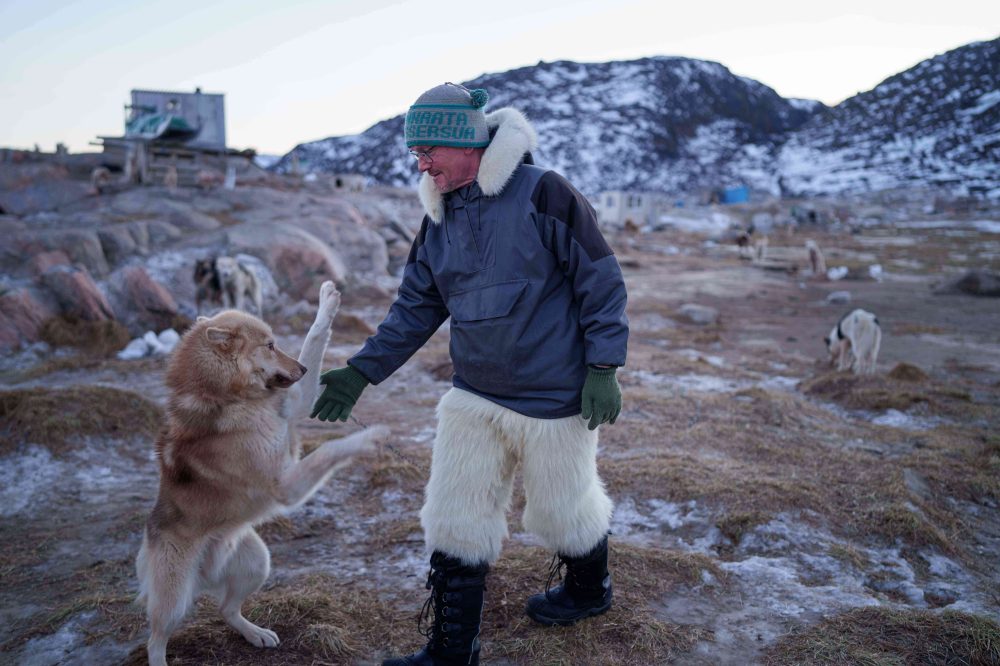

ILULISSAT, Greenland — In a remote northern Greenland village, Jørgen Kristensen found solace with his stepfather’s sled dogs during a difficult childhood. While most schoolmates had dark hair typical of Inuit heritage, Kristensen stood out with blonde locks inherited from a Danish father he never met. When bullies targeted him for being different, the dogs provided comfort.
At just 9 years old, he ventured onto the ice alone with the dogs to fish, beginning a lifelong passion that would lead to five Greenlandic dog sled championships.
“I was just a small child. But many years later, I started thinking about why I love dogs so much,” the 62-year-old Kristensen explained to The Associated Press.
“The dogs were a great support,” he added. “They lifted me up when I was sad.”
For over a millennium, these animals have transported Inuit hunters and fishermen across Arctic ice. However, this winter in Ilulissat — located roughly 186 miles north of the Arctic Circle — such travel has become impossible.
Rather than smoothly crossing snow and ice, Kristensen’s sled now jolts across bare ground and stones. Pointing toward the surrounding hills, he noted this marks the first January in his memory without any snow coverage or bay ice formation.
The warming temperatures affecting Ilulissat are causing underground permafrost to thaw, structures to settle, and water pipes to rupture. These changes also create consequences felt worldwide.
The adjacent Sermeq Kujalleq glacier ranks among Earth’s most rapidly moving and active ice formations, releasing more icebergs than any glacier beyond Antarctica, according to UNESCO. As global temperatures have increased, this glacier has pulled back and broken apart at unprecedented rates, substantially adding to rising sea levels affecting regions from Europe to Pacific island nations, NASA reports.
The disappearing ice may expose previously inaccessible critical mineral reserves. Many Greenland residents suspect this explains why President Donald Trump has made their island a geopolitical flashpoint through ownership demands and past suggestions of potential military acquisition.
During the 1980s, Ilulissat’s winter temperatures typically remained around -13 Fahrenheit, Kristensen recalled.
Currently, however, many days see temperatures climbing above freezing — occasionally reaching as high as 50 Fahrenheit.
Kristensen now must gather snow for his dogs to drink during expeditions since none exists naturally along their paths.
While Greenlanders have historically shown adaptability — potentially developing wheeled dog sleds in the future — losing the ice affects them profoundly, explained Kristensen, who operates a tourism company showcasing his Arctic homeland.
“If we lose the dog sledding, we have large parts of our culture that we’re losing. That scares me,” he told AP, his voice breaking with emotion.
During winter months, hunters traditionally could take their dog teams far across frozen seas, Kristensen explained to AP. These ice formations served as natural “big bridges,” linking Greenlanders to hunting areas and connecting them with fellow Inuit communities throughout Arctic regions of Canada, the United States, and Russia.
“When the sea ice used to come, we felt completely open along the entire coast and we could decide where to go,” Kristensen said.
This past January brought no ice formation whatsoever.
Operating a dog sled across ice feels like traveling “completely without boundaries — like on the world’s longest and widest highway,” he described. Losing this experience represents “a very great loss.”
Years ago, Greenland’s government provided emergency financial assistance to numerous families in the island’s far north after sea ice failed to freeze sufficiently for hunting activities, according to Sara Olsvig, who chairs the Inuit Circumpolar Council representing Inuit populations across Arctic nations.
The warmer conditions also create additional hazards for fishermen who have replaced dog sleds with boats, as increased rainfall replaces snowfall, explained Morgan Angaju Josefsen Røjkjær, Kristensen’s business associate.
Compressed snowfall traps air between flakes, creating ice with a distinctive bright white appearance. However, frozen rain produces ice containing minimal air that resembles glass.
Fishermen can spot and avoid white ice formations, but rain-formed ice adopts the sea’s coloration, creating danger because “it can sink you or throw you off your boat,” Røjkjær warned.
Climate change “is affecting us deeply,” Olsvig stated, with Arctic regions experiencing amplified impacts as they warm “three to four times faster than the global average.”
Throughout his lifetime, the Sermeq Kujalleq glacier has withdrawn approximately 25 miles, reported Karl Sandgreen, 46, who directs Ilulissat’s Icefjord Center, an institution focused on documenting the glacier and its ice formations.
Gazing through windows at typically snow-covered hills now bare, Sandgreen described exposed mountain rock revealed by melting ice and a formerly ice-filled fjord valley that now contains “nothing.”
Environmental pollution accelerates ice melting, Sandgreen noted, explaining how Sermeq Kujalleq melts from above downward, contrasting with Antarctic glaciers that primarily melt from below as ocean temperatures rise.
Two factors worsen this process: black carbon or soot from ship exhausts, and volcanic debris. These materials coat snow and ice with dark substances, reducing sunlight reflection while absorbing additional heat and accelerating melting. Black carbon has grown in recent decades due to increased Arctic shipping traffic, while nearby Iceland experiences regular volcanic activity.
Many Greenlanders told AP they suspect the melting ice motivates Trump — a leader who has labeled climate change “the greatest con job ever” — to seek island ownership.
“His agenda is to get the minerals,” Sandgreen stated.
Since Trump’s return to office, fewer American climate researchers have visited Ilulissat, Sandgreen observed. The president should “listen to the scientists” documenting global warming impacts, he urged.
Kristensen attempts to educate tourists joining his dog sled excursions or iceberg tours about global warming consequences. He emphasizes how Greenland’s glaciers hold importance equal to Brazil’s Amazon rainforest.
International conferences, including November’s United Nations climate discussions in the Amazon gateway city of Belem, serve important purposes, but equally vital is educating “children all over the world” about ice and ocean significance alongside traditional subjects like mathematics, Kristensen argued.
“If we don’t start with the children, we can’t really do anything to help nature. We can only destroy it,” Kristensen concluded.