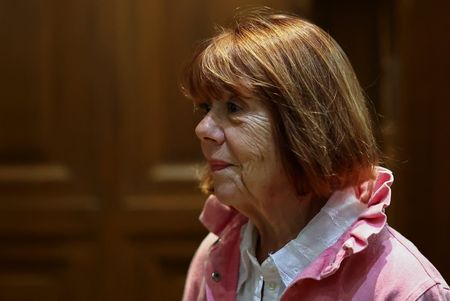

A French woman who became a worldwide advocate for sexual assault survivors has published a book detailing the unimaginable crimes committed against her by her own husband and dozens of other men.
Gisele Pelicot’s memoir “A Hymn to Life” hit shelves Tuesday, offering her personal account of discovering that her husband had been drugging her and orchestrating her sexual assault by strangers for years. The 73-year-old’s decision to make her 2024 trial public transformed her into an international figure in the battle against sexual violence and prompted France to overhaul its laws regarding rape.
In her book, Pelicot explains why she gave up her legal right to remain anonymous during the proceedings. “No one would ever know what they had done to me… No one beyond those involved in the trial would see their faces, look them up and down and wonder how to pick out the rapists among their neighbours and colleagues,” she wrote.
The memoir details the devastating moment when authorities revealed the scope of the crimes against her. Police initially questioned whether she and her then-husband participated in swinging, but when she said no, officers showed her photographs of herself unconscious in bed with men she didn’t recognize.
“The officer says a number. He tells me fifty-three men had come to my house to rape me,” Pelicot wrote in her account.
She describes returning home afterward and doing routine household tasks like hanging her husband’s laundry. “I was like a dog waiting by the garden gate for its master,” she recalled.
The book also chronicles the painful process of informing loved ones, particularly her children, about what had happened. She wrote about knowing her daughter Caroline was about to “go through hell and back.”
Her former husband Dominique Pelicot was convicted along with 50 other men for the assaults against her.
Though she never spoke directly to Dominique during the trial, Pelicot reveals in her memoir that she intends to visit him in prison seeking answers to difficult questions.
“Did you ever think, ‘I must stop’? Did you abuse our daughter? Did you commit the most abject crime of all? Do you have any idea of the hell we’re living in? … Did you kill? … I’ll ask him all these questions. I need answers; he owes me that much,” she wrote.
Pelicot credits the overwhelming support from women worldwide as a source of strength during her ordeal. She received thousands of letters and was moved by supporters who gathered outside the courthouse.
“Not long after the trial began, I started to be presented with a bundle of correspondence at the end of each day … I preferred to read their letters rather than the newspapers; they gave me the chance to listen to women’s voices,” she explained.
“How could I tell the women … that their presence outside the courtroom eased for me what was happening inside,” Pelicot added.
The memoir also reveals that Pelicot has found romance again with someone she met through mutual acquaintances. She described feeling “light-headed with happiness” the evening they first met.
“I needed to love again. I wasn’t afraid. … I still have faith in people. Once, that was my greatest weakness. Now it is my strength. My revenge,” she concluded.