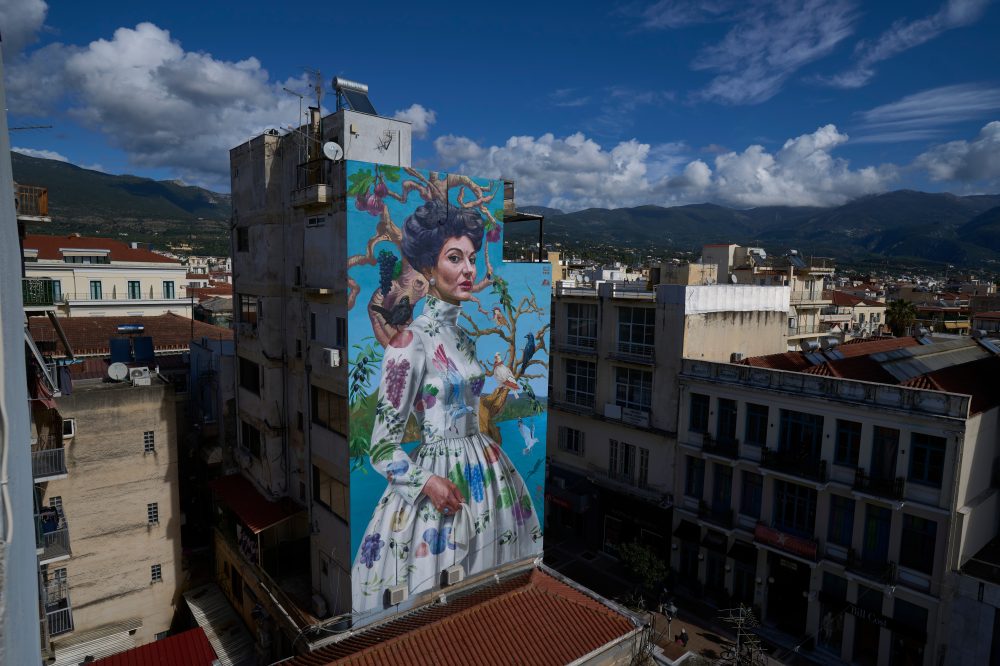

KALAMATA, Greece — A Greek coastal city famous for its olives has earned international recognition after a giant wall painting featuring opera icon Maria Callas was crowned the globe’s top mural for 2025.
Street Art Cities, an international organization that tracks urban artwork worldwide, selected the enormous piece painted on a central building in Kalamata as this year’s “Best Mural of the World.”
The southern Greek community, situated roughly 150 miles southwest of Athens, produces some of the planet’s most celebrated olives, figs and grapes — agricultural products that play starring roles in the award-winning artwork.
City officials say that was exactly their intention.
Deputy Mayor Vassilis Papaefstathiou, who oversees strategic planning and climate initiatives, said Kalamata stands among the rare Greek municipalities pursuing carbon neutrality by 2030. Local leaders sought a method to help their 73,000 residents better understand complex ideas like sustainable growth, agricultural programs, and economic development.
This vision led to commissioning a large-scale public mural.
“We wanted it to reflect a very clear and distinct message of what sustainable development means for a regional city such as Kalamata,” Papaefstathiou said. “We wanted to create an image that combines the humble products of the land, such as olives and olive oil — which, let’s be honest, are famous all over the world and have put Kalamata on the map — with the high-level art.”
“By bringing together what is very elevated with … the humbleness of the land, our aim was to empower the people and, in doing so, strengthen their identity. We want them to be proud to be Kalamatians.”
The region has endured severe heat, drought conditions and devastating fires recently, all threatening the olive farms that drive the local economy.
Officials selected Maria Callas to symbolize their community. The legendary performer, considered among history’s finest opera voices and celebrated throughout Greece as a cultural treasure, was born in New York to Greek parents, though her father originated from a village near Kalamata. Local residents consider her family.
This bond extends beyond symbolism: Kalamata’s music academy alumni group bears Callas’ name, while the community cultural facility maintains a permanent display honoring her life, featuring personal correspondence from her archives.
Creator Kleomenis Kostopoulos, age 52, explained the mural “is not actually called ‘Maria Callas,’ but ‘Kalamata’ and my attempt was to paint Kalamata (the city) allegorically.”
Instead of creating a glamorous portrait of the celebrated singer, Kostopoulos chose a more realistic, relatable approach. He wove in features connecting residents to their homeland: tree limbs representing underground root systems, local bird species, and signature farm products.
“The dress I create on Maria Callas in ‘Kalamata’ is essentially all of this, all of this bloom, all of this fruition,” he said. “The blessed land that Kalamata itself has … is where all of these elements of nature come from.”
The project demanded significant effort. Kostopoulos spent approximately two weeks painting, stretched across a full month due to poor weather conditions. He worked mainly with traditional brushes while adding spray paint details, using mechanical lifts to access the entire wall surface.
Deputy Mayor Papaefstathiou noted the mural has transformed into a community centerpiece.
“We believe this mural has helped us significantly in many ways, including in strengthening the city’s promotion as a tourist destination,” he said.
The artwork has generated discussions about public art beyond attracting visitors. Additional property owners throughout Kalamata have approached officials about featuring murals on their buildings.
“All of us — residents, and I personally — feel immense pride,” said tourism educator Dimitra Kourmouli.
Artist Kostopoulos hopes the international recognition will influence Greece’s broader arts scene and increase support for public artwork.
“We see that such modern interventions in public space bring tremendous cultural, social, educational and economic benefits to a place,” he said. “These are good springboards to start nice conversations that I hope someday will happen in our country, as well.”