
FREETOWN, Sierra Leone — Dozens of expensive homes have been constructed illegally within a protected national park that acts as a crucial environmental shield for Sierra Leone’s capital city, while government authorities have taken minimal action to address the violations, according to an investigation.
The Associated Press and The Gecko Project obtained exclusive access to findings from a government probe into the unauthorized development that has remained hidden from public view for nearly four years since President Julius Maada Bio ordered the investigation. The probe revealed that high-ranking government officials distributed land ownership paperwork for the protected area.
During a recent site visit, AP reporters observed ongoing construction activity.
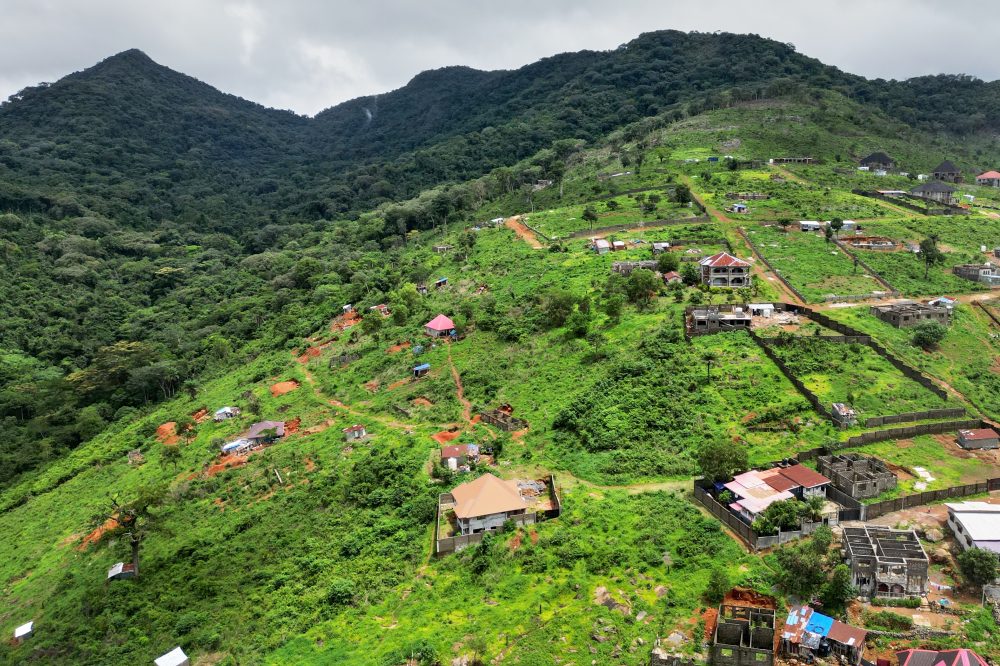
These luxury homes are located in the Bio Barray community, portions of which have been illegally developed within the mountainous Western Area Peninsula National Park — an area Sierra Leone’s administration has nominated for UNESCO World Heritage designation. No fewer than 50 residences in Bio Barray have been completed or remain under development within park limits on terrain that was covered by rainforest just five years ago in 2019.
Bio initiated the investigation in 2022 to determine how the unauthorized encroachment occurred and assess the environmental consequences of the resulting forest destruction.
The probe’s conclusions describe forest clearing in the national park as “an environmental time bomb that has to be nipped in the bud.”
“The government is fully aware of what is going on,” stated Yvonne Aki-Sawyerr, Freetown’s mayor and environmental advocate who intends to run against Bio in the upcoming presidential race.
According to Aki-Sawyerr, the Bio Barray development houses influential individuals who received permission to disregard environmental laws. “They are being given permission, simple,” she explained.
Sierra Leone’s capital sits on a narrow coastal strip between the national park and the Atlantic Ocean. Throughout the last ten years, numerous forested hillsides overlooking the city have been cleared by developers, mining operations, marijuana cultivators, and charcoal producers.
Construction activity within the park at Bio Barray can be easily seen by motorists traveling south from the capital along one of the nation’s major roadways.
Located above the Bio Barray mansions sits a water reservoir that supplies 90% of Freetown residents’ drinking water. The government probe determined that forest destruction and other human interference in the national park might trigger a “water shortage crisis.”
Bio ordered the investigation following a destructive fire near the water reservoir in 2022.
Landslide risks also pose a significant danger. A previous landslide on the national park’s border claimed over 1,000 lives in 2017.
The investigation team’s 13 members — comprising police personnel, attorneys, nonprofit representatives, and an Anti-Corruption Commission member — examined satellite images and reviewed documentation to understand how construction permits were obtained for residences within the park.
The committee discovered “widespread and indiscriminate clearing of forested areas” despite construction prohibitions in the area.
The most significant encroachment occurred in and surrounding Bio Barray, where deforestation had “increased exponentially” during the months before the investigation began. Maada Kpenge, who served as managing director of Freetown’s water utility until recently, informed the AP that this activity endangered the reservoir’s stability by heightening landslide risks.
Personnel at the Ministry of Lands, Housing and Country Planning were aware that “vast stretches” of government property were being illegally occupied but remained “reluctant to act robustly for reasons unknown,” according to the investigation.
The probe found that certain officials promoted encroachment and actively assisted it for financial benefit.
According to the State Land Act, the ministry has authority to transfer government property to private citizens through a process that begins with issuing a letter. However, clearing land and building within a national park violates the Forestry Law, the investigation noted.
Denis Sandy, who held the ministerial position during that period, approved no fewer than 175 documents providing land leases to private parties, which the investigation labeled a “flagrant violation.” The report did not specify how many of these grants involved Bio Barray property.
The committee suggested disciplinary action against Sandy and 16 additional named officials. Sandy has not responded to multiple requests for comment.
The investigation results were allegedly submitted to Sierra Leone’s former chief minister, who coordinates between the president and government departments, in September 2022.
Twelve months later, the president’s office released a photograph showing Bio formally accepting the findings from a commission leader. The related statement mentioned that “people in high places” participated in deforestation, without providing specifics.
“We will act on it very soon and do whatever is needed to be done,” Bio declared.
However, AP analysis of satellite images from Bio Barray demonstrated that unauthorized mansions continue to stand while construction proceeds. Multiple new structures appeared during the months following the chief minister’s reported receipt of the findings.
An AP site inspection last year discovered construction workers actively completing residential projects.
In November, current Chief Minister David Sengeh informed the AP that multiple government agencies had responded to the investigation’s recommendations. He declined to reveal whether the Cabinet had approved any penalties, explaining that cabinet deliberations remain confidential.
Sandy currently holds the position of minister of works and public assets. When asked about the accusations against Sandy, Sengeh responded, “I don’t think government makes decisions based on accusations only.”
Sengeh indicated that the Anti-Corruption Commission represented the proper authority to examine the allegations. However, during an interview, ACC director Ben Kaifala stated that no investigation had begun and claimed he had not reviewed the original probe’s conclusions.
Kaifala said the ACC would examine the report and take action, while noting that other government departments bear responsibility for protecting national parks.
“Other institutions must do their job,” Kaifala explained. “I can’t do it for them.”
Thomas Kamara, executive director of the National Protected Area Authority responsible for managing national parks, also claimed ignorance of the report. The investigation findings indicated that allegations had been raised regarding staff members under his predecessor’s involvement in selling park lands.
Kamara, who was appointed two months after the investigation was publicly presented to the president, asserted that all park encroachment had been halted. He stated he possessed no evidence of staff participation in land transactions. Kamara was dismissed from his role late last year, with the environment minister citing his failure to address the encroachment.
In mid-2025, Bio declared that no one is exempt from prosecution for illegally selling government land. He had previously stated regarding unauthorized homes in the national park, “Even if a house belongs to me or my family, it would be broken down.”
The investigation findings did not identify specific individuals owning homes in Bio Barray. While it identified 876 property owners throughout the national park, only 301 responded to requests for documentation supporting their land ownership claims.
The AP confirmed 46 luxury residences within the national park boundaries. A comprehensive survey of these properties late last year revealed that 14 owners held government positions, according to residents, caretakers, and security personnel.
These included officials reportedly employed in the presidential office, land ministry, and Environment Protection Agency.
Sierra Leone’s president initially consented to an interview but subsequently failed to respond to comment requests.