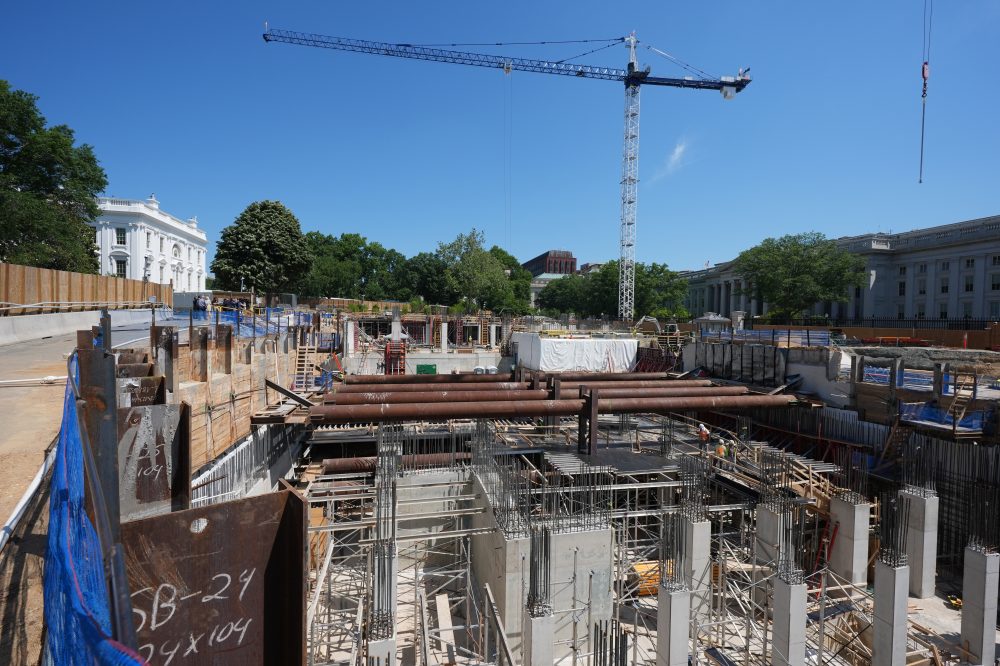

WASHINGTON — Senate Republican leadership plans to drop a controversial $1 billion security funding proposal for the White House complex and President Trump’s ballroom following criticism from within their own ranks over timing concerns and insufficient details from the Secret Service.
Under pressure from the White House, GOP leaders attempted to include this funding in an approximately $70 billion measure aimed at restoring money to U.S. Immigration and Customs Enforcement and the Border Patrol. However, the security proposal faced strong opposition from Republican lawmakers who raised concerns about the expense and questioned how taxpayer money would be spent.
While the bill’s text remains unreleased, the Senate aims to approve it this week and forward it to the House before departing for a weeklong Memorial Day recess. Senate Majority Leader John Thune, R-S.D., admitted to “ongoing vote issues” on Wednesday as leadership worked to gauge Republican backing, along with “ongoing parliamentarian issues” as they determine what provisions will be permitted under chamber rules.
Sen. John Kennedy, R-La., stated Wednesday that without the security funding, the bill would return to “square one” because “the votes are not there.”
Sen. Thom Tillis, R-N.C., characterized the attempt to include the security package as a “bad idea” and expressed doubt about sufficient support for passage, even with reduced costs.
This internal conflict emerges as Democrats have criticized Republicans for attempting to finance Trump’s ballroom while voters face basic affordability challenges — and as some GOP lawmakers grow increasingly frustrated with Trump. Multiple GOP senators have opposed the administration’s $1.776 billion settlement fund intended to compensate Trump’s allies who claim persecution, and many expressed anger over the president’s Tuesday endorsement of Texas Attorney General Ken Paxton in next week’s party primary runoff against Sen. John Cornyn.
“There’s always a consequence with taking on United States senators,” Thune said Wednesday. The president “obviously has his favorites and people he wants to endorse and that’s his prerogative. But what we have to deal with up here is moving the agenda, and obviously that can become slightly more complicated.”
The “anti-weaponization” fund, stemming from a settlement that resolves Trump’s lawsuit against the Internal Revenue Service regarding his tax return leak, has surprisingly become a major complication in the legislation. Democrats indicated they would force votes to block it or impose restrictions.
Democrats have leverage because Republicans are attempting to pass the immigration enforcement bill through a complex budget process requiring numerous amendment votes. Democrats are considering multiple amendments, potentially to eliminate the new fund entirely or prohibit payments to Trump supporters who injured law enforcement officers during the Jan. 6, 2021, Capitol attack.
These amendments, among others, could succeed as increasing numbers of Republicans express doubts about the fund. Republicans are now discussing their own last-minute additions to prevent this, potentially establishing parameters for the settlement and eligible recipients, according to two individuals familiar with private discussions who requested anonymity.
Thune — who stated Tuesday that he is “not a big fan” of the settlement and doesn’t understand its purpose — said Wednesday that any new language potentially restricting the settlement remains “a work in progress.”
How any Senate Republican modifications would be received in the House remains uncertain, despite some House Republicans also criticizing the settlement.
House Speaker Mike Johnson, R-La., said Wednesday that the House will approve the bill “whatever form it takes.”
As Republicans challenged the settlement and portions of his agenda, Trump criticized the Senate in a social media post.
He urged Republicans to dismiss Senate parliamentarian Elizabeth MacDonough, who determined over the weekend that portions of the $1 billion security proposal cannot remain in the ICE and Border Patrol bill. Trump also renewed longstanding calls for the Senate to pass the SAVE Act, a Republican measure requiring all voters to prove U.S. citizenship, and to eliminate the Senate filibuster.
Republicans must “get smart and tough,” Trump said, or “you’ll all be looking for a job much sooner than you thought possible!”
While remaining loyal to Trump on most matters, Senate Republicans have rejected his repeated appeals — including during his first term — to eliminate the filibuster, which creates a 60-vote threshold in the Senate.
Overshadowing the growing GOP division is Trump’s unexpected endorsement of Paxton. This intervention has Republican senators privately angry that it could jeopardize their majority in November as they consider the incumbent, Cornyn, the stronger candidate for the November general election.
According to the Secret Service’s request, approximately $220 million would finance security enhancements related to the ballroom. The remainder would fund a new visitor screening center, training, and additional security measures.
Tillis said the bill should not have included the other security improvements “because it’s just giving everybody the ‘billion-dollar ballroom.’”
Several other House and Senate Republicans have questioned the request, and senators departed a briefing with the Secret Service director last week stating they required much more information.
People “can’t afford groceries and gasoline and healthcare, and we’re going to do a billion dollars for a ballroom?” asked Louisiana Sen. Bill Cassidy, who lost reelection in his GOP primary on Saturday after Trump endorsed one of his opponents.
Remaining in the bill is funding for ICE and Border Patrol, which Democrats have blocked for months in protest of the Trump administration’s immigration enforcement crackdown.
Democrats demanded agency reforms, but negotiations with the White House produced minimal progress. Republicans are therefore using the complex budget maneuver called reconciliation — the same process that enabled them to pass Trump’s tax and spending cuts bill last year — to fund the agencies through Trump’s term with a simple majority and no Democratic votes.
However, passage requires parliamentarian approval and Republican unity.
“We’re working on it,” Thune said as he departed the Capitol on Wednesday evening.