
WASHINGTON — Congressional Republicans are allowing a critical Friday deadline to expire without taking action on President Trump’s military involvement in Iran, despite previous assurances they would step in by the May 1 cutoff date.
The War Powers Resolution from 1973 requires lawmakers to either declare war or approve military force within 60 days of engagement — with Friday marking that deadline — or within 90 days if the president requests additional time. However, Congress has made no effort to enforce this mandate, departing for a weeklong break Thursday following the Senate’s sixth rejection of a Democratic proposal to end the military action.
The Trump White House has demonstrated no interest in seeking legislative approval whatsoever. Administration officials contend the legal deadlines don’t apply since military operations in Iran essentially concluded when a ceasefire took effect in early April.
Senate Majority Leader John Thune of South Dakota stated Thursday he has no plans for a vote authorizing Iranian military action or other intervention.
“I’m listening carefully to what the members of our conference are saying, and at this point I don’t see that,” Thune said.
This hesitation to challenge Trump on military matters comes during a politically challenging period for Republicans, as public dissatisfaction grows regarding both the conflict and rising gasoline costs. Nevertheless, most GOP legislators express support for Trump’s wartime decisions or indicate willingness to allow him additional time given the delicate ceasefire situation.
North Dakota Republican Senator Kevin Cramer indicated he would support war authorization if Trump requested it. However, he questioned whether the War Powers Resolution, enacted during the Vietnam era to restore congressional authority, is even constitutionally valid.
“Our founders created a really strong executive, like it or not like it,” Cramer said.
However, some Republican senators have expressed desire for eventual congressional involvement. Alaska’s Lisa Murkowski announced during Thursday floor remarks that she plans to introduce limited military force authorization when the Senate reconvenes after recess if the administration hasn’t presented what she termed a “credible plan.”
“I do not believe we should engage in open-ended military action without clear accountability,” Murkowski said. “Congress has a role.”
Several GOP senators have maintained for weeks that Congress should exercise its war authority at some point. Maine’s Susan Collins, one such senator, joined Democrats for the first time Thursday in voting to end the military action. Her statement emphasized wanting a clear strategy for conflict resolution.
“The president’s authority as commander-in-chief is not without limits,” Collins said, noting the 60-day deadline is “not a suggestion, it is a requirement.”
Beyond Collins and Murkowski, Republican Senators John Curtis of Utah, Thom Tillis of North Carolina, and Josh Hawley of Missouri have recently expressed interest in eventual voting.
Curtis stated he wouldn’t support continued war funding until Congress authorizes it.
“It is time for decision-making from both the administration and from Congress — and that can happen in league with one another, not in conflict,” Curtis said.
Thune recommended increased White House communication with legislators through briefings and hearings to maintain Capitol Hill support.
“Obviously, getting readouts from our military leadership on a somewhat regular basis I think will be helpful in terms of shaping the views of our members about how comfortable they are with everything that’s happening there, and the direction headed forward,” Thune said.
The 1973 War Powers Resolution mandates presidents have 60 calendar days after congressional notification of U.S. military engagement to either conclude operations or obtain legislative approval. The White House may request a 30-day extension for safe troop withdrawal, requiring congressional notification.
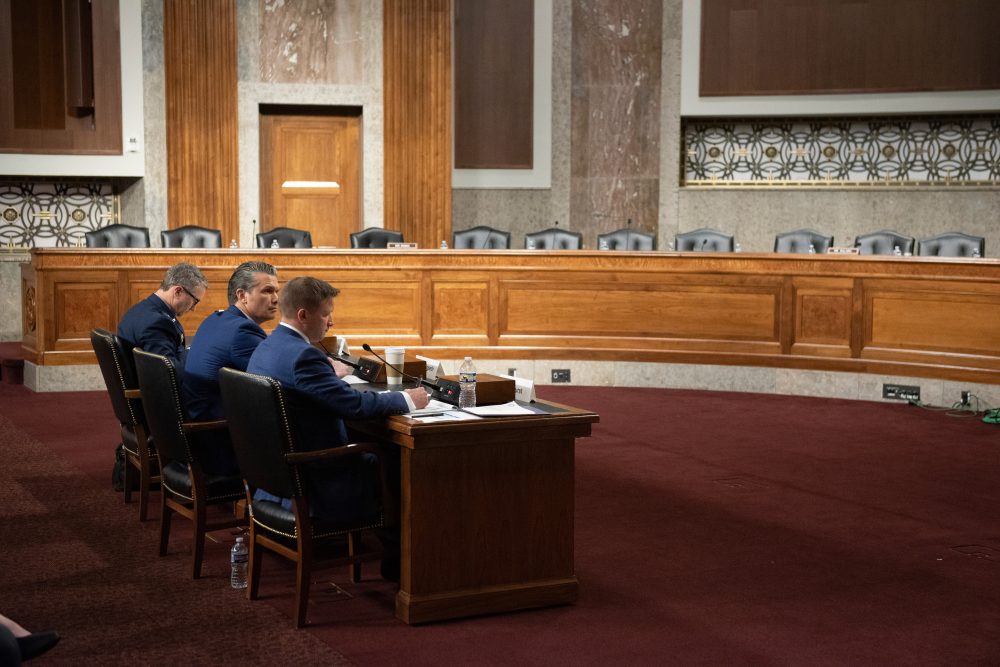
While Friday marks the 60-day expiration, Defense Secretary Pete Hegseth testified Thursday, “We are in a ceasefire right now, which our understanding means, the 60-day clock pauses or stops.”
A senior administration official, speaking anonymously about the administration’s stance, claimed that for war powers purposes, “the hostilities that began on Saturday, Feb. 28 have terminated.” The official noted no military exchanges between U.S. and Iranian forces since the two-week ceasefire beginning April 7.
The administration maintains this position despite Iran’s continued control of the Strait of Hormuz and ongoing U.S. Navy blockade preventing Iranian oil tankers from reaching open waters.
Democrats dismissed suggestions that May 1 isn’t the actual deadline. “I do not believe the statute would support that,” Virginia Senator Tim Kaine told Hegseth during hearings.
California Senator Adam Schiff argued that military operations continue with warships and other assets despite halted bombing during the ceasefire.
“Ceasing to use some forces while using others does not somehow stop the clock,” Schiff said.
The development didn’t surprise at least one House Democrat with military oversight responsibilities.
Representative Adam Smith, ranking Democrat on the House Armed Services Committee, told The Associated Press: “Is the expectation that the Trump administration is going to follow the law? I do not have that expectation.”