
Global stock markets posted gains Thursday as technology sector developments boosted investor confidence, with Nvidia’s strong earnings report and Samsung’s strike resolution driving chipmaker shares higher.
Asian markets outside Japan saw broad increases of 1.2% according to MSCI’s regional index, ending a four-day losing streak. South Korea’s KOSPI jumped more than 4% on the positive news.
Oil markets also moved higher, with Brent crude futures gaining 0.7% to reach $105.76 per barrel during Asian trading. The increase came after three large tankers successfully navigated the Strait of Hormuz on Wednesday, while Iran maintained control over the strategic waterway.
U.S. markets had posted solid gains the previous day, with the S&P 500 advancing 1.1% and the Nasdaq climbing 1.5% following three consecutive days of declines. The rally came as President Donald Trump indicated the United States remained prepared for additional military action against Iran if Tehran rejected peace negotiations, though he suggested Washington might wait several days to “get the right answers.”
“Oil prices declined and other major markets rallied, as investors took comfort from headlines quoting Trump saying the U.S. was in the ‘final stages’ with Iran,” analysts from Westpac wrote in a research report.
Technology stocks received a boost after Nvidia exceeded revenue expectations in its Wednesday forecast. CEO Jensen Huang worked to convince investors that the world’s most valuable company could maintain explosive growth in artificial intelligence chip demand.
“The chip landscape remains Nvidia’s world with everybody else paying rent, as more sovereigns and enterprises wait in line for Nvidia’s chips,” said Dan Ives, global head of technology research at Wedbush Securities in New York.
Despite the positive forecast, Nvidia shares dropped 1.1% in after-hours trading, while S&P 500 e-mini futures declined 0.5%.
“The market’s reaction was relatively muted by its own lofty standards,” said Tony Sycamore, market analyst at IG in Sydney. “The lack of any China sales in the outlook and guidance that was only modestly ahead of expectations left some investors wanting a bit more fireworks.”
Samsung Electronics shares soared more than 6% in Seoul after the company’s union announced it would halt planned industrial action following a preliminary wage agreement. The move prevented a strike by nearly 48,000 workers that could have disrupted South Korea’s economy and worldwide semiconductor supply chains.
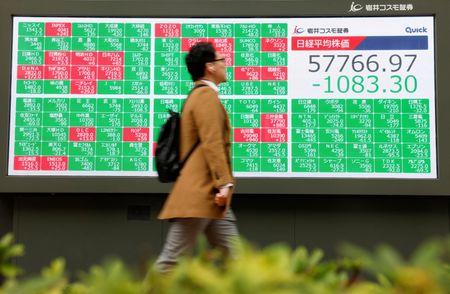
Japan’s Nikkei 225 index rose 1.9% even as S&P Global’s preliminary manufacturing activity index showed slower expansion, falling to 54.5 in May from 55.1 the prior month.
Japanese export data provided additional economic encouragement, with April shipments increasing 14.8% compared to the same period last year. The finance ministry figures marked the eighth consecutive month of export growth, easing concerns about global economic stagnation.
Australian markets gained 1.5% despite mixed economic indicators. Preliminary service sector activity slowed to 47.7 in May from 50.7 in April, while manufacturing activity remained steady at 50.2, just above the threshold indicating expansion.
The 10-year U.S. Treasury yield increased 1.9 basis points to 4.588%, continuing its upward trend after breaking a three-day decline Wednesday. Federal Reserve meeting minutes from April 28-29 revealed heightened inflation concerns among policymakers, with more officials considering potential interest rate increases.
Cryptocurrency markets showed minor declines, with Bitcoin falling 0.3% to $77,453.44 and ether dropping 0.3% to $2,127.53.