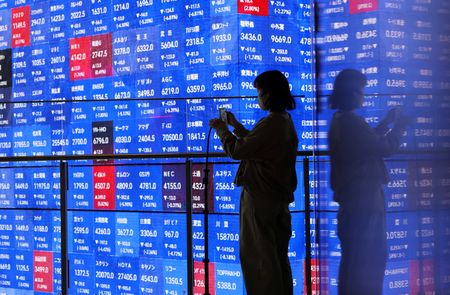

SINGAPORE – Financial markets across Asia displayed volatile trading patterns Monday morning following President Donald Trump’s ultimatum to Iran regarding the critical Strait of Hormuz shipping lane.
Trump has issued stark warnings promising devastating consequences if Tehran fails to reopen the strategic waterway by his Tuesday deadline, specifically threatening to target civilian infrastructure such as electrical facilities and transportation networks.
The president’s aggressive stance has created anxiety among financial traders who fear Iran may launch retaliatory strikes against Gulf region targets in response to any American military action.
Trading volumes remained light Monday due to regional holidays, with S&P 500 electronic futures declining 0.2%. Meanwhile, MSCI’s comprehensive Asia-Pacific stock index excluding Japan gained 0.5%, Japan’s Nikkei 225 climbed 1.2%, and South Korea’s Kospi jumped 2%.
Energy markets saw significant movement as Brent crude futures increased 1.4% to reach $110.58 per barrel. This followed Sunday’s OPEC+ decision to boost production quotas by 206,000 barrels daily for May, though several key producers behind the Strait of Hormuz cannot meet these targets due to war-damaged facilities and infrastructure.
Investment analyst Ed Yardeni from Yardeni Research noted the week’s focus on Middle Eastern developments, stating: “This week will continue to be dominated by developments in the Middle East, though a heavy slate of data releases — including the FOMC March minutes, February personal income, and March CPI — will compete for attention.”
Yardeni further explained Trump’s position in his research analysis: “Trump warned Iran that unless the Strait is opened immediately, Monday will be Obliteration Day, when the U.S. will bomb Iran’s electric power plants.”
Friday’s positive employment data showed stronger-than-anticipated job growth, with nonfarm payrolls adding 178,000 positions in March – the largest monthly gain in over a year. Unemployment dropped to 4.3% from 4.4% as workforce participation declined.
These employment figures create complexity for Federal Reserve policy decisions ahead of their April 29 meeting. Market indicators suggest traders don’t anticipate any central bank rate changes until September 2027, according to CME Group’s monitoring tools.
Currency markets showed the dollar index holding steady at 100.23 against major trading partners. U.S. 10-year Treasury yields rose 1.4 basis points to 4.3584%.
Japanese government bonds reached their highest yields since February 1999, with rates climbing 2.0 basis points to 2.4% amid inflation concerns. The dollar remained unchanged against the yen at 159.635.
Precious metals declined with gold falling 0.8% to $4,638.54. Digital currencies showed gains as bitcoin rose 1.9% to $68,915.85 and ethereum increased 2.4% to $2,117.61.