
HONG KONG (AP) — Markets across Asia declined Friday morning, mirroring Wall Street’s retreat from record highs, while crude oil prices continued climbing as diplomatic efforts to resolve the U.S.-Iran conflict showed little progress.
American market futures dropped following Thursday’s pullback on Wall Street from historic peaks.
Japan’s Nikkei 225 bucked the trend, rising 0.6% to close at 59,504.22, driven by strong technology sector purchases. The index had reached a record intraday peak above 60,000 on Thursday.
Hong Kong’s Hang Seng index dropped 0.8% to 25,714.99, while Shanghai’s Composite index declined 0.5% to 4,071.52.
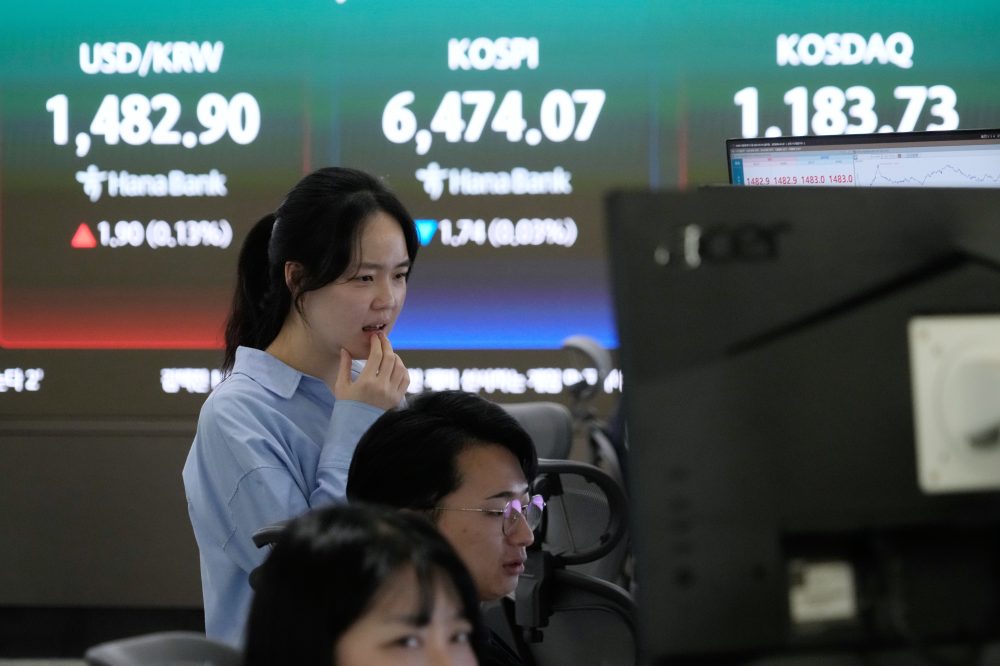
South Korea’s Kospi fell 0.4% to 6,452.33.
Australia’s S&P/ASX 200 decreased 0.6% to 8,745.00.
Taiwan’s Taiex surged 2.5% as semiconductor giant TSMC, a major component of the index, climbed more than 4%.
Diplomatic efforts to broker another round of peace negotiations between Washington and Tehran showed minimal advancement, despite President Donald Trump announcing Tuesday that America would indefinitely extend a two-week ceasefire with Iran, just one day before its scheduled expiration.
The Strait of Hormuz, a crucial corridor for international energy transport where approximately one-fifth of global oil and natural gas typically flows before the conflict began, continues to remain mostly blocked, with American naval forces maintaining a blockade of Iranian ports. Following last week’s U.S. port blockade, Iranian forces attacked three vessels in the waterway Wednesday, capturing two of them.
On Thursday, Trump announced that American military forces were expanding mine-clearing operations in the strait and directed troops to “shoot and kill” small Iranian vessels deploying mines in the region.
Crude oil prices have stayed high since the Iran conflict started on February 28.
June delivery Brent crude jumped 3.1% Thursday to close at $105.07 per barrel, reaching above $107 at one point. July Brent delivery, the more actively traded contract, settled at $99.35 after hitting $101.
In early Friday trading, Brent crude gained 0.4% to $99.70 per barrel. U.S. benchmark crude increased 0.6% to $96.62 per barrel.
The worldwide energy crisis triggered by the Iran war threatens to accelerate inflation across numerous nations and has rattled international markets. However, Wall Street continues reaching record levels, supported by robust corporate earnings and some hope for a swift conflict resolution.
“With the S&P 500 still hugging record highs, markets are still at ease to give the negotiations more time,” ING Bank analysts Michiel Tukker and Padhraic Garvey wrote in a research note.
Thursday saw Wall Street’s benchmark S&P 500 fall 0.4% to 7,108.40, ending a multi-week surge that pushed it to new record highs. The Dow Jones Industrial Average similarly dropped 0.4% to 49,310.32, while the tech-heavy Nasdaq composite slipped 0.9% to 24,438.50.
Tesla stock tumbled 3.6%, weighing on the broader market despite better-than-anticipated quarterly earnings, as investors worried about significant increases in capital spending as the automaker shifts focus toward artificial intelligence and robotics.
Paramount Skydance shares declined 4.5% after Warner Bros. Discovery shareholders approved its merger with Paramount. Warner Bros. Discovery stock dropped 1.6%.
In early Friday trading, precious metals prices declined. Gold fell 0.7% to $4,689.60 per ounce. Silver decreased 0.8% to $74.92 per ounce.
The U.S. dollar strengthened to 159.83 Japanese yen from 159.71 yen. The euro traded at $1.1677, down from $1.1683.