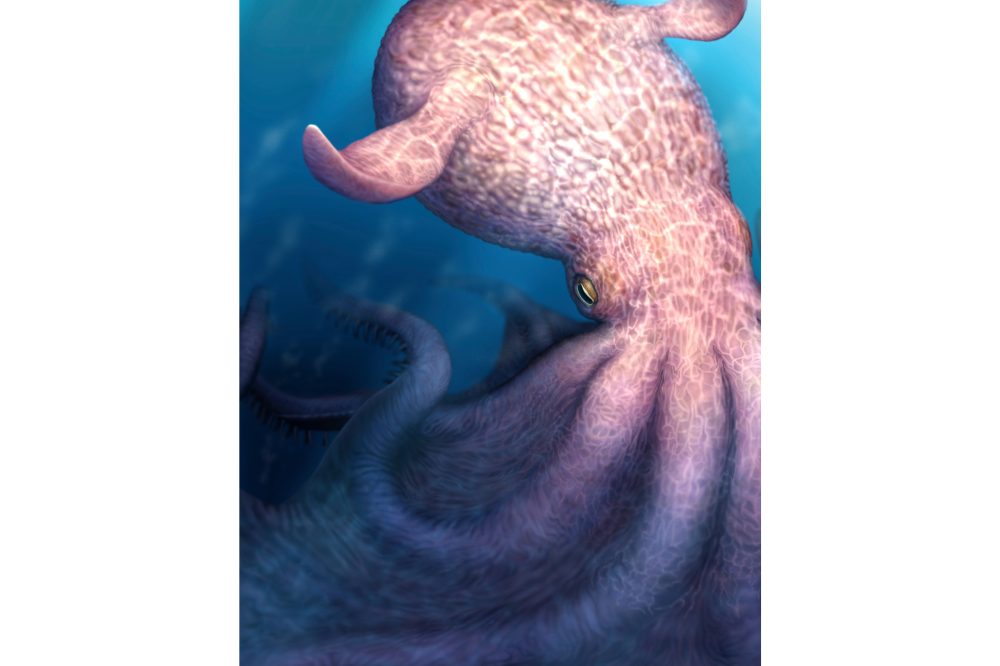

Scientists have uncovered evidence that colossal octopuses stretching more than 60 feet in length dominated ancient oceans during the dinosaur era 100 million years ago.
Research published Thursday in the journal Science examined fossilized jaw remains, showing these enormous sea creatures with eight arms competed alongside other apex marine predators of their time.
University of Alabama paleontologist Adiel Klompmaker, who was not part of the research team, described the discovery in an email, stating “These krakens must have been a fearsome sight to behold.”
While most people associate late Cretaceous ocean dominance with razor-toothed sharks and large marine reptiles like mosasaurs and plesiosaurs, these giant octopuses have been overlooked in discussions of prehistoric sea life.
The challenge in studying ancient octopuses stems from their soft tissue composition, which rarely fossilizes well, making size estimates difficult. Additionally, many scientists have underestimated soft-bodied invertebrates as serious contenders among top predators, despite octopuses possessing powerful beaks made of hardened chitin capable of crushing shells and bones.
Researchers examined jaw fossils from 15 ancient octopus specimens previously discovered in Japan and Vancouver Island, Canada. Using an innovative method called digital fossil mining, they identified 12 additional jaw specimens from Japan by scanning rock cross-sections to locate hidden fossils.
By comparing these ancient jaws to modern octopus specimens, scientists calculated that these prehistoric creatures measured between 23 and 62 feet in total length. Co-author and Hokkaido University paleontologist Yasuhiro Iba noted in an email that the largest jaw significantly exceeded the size of any contemporary octopus.
The research team observed extensive damage on the largest specimens’ jaws, including scratches, chips, and worn edges. According to Iba, this wear pattern indicates “the animals repeatedly crushed hard prey such as shells and bones.”
Without preserved stomach contents, researchers cannot definitively determine these creatures’ exact diet or confirm direct competition with other apex predators. They likely fed on fish and snails, capturing prey with their flexible tentacles before crushing it with their powerful beaks.
American Museum of Natural History paleontologist Neil Landman, who was not involved in the study, suggested that discovering octopus fossils in additional locations could provide better insight into their role in ancient marine ecosystems.
“It’s a big old planet,” Landman explained. “So we have lots to look at to piece together the marine ecosystem through time.”