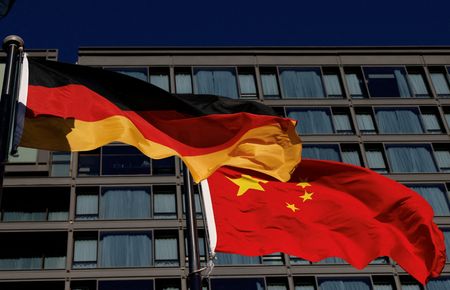

German Chancellor Friedrich Merz arrived in Beijing Wednesday for high-level discussions with Chinese Premier Li Qiang, focusing on improving economic relations between the two nations amid growing trade tensions.
During their meeting, Merz stressed Germany’s commitment to strengthening business ties with China, which became Germany’s top trading partner last year. However, he also highlighted the importance of creating more balanced and transparent cooperation moving forward.
“We have very specific concerns regarding our cooperation, which we want to improve and make fair,” Merz stated during the discussions. The chancellor faces the challenging task of restructuring an economic partnership that has become increasingly disadvantageous for German businesses.
Premier Li responded by urging both nations to collaborate in protecting global free trade and multilateral cooperation, appearing to reference the trade disputes initiated by U.S. President Donald Trump that have disrupted international commerce.
“China and Germany, as two of the world’s largest economies and major countries with important influence, should strengthen our confidence in cooperation, jointly safeguard multilateralism and free trade, and strive to build a more just and fair global governance system,” Li declared.
Beijing is positioning itself as a dependable economic ally compared to the United States, while European nations grapple with supply chain weaknesses and concerns about over-reliance on Chinese markets.
European Trade Commissioner Maroš Šefčovič warned the European Parliament Tuesday about troubling developments in China-Europe relations, including China’s increasing control over essential manufacturing industries, growing trade deficits, and declining market presence for European Union businesses in China.
This marks Merz’s inaugural trip to China, making him the most recent European leader attempting to rebuild relationships with Beijing, following similar visits by British Prime Minister Starmer and Canadian officials earlier this year.
The German delegation includes representatives from 30 major companies, featuring automotive giants Volkswagen and BMW, which are experiencing significant pressure from Chinese competitors. This competition has contributed to widening trade gaps that worry Berlin officials and fuel discussions about protective trade measures.
According to Rhodium Group analyst Noah Barkin, Germany’s manufacturing-focused economy has been especially affected by competition from Chinese producers.
China’s market appeal has shifted dramatically in recent years, as economic slowdowns have reduced consumer spending and excess manufacturing capacity has pushed Chinese companies to expand internationally.
Prior to the visit, Chinese government media highlighted opportunities for European-Chinese cooperation to provide stability while U.S. tariff policies disrupt global trade patterns.
The state-run Xinhua news agency referenced a German business survey showing that technological advances in China are benefiting German corporate headquarters.
The Global Times, a government-supported publication, suggested that China’s enormous market potential would overcome competitive concerns.
“Rhetoric such as ‘systemic rival’ and ‘de-risking’ has at times complicated Germany’s China policy,” the publication noted. “Yet the enthusiasm and actions of the German business community speak louder than political slogans.”