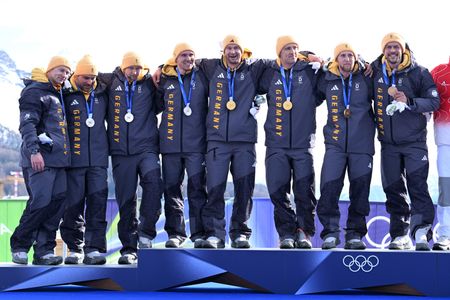

CORTINA D’AMPEZZO, Italy – German bobsledders delivered a spectacular performance at the Winter Olympics, securing gold medals in three team competitions while falling just short of a complete sweep when they narrowly lost the women’s Monobob event.
The impressive showing marked Germany’s second consecutive Olympics where their men’s teams occupied all three medal positions in their respective races – a feat no nation had accomplished before the Beijing Games four years earlier.
While Germany’s dominance was undeniable, it came after disappointing results in luge and skeleton events, where the traditional sliding powerhouse managed only three of five possible golds in luge and zero medals in skeleton after previously winning every title in those sports.
The Monobob competition provided the most dramatic moment when Germany’s Laura Nolte held the lead through three runs but stumbled in her final attempt. That opening allowed 41-year-old American Elana Meyers Taylor to claim her first Olympic gold after collecting three silver and two bronze medals across five Olympic appearances. Meyers Taylor edged Nolte by just four hundredths of a second, while defending champion Kaillie Humphries earned bronze for the United States.
Nolte quickly bounced back, successfully defending her Two-Woman title alongside pusher Deborah Levi. Despite holding a commanding lead after three runs, she executed her final run flawlessly this time, winning by half a second over teammate Lisa Buckwitz. Humphries added another bronze medal, bringing her Olympic total to six medals – three earned for Canada and three for the United States.
Germany’s most dominant performance came in the Two-Man event, where they had claimed all podium spots in six of seven World Cup races during the season. Johannes Lochner and Georg Fleischhauer controlled the competition from beginning to end, posting the fastest time in every run and finishing 1.34 seconds ahead of perennial champion Francesco Friedrich and Alexander Schuller. Adam Ammour and Alexander Schaller completed the German sweep with bronze.
The Four-Man competition nearly produced another complete German podium takeover, but Switzerland’s Michael Vogt disrupted those plans with a final-run surge to capture bronze – Switzerland’s first medal in the event in two decades. Lochner claimed his second gold of these Games while Friedrich settled for silver. Thorsten Margis, competing behind Lochner, made Olympic history by earning his fifth medal after previously winning four golds as Friedrich’s pusher.
Some observers argue that Germany’s technological superiority makes them nearly unbeatable in events where teams use their own equipment, unlike the Monobob where identical sleds level the playing field. Friedrich, now the most decorated Olympic bobsled pilot with four golds and two silvers, rejected those criticisms.
“If we look at the start times and we look at the lines that we drive on the ice and at the push, then the others don’t have to talk about our equipment,” Friedrich stated following the Two-Man sweep. “If they push fast, or faster than us, or they drive better than us, and they lose, then they can talk about the material. But until this point arrives, they have a lot of work to do.”