
Orthodox bishops in the nation of Georgia have selected a new spiritual leader during a critical period for the South Caucasus country, where religious institutions wield significant influence over society and politics.
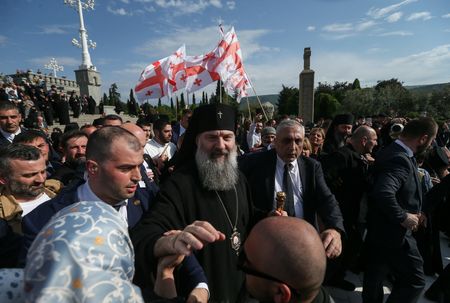
The 57-year-old cleric, originally named Elizbar Mujiri, received the title Shio III after securing 22 votes from Georgia’s Holy Synod, which consists of 39 senior religious leaders, during Monday’s election.
Before the voting took place at Tbilisi’s Holy Trinity Cathedral, Shio III told those gathered that Georgian citizens were witnessing a “historic event” in selecting their patriarch.
“…with the Lord’s help, the Georgian Orthodox Church, which has always been a unifier of the nation, a defender of the true faith, the Georgian language, traditions and historical memory will continue on this path,” he was cited by the Interpress news agency as saying.
The new patriarch will officially assume his role during Tuesday’s enthronement ceremony in Mtskheta, Georgia’s former capital and the center of its Orthodox faith.
Christianity became Georgia’s official religion in the early 300s, and faith remains central to Georgian identity today. Research from the Pew Research Center in 2017 showed that 89% of Georgians consider themselves Orthodox Christians.
The previous patriarch, Ilia II, passed away in March at age 93 after leading the religious institution for nearly five decades. During his tenure, he guided the Church’s evolution from a suppressed organization under Soviet Communist control to become Georgia’s most influential non-governmental institution.
However, Ilia II faced criticism for allegedly allowing the Church to fall under Moscow’s Orthodox Church influence. Russian President Vladimir Putin has utilized the Russian Orthodox Church to build support for his military campaign in Ukraine. Given Georgia’s 2008 military conflict with Russia, which Georgia lost, Moscow’s influence remains a contentious political topic.
Shio III assumes leadership while ongoing demonstrations target the ruling Georgian Dream party. Opposition groups accuse the party of abandoning Western alignment in favor of pro-Russian and authoritarian policies. Ten protest organizers recently received lengthy prison terms.
While the Orthodox Church typically avoids direct political commentary, analysts note its historical impact on social policies including abortion and LGBT rights, both of which Ilia II publicly opposed.
The new patriarch, a Tbilisi native, originally pursued music as a cellist before entering monastic life. Similar to his predecessor, he completed religious education at Moscow’s Theological Academy. In 2017, Ilia II designated him as “locum tenens,” positioning him to serve as interim patriarch following the incumbent’s death.