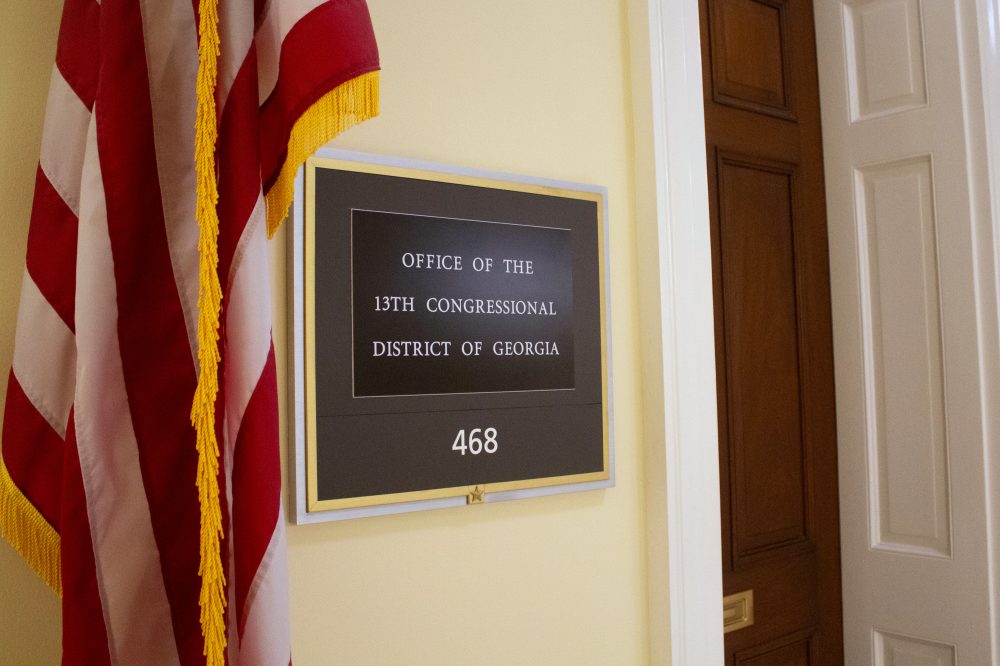

Voters in Georgia’s 13th Congressional District will cast ballots Tuesday in a special election to fill the congressional seat left empty by the death of Democratic U.S. Rep. David Scott, who passed away in April at the age of 80.
The race carries national significance because Republicans currently hold a slim majority in the U.S. House of Representatives, and the outcome of this contest could affect that balance of power.
Under Georgia election law, all six candidates — four Democrats and two Republicans — appear on the same ballot. A candidate who earns more than half of all votes cast will win the seat outright. If no one clears that threshold, the top two finishers, regardless of party, will advance to a special runoff election scheduled for August 25.
Whoever wins will serve the remaining months of Scott’s current congressional term.
The Democratic candidates in the race include former Gwinnett County School Board Chair Everton Blair, Marcye Scott — the late congressman’s daughter — Tony Brown, and Carlos Moore. The two Republicans on the ballot are Caesar Gonzales and Fayth Park.
Blair is the only candidate competing in both this special election and the race for the full-term seat that begins in January 2027. He finished third in the May 19 Democratic primary with roughly 12% of the vote. State Rep. Jasmine Clark won that primary with 56% of the vote and will face Republican Jonathan Chavez in the November general election. Chavez ran unopposed for the Republican nomination and previously challenged David Scott in the 2024 general election, receiving about 28% of the vote at that time.
Clark chose not to enter the special election. Filing would have required her to give up her state legislative seat at a time when Republican Gov. Brian Kemp was calling a special session to redraw the state’s congressional district boundaries ahead of the 2028 elections. The state constitution prohibits sitting officeholders from seeking a different office when that new office would begin more than 30 days before their current term ends. The special session did take place, but Republican leaders ultimately decided not to pursue redistricting.
In his later years, Scott had faced growing scrutiny about his age and health. He was seeking a 13th term in Congress and was dealing with a strong primary challenge from Clark and others at the time of his death.
Georgia’s 13th Congressional District sits east and southeast of Atlanta and covers portions of six heavily Democratic counties: Clayton, DeKalb, Gwinnett, Henry, Newton, and Rockdale. Gwinnett County makes up the largest share of the district’s voters, accounting for about 46% of the electorate in the 2024 general election. Only a small portion of DeKalb County falls within the 13th District, with that county playing a much larger role in the neighboring 4th and 5th Congressional Districts.
Scott won his 2024 reelection race with about 72% of the vote. In that same election, then-Vice President Kamala Harris received approximately 71% of the presidential vote in the district, while Republican Donald Trump received about 28%. Trump’s strongest showing in the district came from Gwinnett County, where he still only managed around 35% of the vote.
Polls in Tuesday’s special election close at 7 p.m. Eastern Time.
As of July 21, approximately 584,000 voters were registered in the 13th Congressional District. Georgia does not require voters to register by party. Around 358,000 votes were cast in the district’s 2024 U.S. House general election, though turnout in special elections is typically much lower than in November general elections.
Nearly 8,700 ballots had already been cast as of last Friday, with Gwinnett County accounting for the largest share, followed by Clayton County. About 78% of votes in the 2024 general election in the district were cast early — either in person or by mail.
All six counties within the district typically release most or all of their early and mail-in ballot results in the first vote update of the evening, generally before any Election Day in-person results are reported.
For reference, during the 2024 general election, the Associated Press first reported results in the 13th District House race at 7:10 p.m. ET — just 10 minutes after polls closed. About half of all votes had been counted by 9:31 p.m. ET, and the final vote update of the night came at 2:21 a.m. ET, with approximately 99.9% of ballots tallied.
The AP will declare a winner only when it determines that no remaining uncounted votes could change the outcome. If a race remains uncalled, the AP will continue to report on any significant developments, including candidate concessions or victory claims, while making clear that no winner has been officially declared.
Georgia does not have an automatic recount provision, but a losing candidate may request a recount if the margin falls at or below 0.5% of the total vote. The AP may still call a winner in such a race if the lead is determined to be too large for a recount or legal challenge to change the result.
If Tuesday’s special election does not produce an outright winner, the runoff election is set for August 25 — 28 days away. The 2026 midterm elections are scheduled for November 3, which is 98 days from Tuesday.