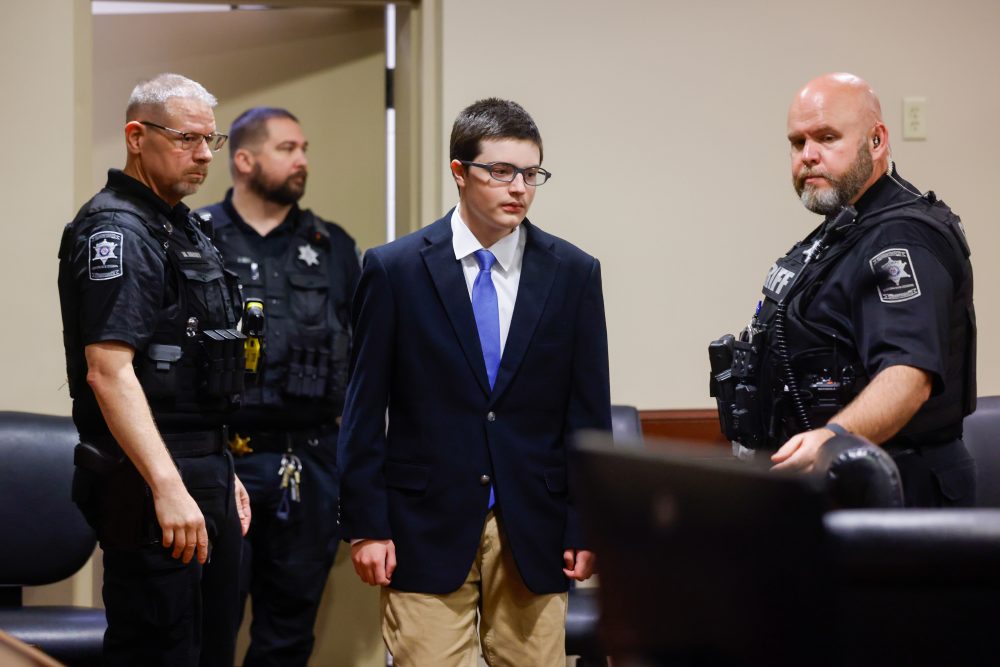

A forensic psychologist took the stand Monday and described how the teenager responsible for the deadly 2024 shooting at Apalachee High School in Georgia endured a troubled, isolated upbringing and fell deep into an online world centered on mass killings.
Colt Gray, 16, entered a guilty plea Friday on 55 charges, including murder, stemming from the September 4, 2024 shooting at the school located roughly 45 miles northeast of Atlanta. The attack left two students and two teachers dead and several others wounded.
Gray entered the plea without any prior agreement with prosecutors. Because murder carries a minimum sentence of life in prison, Barrow County Superior Court Judge Nicholas Primm will determine whether Gray has any chance at parole after reviewing testimony and evidence presented in court.
The victims killed in the attack were teachers Richard “Ricky” Aspinwall, 39, and Cristina Irimie, 53, along with 14-year-old students Mason Schermerhorn and Christian Angulo. One additional teacher and eight students were wounded, with seven of those struck by gunfire.
Forensic psychologist Kevin Richards, who evaluated Gray at the request of the teen’s defense attorney, described a notable moment during their first meeting in May 2025 — Gray asked whether he could pull his arms inside his sweatshirt to wrap around himself. “I thought he was kind of an odd kid,” Richards said. He conducted four interviews with Gray totaling roughly 15 hours and also spoke with Gray’s mother on two separate occasions for a combined three hours.
Richards painted a bleak picture of Gray’s home life. “It was pretty chaotic,” he said, explaining that the family struggled financially, moved frequently, and that Gray missed extended periods of school as a result. His parents battled drug use and fought often, leaving Gray with a lonely and neglected childhood, according to Richards’ testimony.
The psychologist also described Gray as deeply paranoid. Gray reportedly believed teachers were conspiring against him and that strangers in public were whispering about him. He also feared his home computer had been compromised, which led him to repeatedly change usernames and destroy external storage devices.
Despite noting the paranoia, Richards said he does not believe it was the driving force behind the shooting. “I don’t think he was driven by hallucinations or delusions to do what he did. I think he planned it out,” Richards testified.
Richards said most of Gray’s social interactions took place online. While he was an avid gamer, he also became deeply embedded in an online community of young true crime enthusiasts with a particular interest in mass shootings. Gray initially focused on Adam Lanza, who killed 26 people at Sandy Hook Elementary School in Connecticut, and James Holmes, who killed 12 people in a Colorado movie theater. Richards said Gray was especially fixated on Nikolas Cruz, the shooter behind the 2018 massacre at Marjory Stoneman Douglas High School in Florida.
“He had just kind of disappeared into Discord and disappeared into the true crime community,” Richards said.
District Attorney Brad Smith presented Richards with examples of Gray’s online conversations on Discord, the messaging platform. Those exchanges showed that Gray sometimes fabricated or exaggerated mental health symptoms and drug use when speaking with people online in order to connect with them and gain attention.
When Smith asked whether Gray had studied and modeled himself after school shooters, Richards said Gray was “kind of obsessed” with them.
Following Friday’s guilty plea, Judge Primm heard victim impact statements from the families of those killed and from survivors of the shooting. The majority called on the judge to sentence Gray to life without any possibility of parole.
Prosecutors also played audio recordings of two interviews investigators conducted with Gray — one taken less than an hour after the shooting while still at the school, and a second conducted hours later at the sheriff’s office. In those recordings, Gray referenced uncontrollable urges and hearing voices directing him to act.
Gray’s father, Colin Gray, was convicted by a jury in March on charges that included second-degree murder and involuntary manslaughter. His sentencing is scheduled for later this week. Prosecutors say he provided his son with the assault-style rifle used in the attack.