
ATLANTA (AP) — The aftermath of the 2020 presidential contest — when President Donald Trump declined to acknowledge his defeat to Democrat Joe Biden — continues to influence Georgia politics and creates a major dividing line in the Republican contest for the state’s chief election administrator.
Brad Raffensperger, Georgia’s sitting secretary of state, gained national recognition after he stood by the state’s voting outcomes despite Trump’s unsubstantiated allegations of massive election fraud and declined the president’s request to help “find” sufficient votes to change the outcome.
With Raffensperger now leaving his post to seek the governor’s office, election administration has become a central topic in the campaign to succeed him. Several Republican contenders are promoting the same misleading narratives that Trump advanced six years earlier. The president has filled federal positions with individuals who support his unfounded theories, and election skepticism has also infiltrated state-level offices.
This contest occurs as state legislators have created conflicting provisions in election law regarding vote tabulation procedures. Gov. Brian Kemp announced Wednesday that he’s convening lawmakers for a special session on June 17 to handle redistricting matters and address an approaching voting deadline.
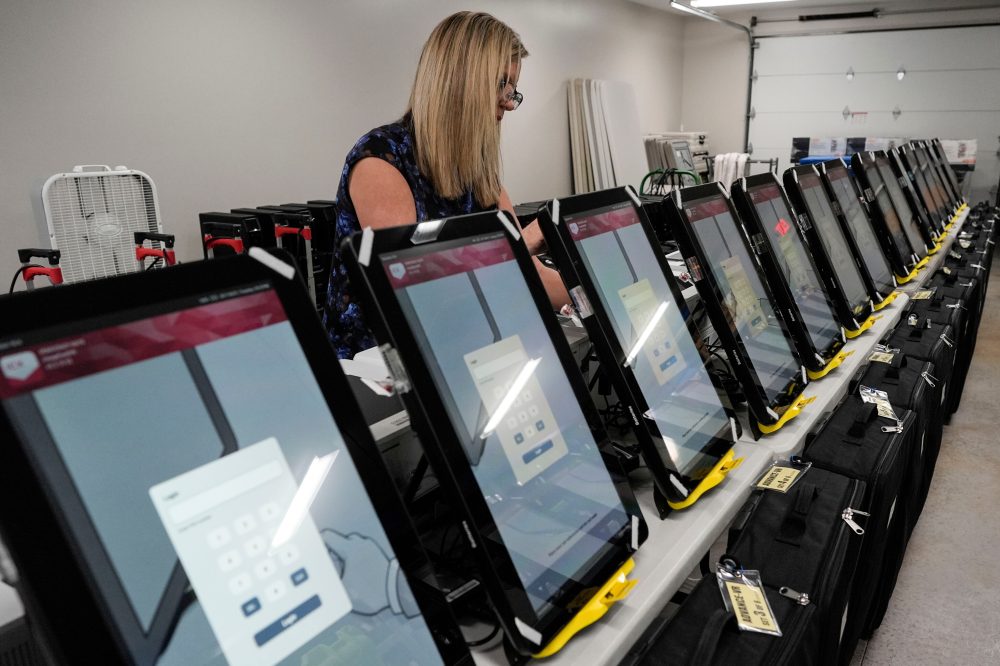
Georgia’s electronic voting equipment produces paper ballots containing both a readable summary of voter choices and a QR code that scanners use for vote tallying. Two years ago, legislators enacted a measure prohibiting QR codes from being used in official vote counting after July 1 of this year.
Yet they haven’t reached consensus on a replacement approach since that time, creating confusion and potential legal challenges for Georgia elections until the matter is resolved.
Although the special session might temporarily address the issue, the incoming secretary of state will probably play a role in establishing a new voting framework by 2028.
Gabriel Sterling, who served as one of Raffensperger’s senior staff members, stands as the sole Republican secretary of state hopeful who actively supports the state’s 2020 election outcomes.
He gained national attention by urging Trump to help prevent violent threats against election personnel, and during a recent Atlanta Press Club forum, he declared that the state conducts “the best and safest elections in America.”
However, other candidates persist in repeating Trump’s assertions.
Vernon Jones, who previously won office as a state representative and DeKalb County CEO while a Democrat before changing parties to become a Republican and strong Trump ally, offers perhaps the strongest criticism.
“I believe there were many irregularities. I believe violations have taken place,” Jones stated, continuing, “I stand with those who believe there was election fraud.”
Kelvin King, a general contractor who previously sought a U.S. Senate seat and is married to State Election Board member and conservative commentator Janelle King, takes a slightly more cautious approach.
“I think 2020 is still in question to be frank with you,” King stated.
State Rep. Tim Fleming indicated he thinks there were some “irregularities” in 2020 and that “great strides” have been made to address the issues. He emphasized he’s “not running on conspiracy theories” and is focused on the future.
Fleming expressed his belief that he and his legislative colleagues need to find a “temporary fix” during the special session to eliminate the QR code from ballots in a manner that is “least disruptive for the county elections officials.” However, he said he ultimately wants the state to adopt hand-marked paper ballots, a stance favored by many other Republicans.
Fleming worked previously for the secretary of state’s office during the tenure of Brian Kemp, now the outgoing Republican governor. He headed a study committee examining Georgia’s election system last summer, though the committee issued only a minimal report.
Jones and King and Ted Metz, who has previously sought governor and secretary of state as a Libertarian, have attacked Raffensperger’s performance as secretary of state. They have denounced what they characterize as incompetence, which he disputes, and insufficient transparency while advocating for replacing touch-screen voting equipment with hand-marked paper ballots. They have directed similar criticism toward Sterling, who supervised the deployment of the state’s current voting technology and continues to support it.
Sterling, meanwhile, has maintained he is best equipped to defeat a Democrat in the general election. He consistently emphasizes that he has protected Georgia’s election laws and procedures against criticism from “Stacey Abrams, Joe Biden’s Justice Department and the woke world.”
Cole Muzio, president of Frontline Policy, a Christian conservative group, said he thinks Jones has “traction” in the race’s final days, but believes that in any runoff, grassroots Republicans would likely unite behind whoever opposes Jones. Muzio noted that despite Jones’ vocal pro-MAGA stance, concerns about his party change could become more prominent in a runoff, especially regarding Jones’ shift from strongly supporting legal abortion to opposing it.
Among Democratic candidates, the focus has been on safeguarding voting rights and countering challenges to the state’s elections.
The Democratic secretary of state candidates include certified financial planner and political organizer Cam Ashling; Fulton County Commissioner Dana Barrett; nonprofit founder Adrian Consonery Jr; and former Fulton County State Court Judge Penny Brown Reynolds.