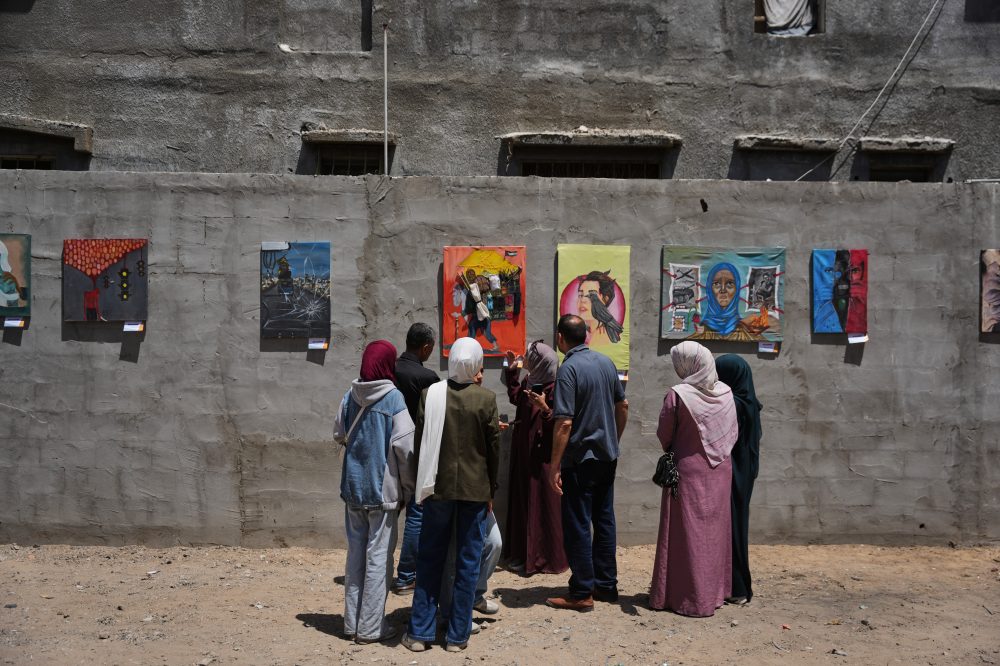

BUREIJ, Gaza Strip — A group of young Palestinian artists organized an outdoor art exhibition Tuesday in Gaza, using their artwork as another medium to communicate their wartime experiences to the global community during the current fragile ceasefire.
The collection of artwork was set up in the open air, much like daily life throughout Gaza, exposed to weather conditions and onlookers’ attention. The paintings depicted images including a dove, bullet damage, and human figures in a region where the conflict between Israel and Hamas has claimed more than 70,000 lives.
Under clear skies in central Gaza’s Bureij area, children could be heard playing and shouting while visitors photographed the artwork and contemplated its meaning.
Ghanem Al-Din, who coordinated the exhibition featuring numerous paintings, explained: “They painted their feelings, their ambitions, their hopes, their visions, over four months during a continuous workshop in my studio.”
Among the participating artists was 21-year-old Obay Al-Qarshali, who evacuated his Gaza City residence in late 2023 when the conflict erupted following Hamas’s Oct. 7 assault on southern Israel. During his hasty departure, he could only take essential items, abandoning more than 30 of his artworks.
Those pieces have since been destroyed in the bombing and devastation, he explained.
The artwork he contributed to the exhibition depicted shattered glass, vehicles loaded with mattresses and personal possessions, and building rubble — scenes all too recognizable to him and countless other displaced Palestinians who have relocated multiple times.
Al-Qarshali reported moving at least seven times throughout the war.
“Because of how much we were displaced and suffered in moving and carrying our belongings, the tents, the crowds, and so much more, I wanted to express something that deeply troubled me: that we left our homes and our safe places, forced to flee, scatter, and change our location. This piece expresses so much,” he stated.
The timeline for Gaza’s next ceasefire phases remains uncertain. Dismantling Hamas represents a significant obstacle before the territory can transition to new governance, achieve stability, and begin serious reconstruction efforts.
According to a recent United Nations and European Union assessment, rebuilding efforts will likely exceed $70 billion and require a decade to complete.
The report indicated Gaza’s economy has shrunk by 84 percent. More than 371,000 residential units have been demolished. Over half of the territory’s hospitals are “non-functional.” Almost all educational facilities in the area housing more than 2 million residents are either destroyed or damaged.
Although major combat operations have decreased since the ceasefire began in October, Israeli military forces have maintained almost daily attacks and gunfire near military-controlled zones, resulting in over 800 Palestinian deaths, according to Gaza’s Health Ministry. The ministry, operating under Hamas leadership, keeps comprehensive casualty documentation that U.N. agencies and independent analysts generally consider credible. However, it doesn’t distinguish between civilian and militant casualties.
Tuesday saw an Israeli airstrike target a vehicle in Gaza City, killing four men, Shifa Hospital reported.
The attack occurred outside the designated Yellow Line that divides Israeli-controlled territory from other Gaza areas. Israel’s military confirmed striking a “terrorist” at that location but provided no additional information.
The victims were shrouded in white cloth and laid on the ground outdoors, allowing mourners to gather.