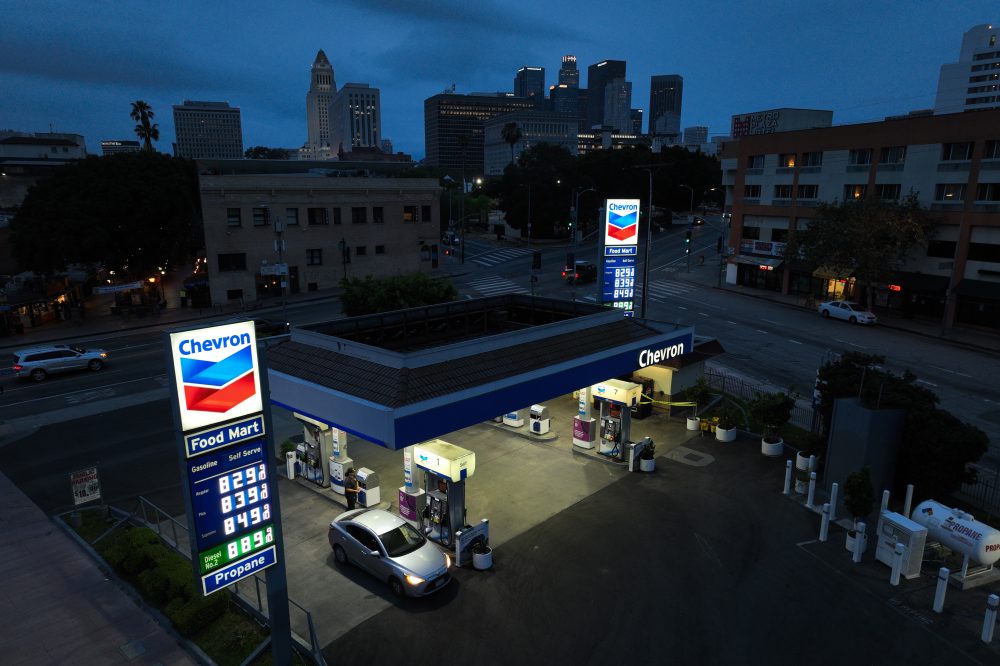

DES MOINES, Iowa (AP) — American motorists are experiencing wild daily fluctuations in gasoline costs, leaving drivers frustrated and financially strained as fuel expenses reach their highest levels since 2022.
International conflicts involving Iran have driven up petroleum costs globally, pushing the national average price for gasoline beyond $4 per gallon this Tuesday, AAA data shows.
Fuel costs can shift overnight or vary significantly between neighboring stations, compelling American drivers to strategize when to refuel or search extensively for better deals.
Industry analysts explain that individual gas retailers typically don’t control these price variations, and most station owners aren’t profiting from the additional costs when prices climb. The volatility drivers see reflects a massive, unpredictable petroleum market that makes it challenging for stations to maintain consistent pricing.
Lonnie McQuirter, who oversees operations at 36 Lyn Refuel Station in south Minneapolis, reports his profit margins have become significantly narrower. Located approximately one mile from Interstate 35, his neighborhood store displayed $3.399 per gallon for regular gasoline Wednesday, roughly 18 cents below the metropolitan area’s average according to AAA.
“We price based on what we’re able to buy fuel at, and how well we can operate,” McQuirter explained. He avoided commenting on competitors’ strategies, noting, “They’ve got different economics.”
McQuirter attributes his higher charges compared to last month primarily to wholesale fuel costs, which fluctuate several times daily. He’s simultaneously dealing with increased credit card processing fees and rising pump maintenance expenses.
During challenging periods like this, when consumers are “screaming for help,” McQuirter said independent operators like himself respond more from compassion than profit motives.
“We’re in our stores every day looking our customers in the eye,” he stated. “It really takes a toll when people are having to cut back on certain things in order to afford to live.”
Much of the pricing remains beyond gas retailers’ influence. Approximately half of pump prices cover crude oil costs, gasoline’s primary component, according to the U.S. Energy Information Administration. About 20% compensates refineries that convert crude into gasoline.
These expenses have increased as crude oil values surged responding to warfare and transportation disruptions in the Strait of Hormuz. Gas retailers adjust pump pricing to reflect higher costs they’ve just paid for incoming gasoline shipments.
Government levies — federal, state and municipal — comprise nearly 20% of pricing, while roughly 10% remains for retailers, who must still cover transportation, labor and additional operating costs.
Retailers’ markup has averaged approximately 38 cents per gallon during the past five years, according to convenience store industry group NACS, citing OPIS research data. Following expenses, stations might retain around 15 cents per gallon, explained Jeff Lenard, a NACS vice president.
“Some make more, some make less,” Lenard observed.
Patrick De Haan, petroleum analysis director at GasBuddy, drew comparisons to homeowners determining sale prices.
“If I was selling a house today, I’d be beholden to whatever the housing market is,” De Haan noted. “That’s the same for gas station owners. Whatever the price of oil and gasoline are, they are a price taker, not maker.”
Though the national average recently exceeded $4 per gallon, costs vary dramatically across states, cities and individual stations.
Tax differences alone create substantial gaps. California’s gasoline taxes and fees totaled approximately 71 cents per gallon last year, while Alaska charged roughly 9 cents.
Refinery proximity, retailer type, location volume and nearby fuel alternatives also influence pricing.
Stations near competitors might price gasoline competitively on prominent outdoor displays to draw drivers, hoping they’ll enter and purchase higher-profit merchandise, said Neal Walters, an energy-focused partner at global consulting firm Kearney.
“It’s one of the only retail locations where you don’t have to go into the store to find out what you’re paying,” Walters noted.
While American retailers distribute hundreds of millions of gasoline gallons daily nationwide, they typically don’t experience substantial profits when prices increase.
“The margins shrink when prices go up because it’s harder for them to pass along the increases as quickly as they themselves get them,” De Haan explained.
When petroleum costs begin declining, retailers might recoup some losses, especially during supply cost uncertainty. Prices can surge rapidly but tend to decrease gradually like a drifting feather, said Garrett Golding, assistant vice president for energy programs at the Federal Reserve Bank of Dallas.
Elevated gas prices can also damage sales inside stations, when customers squeezed at pumps reduce spending on other items.
“So it’s not always the case that higher prices mean the service station owners are actually doing better,” Golding explained.
Most petroleum industry profits occur upstream, he said, through companies extracting and refining crude oil. However, Golding notes they aren’t necessarily celebrating; eventually, significant price spikes could begin reducing demand.
“It may be a good stretch of days or weeks for them,” he said, “but they’re also cautious of what it could portend.”