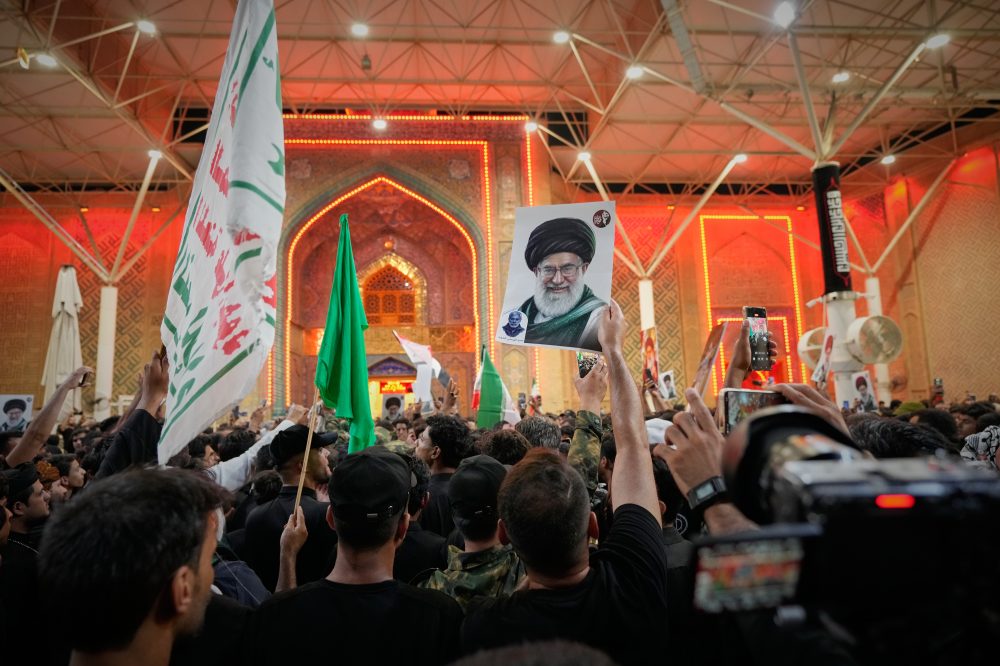

NAJAF, Iraq — Funeral processions for Iran’s late Supreme Leader Ayatollah Ali Khamenei got underway Wednesday in the Iraqi city of Najaf, drawing thousands of mourners into the streets.
The multi-day funeral began Saturday in Tehran, where Iranian authorities shut down roads, airspace, and much of daily life as crowds gathered to honor the man who ruled Iran for decades with a firm grip while repeatedly clashing with Western nations. Following ceremonies in Najaf, Khamenei’s body will be transported to the city of Karbala before making its final journey back to Iran.
Diplomatic talks between the United States and Iran appear to be paused until after the burial concludes. Meanwhile, military exchanges between both countries in the Persian Gulf on Tuesday and into Wednesday have raised concerns that a fragile interim agreement — meant to halt the monthslong regional war — could collapse. The U.S. military carried out strikes on Iran early Wednesday, saying Tehran had first targeted three vessels in the Strait of Hormuz. Iran then launched retaliatory strikes on Kuwait and Bahrain.
Khamenei’s remains arrived in Najaf — one of the most sacred cities for Shiite Muslims worldwide — on Tuesday. Iranian President Masoud Pezeshkian, Foreign Minister Abbas Araghchi, and other top officials accompanied the body. Crowds lined the streets holding portraits of the late leader, while some mourners performed acts of self-flagellation as a sign of grief.
The casket carrying Khamenei was draped in Iran’s national flag and enclosed in glass. Mourners in the streets waved Iranian flags alongside red and black banners representing mourning and a desire for revenge.
One attendee, Jaafar Jawad, expressed his feelings about the occasion. “We the people of Iraq will remain a thorn in the eyes of the enemies,” he said. “His arrival to us is the greatest possible honor, and God willing we will be loyal, and repay a little of his due in the holy city of Najaf.”
Funeral prayers in Najaf are scheduled to take place at the Shrine of Imam Ali, the cousin and son-in-law of the Prophet Muhammad. The ceremony will be led by Muhammad Taqi al-Hakim, a senior religious scholar at the Najaf seminary.
In Karbala — another city of deep significance to Shiite Muslims, where Imam Hussein, the Prophet’s grandson, was killed in 680 AD — prayers will be held at the Imam Hussein Shrine. Abdul Mahdi al-Karbalaei, a representative of Iraq’s top Shiite religious authority, will lead those services.
Khamenei was killed in late February during large-scale strikes carried out by the United States and Israel against Iran. He was one of several high-ranking Iranian leaders who died during the conflict. He was 86 years old.
Iran’s newly designated supreme leader, Ayatollah Mojtaba Khamenei, has not appeared at any of the funeral events so far. He is believed to be in hiding after reportedly sustaining injuries in the same airstrike that killed his father.