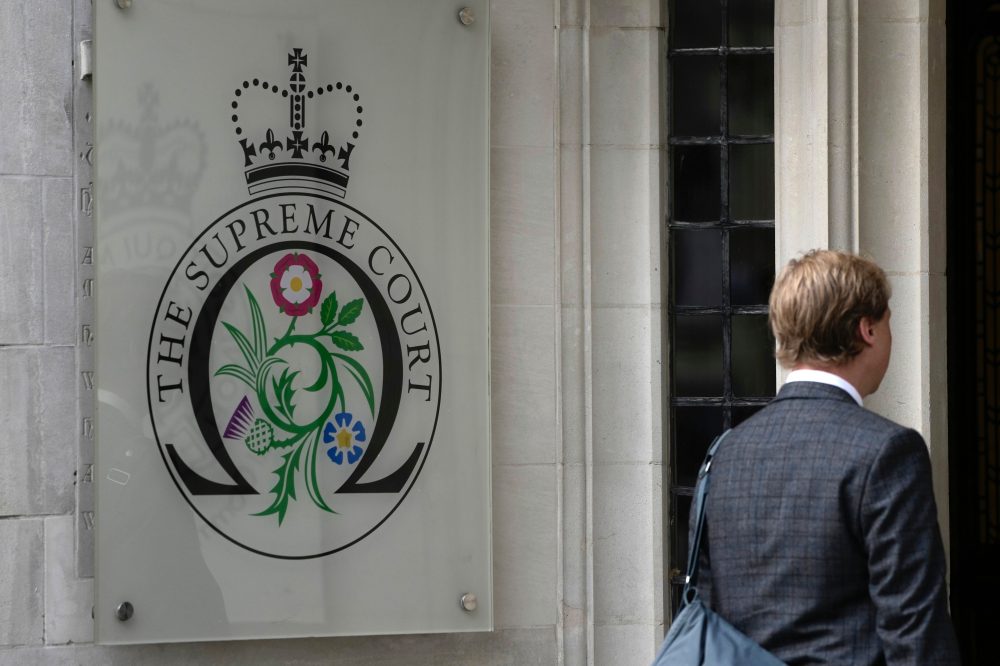

A legal fight that has stretched nearly a decade may be reaching its conclusion Wednesday, as a top English court prepares to hear the final appeal in a case challenging Trinidad and Tobago’s ban on gay sex.
Supreme Court judges in London are set to consider a significant human rights case that, if decided in favor of the challenger, could make same-sex relations legal in the eastern Caribbean nation — and potentially influence how other Caribbean countries handle similar laws.
The case was originally brought in February 2017 by Jason Jones, who contends that his country’s so-called “buggery” laws — holdovers from the colonial era that criminalize gay sex — are unconstitutional. Anyone convicted under those laws faces up to five years behind bars.
Standing against Jones is the government of Trinidad and Tobago, which has the support of the country’s Council of Evangelical Churches and its largest Hindu organization, Sanatan Dharma Maha Sabha.
The legal journey has passed through multiple courts over the years. Trinidad’s High Court ruled the laws unconstitutional back in April 2018, but a local appeals court partially overturned that decision in March 2025. That July, Trinidad’s Court of Appeals gave Jones the green light to bring the matter before England’s final appeals court.
The case is now in the hands of the Judicial Committee of the Privy Council, and LGBTQ advocates throughout the Caribbean are watching closely to see how it unfolds.
The region has seen a mixed record on the issue. The Bahamas decriminalized homosexuality in 1991, and the U.K. government struck down similar laws in 2001 across Anguilla, the British Virgin Islands, the Cayman Islands, Montserrat, and the Turks and Caicos Islands. More recently, courts in Barbados, Dominica, St. Lucia, and Antigua and Barbuda have also thrown out comparable laws. However, gay sex remains a criminal offense in Grenada, Jamaica, Trinidad and Tobago, and St. Vincent and the Grenadines.
Jones, now 61, has been openly gay since age 16 and left Trinidad and Tobago in 1996, citing what he described as homophobic violence and discrimination he experienced there.
LGBTQ organizations backing Jones noted in a recent court filing that his story reflects a broader reality, stating that he “is unable to fully express his sexuality without being branded a criminal.”
Jones himself has framed the issue as one of secular values, arguing that “Trinidad and Tobago is a secular society and a multi-racial one. Christian morality is neither universal nor superior.”
Attorneys and advocates point out that even though the buggery laws have not been actively enforced in recent times, their existence still carries real consequences. As one written argument recently submitted in Jones’s favor put it, “A law of this kind operates not only through arrest and conviction, but through the stigma, fear, concealment and exclusion.”
That same filing argued that criminalizing gay sex “compounds stigma at precisely the stage at which young people may be forming identity, seeking support, accessing education and healthcare, and deciding whether it is safe to disclose abuse, bullying or self-harm risks.”
The five-judge panel of the Judicial Committee of the Privy Council could announce a decision as soon as the Wednesday hearing concludes, though there is no set deadline for them to do so.