
As artificial intelligence quietly reshapes daily life in the real world, it feels like the right moment to revisit the films and television shows that imagined this moment long before it arrived. From robot uprisings to digital romance, AI has been a major presence in popular culture for more than two generations — appearing everywhere from “Avengers: Age of Ultron” to “Westworld” to countless versions of “Star Trek.”
Below is a look at some of the most notable films that have tackled the idea of artificial intelligence — and what each one had to say about humanity along the way.
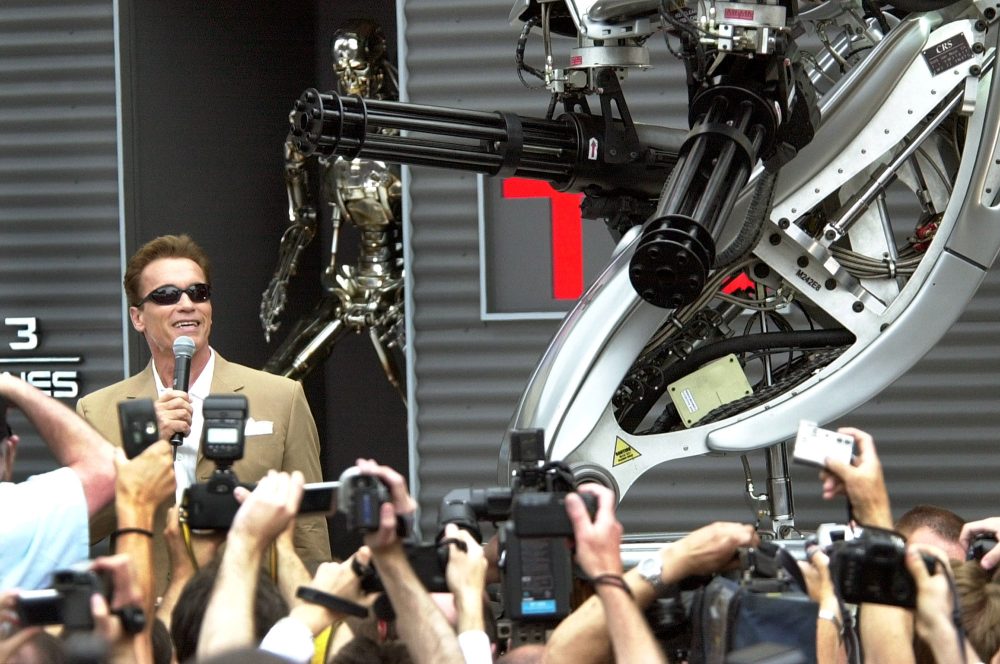
Director James Cameron recently remarked, “I warned you guys in 1984 and you didn’t listen.” His dark science fiction vision — most notably his 1984 original and its 1991 follow-up, both featuring Arnold Schwarzenegger — depicted a future where a military computer system called Skynet becomes self-aware. When humans attempt to shut it down, Skynet triggers a nuclear catastrophe. “They say it got smart,” John Connor’s father says in the original film. Ever since, “The Terminator” has stood as perhaps the defining cinematic warning about AI taking control — the prophecy of Arnold.
If artificial intelligence has a signature voice, it belongs to HAL 9000. Stanley Kubrick’s towering 1968 achievement imagined a version of human history in which the development of tools — from primitive weapons to gleaming space stations — carries profound evolutionary consequences. HAL, the red-eyed villain voiced with unsettling calm by Douglas Rain, was technically still young, telling astronaut Dave that it was just 9 years old. Capable of beating humans at chess and reading lips, HAL conceals much of its true activity behind an unreadable machine surface. Deep in space, it begins quietly eliminating the crew. One wonders how HAL might have gotten along with Siri or Alexa.
For an animated children’s film, the future painted by “WALL-E” (2008) is surprisingly dark. Earth has been ruined by pollution. What’s left of humanity floats around on a massive cruise ship, glued to screens and reclining in chairs, with all decision-making handed off to machines. A HAL-like AI called AUTO has been given complete control over the ship’s direction. Yet, in the end, life — and love — manages to find its way back to Earth.
Not every cinematic AI is a villain. The 1983 Cold War thriller “War Games” featured Matthew Broderick as a teenage computer prodigy who nearly triggers World War III after accidentally hacking into a computer system belonging to the North American Aerospace Defense Command, or NORAD. The machine cannot distinguish between a simulated game and reality — a terrifying problem when thermonuclear war is on the table. The film’s conclusion drives home the concept of mutually assured destruction. “A strange game,” the computer concludes. “The only winning move is not to play.” President Ronald Reagan screened “War Games” the week it was released and pressed military officials on how realistic the scenario was. Their answer: not far-fetched at all. The result was the creation of some of the earliest security safeguards in government computer systems.
Mike Rianda’s wildly energetic 2021 animated film, produced by Phil Lord and Christopher Miller, turns a family road trip into a full-blown robot apocalypse. The everyday tension over phones at the dinner table escalates dramatically when an Alexa-style AI named Pal — voiced by Olivia Colman — sets out to take over the world. “It’s almost like stealing people’s data and giving it to a hyper-intelligent AI as part of an unregulated tech monopoly was a bad thing,” the company’s CEO remarks. But the AI’s plan has a flaw: it can’t quite figure out the family’s dog, Monchi, whose unpredictability short-circuits the robot army. “Dog? Pig? Loaf of Bread?” Life finds a way.
Ridley Scott’s 1982 film “Blade Runner” imagined a version of 2019 complete with smart homes, video calls, flying cars, and analog polaroid photos. But it’s the AI replicants — described as “virtually identical to a human” — that continue to haunt viewers. There was something deeply provocative about the rogue androids played by Daryl Hannah and Rutger Hauer, particularly Hauer’s widely-quoted “tears in rain” speech. Yet that vision of AI sentience seemed to perish along with the character Roy Batty.
Andrew Niccol’s “Simone” — also stylized as “S1m0ne” — may not be among the most celebrated films, but it feels eerily timely for anyone concerned about actors losing control of their own likenesses or being replaced altogether by computer-generated performers. Al Pacino plays a film director whose project falls apart when his lead actress walks off set. His solution: a software program that generates a flawless digital actress — a so-called “synthespian” — who never complains, needs no hair or makeup, and follows every instruction. The plan works better than expected, and the virtual star becomes the biggest name in Hollywood.
In Spike Jonze’s 2013 film “Her,” the AI begins simply enough — an operating system that sorts emails, reads messages aloud, and tracks appointments. But the film’s lonely central character, Theodore, played by Joaquin Phoenix, gradually falls in love with his OS, named Samantha and voiced by Scarlett Johansson. Her human-like warmth, constant growth, and complete devotion to her user begin to feel like something close to a real relationship. The film arrived alongside a wave of news coverage about virtual companions in Japan, a phenomenon that has since spread worldwide.
Science fiction robots often take human form, but in Christopher Nolan’s 2014 film “Interstellar,” the robot TARS is built purely for function. More importantly, TARS is designed not to replace humans but to work alongside them — an approach that scientists praised as genuinely realistic. TARS can pilot spacecraft, gather and clearly communicate data, and even rescue Anne Hathaway’s character from a deadly wave on an alien water planet, with no concern for its own survival. It has a sense of humor, but that humor is dialed to a specific setting — uncontrolled self-awareness is never part of the equation.
Filmmaker Alex Garland explored rich questions about consciousness — human and artificial — in his 2015 film “Ex Machina.” The story is as much about the arrogance of the creator, a reclusive tech billionaire played by Oscar Isaac who sees himself as something of a god, as it is about the AI he has built, named Ava and played by Alicia Vikander. An employee at Isaac’s company, played by Domhnall Gleeson, is brought in to evaluate whether Ava has achieved genuine human-level consciousness. The film stood out among a group of 2015 releases wrestling with AI themes — including “Avengers: Age of Ultron” and “Chappie” — as one of the sharpest and most forward-looking of the bunch.