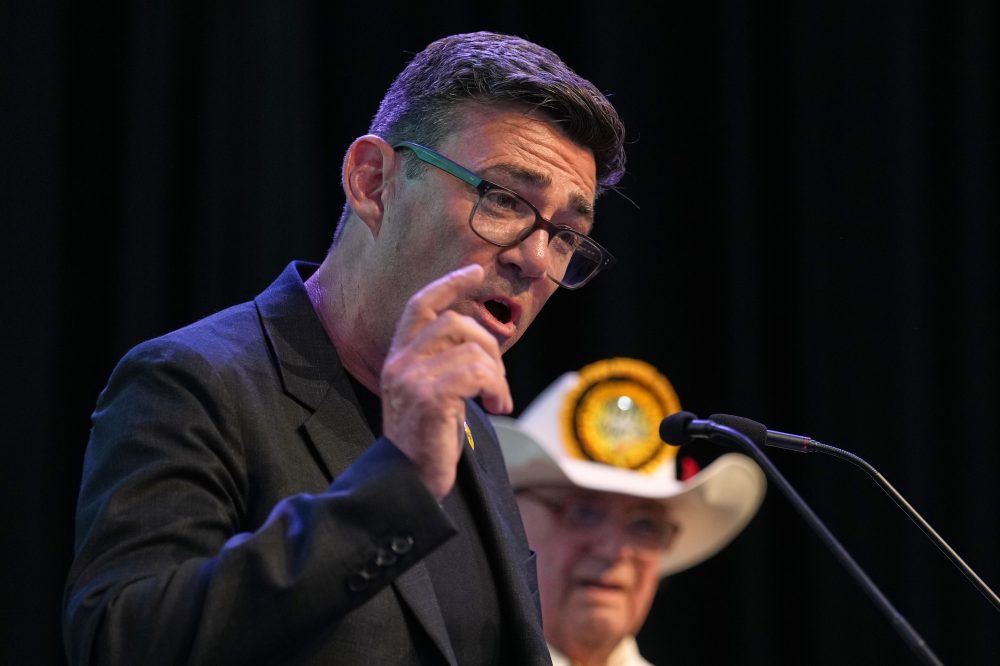

LONDON (AP) — Andy Burnham has spent his career navigating the corridors of British political power, and now he has his sights set on the very top — the prime minister’s office at 10 Downing Street.
The 56-year-old presents himself as a down-to-earth northerner who favors T-shirts over suits, enjoys a game of soccer in his free time, and has been known to take the decks at DJ competitions spinning tracks from the 1990s. But beneath that casual image lies a seasoned political operator with decades of experience at the highest levels of British government.
Burnham is widely expected to mount a challenge against Prime Minister Keir Starmer following his victory in a special parliamentary election — a result he described as a “turning point” for politics in the United Kingdom.
He grew up in a part of northwest England situated between Liverpool and Manchester, the son of a British Telecom engineer and a receptionist. He joined the Labour Party during his teenage years, went on to study at Cambridge University, and first entered Parliament in 2001.
Over the next fifteen years as a lawmaker, he climbed the political ladder under Prime Minister Tony Blair and later served in Prime Minister Gordon Brown’s Cabinet from 2007 to 2010.
He made two unsuccessful bids for the Labour Party leadership — in 2010 and again in 2015 — before stepping away from Westminster entirely to pursue the mayoralty of Manchester.
It was in that role that he earned the nickname “King of the North,” a reference inspired by the television series “Game of Thrones” that reflects both his fierce advocacy for his home region and his openly ambitious political outlook.
The title gained traction during the COVID-19 pandemic, when Burnham publicly clashed with Conservative Prime Minister Boris Johnson over what he characterized as a “London-centric” response to the health crisis.
Since taking charge of Greater Manchester in 2017, Burnham has overseen a dramatic transformation of the region — a city historically tied to the Industrial Revolution. The city center has experienced a building boom, with skyscrapers rising on former industrial land. He also unified a fragmented public transit system under public ownership, rebranding it as the Bee Network and expanding its services.
Within the Labour Party, he is seen as sitting to the left of Starmer, which plays well with party members. He is also regarded as one of the party’s most effective communicators — a stark contrast to the more rigid public speaking style he displayed during his earlier leadership campaigns. Today he comes across as relaxed and approachable.
Three successive mayoral election wins, combined with his strong showing in the Makerfield by-election — where he soundly defeated the candidate from the anti-immigration party Reform UK — have reinforced his reputation as someone who can win. Many within Labour are hoping he can help reverse the sharp drop in the party’s popularity that has occurred in the two years since Starmer led them to a landslide general election victory.
Burnham is now promising to take what he calls “Manchesterism” to a national level — a governing philosophy centered on investing in communities that have long been overlooked by decision-makers in London, and prioritizing people and place over party politics.
“What we’ve built in Greater Manchester needs to go national,” he said during the campaign. “I know what it is to turn places around.”
Not everyone is convinced. Critics argue that his policy platform lacks specifics and sidesteps difficult questions — particularly around how his proposals would be funded. They also point out that governing an entire nation of 70 million people is a fundamentally different challenge from leading a city region of 3 million.
Even so, Burnham enters this next chapter with considerable momentum behind him as he positions himself for a potential run at Britain’s highest office.