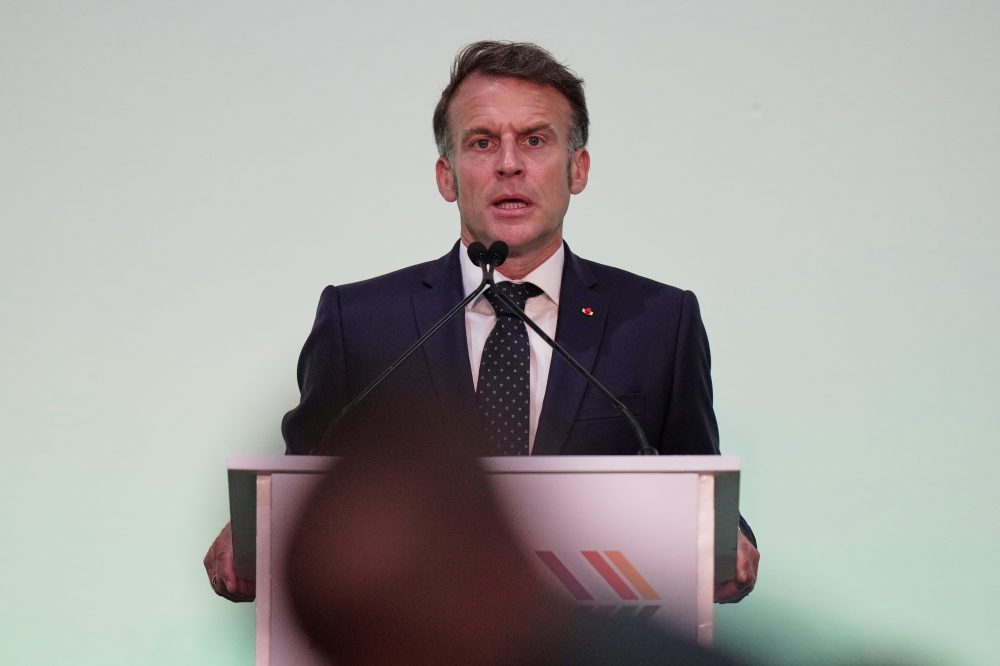

French President Emmanuel Macron is under fire following a controversial moment at the Africa Forward Summit in Kenya where he took over the stage to silence what he deemed disruptive audience members.
The French leader left his seat and approached the stage during a presentation featuring artists and young entrepreneurs, taking the microphone to address what he characterized as a “total lack of respect” from attendees who were talking during the session. Speaking in English, Macron told the crowd he would “restore order” after becoming visibly agitated by the noise level in the room.
The Monday incident quickly gained traction on social media platforms, generating mixed reactions ranging from support to sharp criticism and ridicule.
The summit represents France’s attempt to redefine its relationship with African nations, moving away from its historical role as a dominant colonial force toward what French officials characterize as an equal partnership. During Tuesday’s proceedings, Macron unveiled a $27 billion investment package targeting multiple African sectors including energy, artificial intelligence, and agriculture.
While some attendees supported Macron’s intervention, others viewed it as inappropriate and reminiscent of colonial-era attitudes.
“Just imagine what would happen if an African leader did the same thing in America or Europe,” commented Thierno Mbaye, a history student at a Dakar university. “He acted like a schoolteacher scolding children,” Mbaye explained to The Associated Press.
The criticism extended to France itself, where lawmakers questioned Macron’s approach.
“It’s stronger than him: as soon as he sets foot on the African continent, he can’t help but behave like a colonizer,” wrote Danièle Obono, a representative from the hard-left France Unbowed party, in a social media post.
The 30-nation summit, scheduled to conclude Tuesday with a signed declaration from all participating heads of state, occurs during a period of strained relations between France and several of its former West African colonies.
For decades, France maintained what critics called “Françafrique” – a system of economic, political, and military influence that included deploying thousands of troops throughout regions under its former control.
Following sustained criticism from African leaders and opposition groups who described France’s approach as condescending and heavy-handed, the country has pulled most of its military presence from the region. The troop withdrawal from Senegal was completed in July.
Macron had already generated controversy before the summit began when he declared during a Sunday press conference with Kenyan President William Ruto that “we are the true Pan-Africanists.”
“We believe that Africa is a continent, and that this continent has an enormous amount to build,” Macron stated.
The Pan-Africanist movement historically focuses on African unity and the elimination of colonial influence, making Macron’s claim particularly provocative given France’s extensive colonial history across the continent.
“Pan Africanism is not a brand, Mr. Macron, neither is it a diplomatic posture,” Togolese human rights activist Farida Nabourema wrote in a Monday open letter. “It is a political philosophy that said no to everything France spent three centuries saying yes to: slavery, colonialism and neocolonialism.”
Beverly Ochieng, a senior analyst with geopolitical risk consultancy Control Risks, suggested Macron is attempting to recover from France’s diplomatic and military failures in West Africa by focusing on eastern African nations where France maintains better relationships.
Ochieng noted that Macron’s statements raise questions about whether France’s renewed African engagement represents genuine equal partnership or simply strategic rhetoric.
French government officials from both the presidency and Foreign Ministry did not respond to requests for comment.
On Tuesday, Macron emphasized that Paris would respect African nations’ independence, stating that “sovereignty and autonomy is shared, and your success is our success.”
Alioune Tine, who founded the Afrikajom Center think tank, interpreted Macron’s Pan-Africanist claim as potentially targeting Russia, which has emerged as France’s replacement as a security partner in several West African countries.
“When Macron describes himself as the ‘true’ pan-Africanist, it is also a subtle response to the pro-Russian pan-Africanist voices online, which French officials tend to view as inauthentic or politically manipulated,” Tine explained.
Tine acknowledged that Western powers, including France, typically maintain paternalistic relationships with African states, but credited Macron with attempting to move away from colonial practices through a more informal diplomatic approach designed to rebuild trust.
An Ipsos poll commissioned by the French Foreign Ministry and conducted in nine African countries prior to the summit found that 74% of respondents maintain a positive view of France. The highest approval ratings came from English-speaking nations and respondents under 35 years old.
Macron, who became the first French president born after the colonial period, promised following his 2017 election victory to fundamentally restructure France’s relationship with African nations.