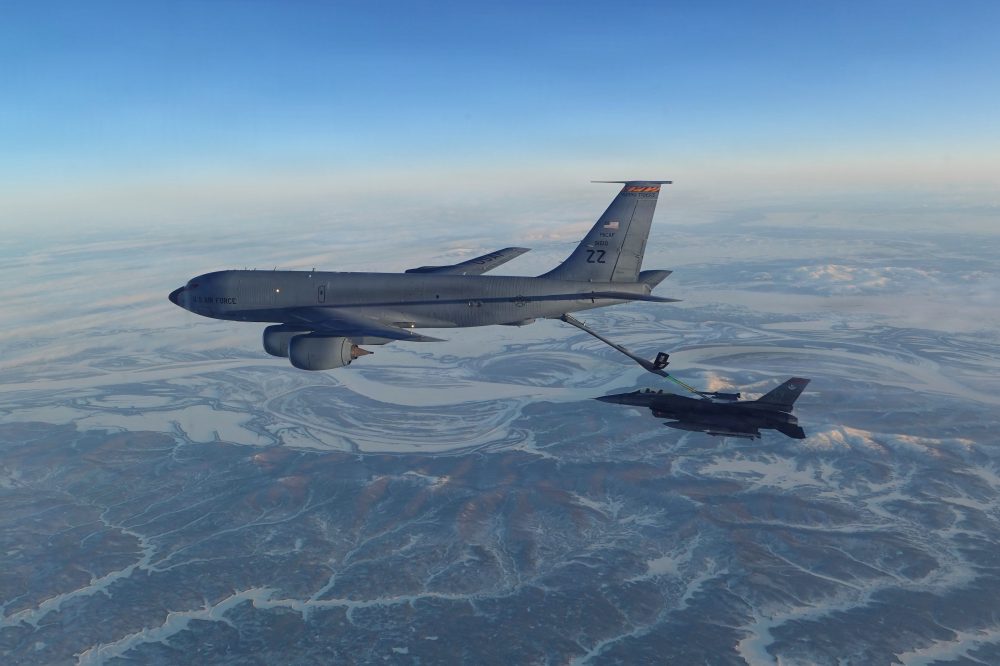

Four American service members lost their lives when their KC-135 refueling plane went down in western Iraq while conducting operations against Iran, military officials announced.
U.S. Central Command, responsible for Middle East operations, reported that six crew members were aboard the aircraft when it crashed following an undisclosed incident involving two planes in “friendly airspace.” The second aircraft involved made a safe landing.
This marks the fourth confirmed U.S. military aircraft loss during the ongoing conflict with Iran.
The KC-135 Stratotanker serves as the Air Force’s primary aerial refueling platform, enabling other aircraft to extend their range and operational time without returning to base. Military specialists note these planes also handle medical evacuations and surveillance duties.
Built on the same framework as the Boeing 707 commercial airliner, these tankers have served for over six decades, supporting Air Force, Navy, and Marine Corps operations alongside allied forces, according to Air Force documentation. The military plans to eventually replace these aging aircraft with the newer KC-46A Pegasus tankers.
Concerns about the fleet’s dependability have grown due to their advanced age and ongoing mechanical issues.
“The last of these planes were produced in the 1960s,” said Yang Uk, a security expert at South Korea’s Asan Institute for Policy Studies. He added that the transition to the KC-46A has progressed more slowly than expected.
Congressional Research Service data shows the Air Force operated 376 KC-135s last year, with 151 in active service, 163 assigned to the Air National Guard, and 62 with Air Force Reserve units.
Standard KC-135 crews consist of three personnel: a pilot, co-pilot, and boom operator. Medical staff join the crew for evacuation missions.
Fuel transfer operations occur at the aircraft’s rear section, where the boom operator manages a retractable fuel line that connects to fighters, bombers, and other military aircraft. Many boom operators work in a prone position while monitoring operations through a window beneath the plane.
Certain KC-135 variants can also transfer fuel through wing-mounted pods. These aircraft feature cargo and passenger space above their fuel storage areas when needed.
Yang suggested that refueling aircraft could become increasingly vital if the Iran conflict continues, as American warplanes may require extended missions to target Iranian forces withdrawing further inland.
Central Command confirmed four crew members died in the crash while search and rescue operations continue for the remaining two. Officials stated the investigation is ongoing but ruled out “hostile or friendly fire” as the cause.
An unnamed U.S. official revealed the second aircraft was also a KC-135. Israeli Ambassador to the U.S. Yechiel Leiter confirmed on X that the other plane successfully landed in Israel.
Yang noted that enemy fire rarely targets refueling tankers since these operations typically occur away from front-line combat areas.
The incident follows last week’s accidental downing of three U.S. F-15E fighter jets by friendly Kuwaiti forces.
Previous KC-135 accidents include a fatal crash on May 3, 2013, when a KC-135R went down after takeoff near Chaldovar, Kyrgyzstan, during Afghanistan War support operations.
Air Force investigators determined the crew battled rudder problems in that incident. As they attempted to regain control, the tail section separated and the aircraft exploded in flight, killing all three aboard.
The most catastrophic midair collision involving these aircraft occurred in 1966 when a nuclear-armed B-52 bomber collided with a tanker near Palomares, Spain.
That accident destroyed the tanker and killed four crew members. The disaster required extensive cleanup efforts after conventional explosives in the hydrogen bombs detonated upon ground impact, spreading radioactive material.