
Four international leaders are participating in intensive public questioning sessions this week as they compete for the position of United Nations Secretary-General, seeking to lead the struggling global organization starting next year.
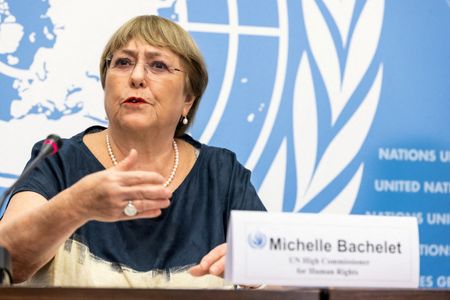
The candidates include Michelle Bachelet from Chile, Rafael Grossi from Argentina, Rebeca Grynspan from Costa Rica, and Macky Sall from Senegal. Each is pursuing a five-year leadership role for the 193-nation organization, with the possibility of extending for an additional five years.
Although these four represent the only announced candidates currently, additional contenders may enter the competition in upcoming months.
The future UN leader will inherit significant challenges in revitalizing an organization experiencing a crisis of relevance, as its influence has notably weakened in recent years. Global powers have demanded that the UN undergo reforms, reduce expenses, and demonstrate its importance, even while these same nations increasingly ignore established international standards.
Bachelet and Grossi will undergo three hours of intensive questioning at UN headquarters in New York on Tuesday from member nation representatives and civil society groups, with Grynspan and Sall facing similar sessions on Wednesday.
The current candidate pool is significantly smaller compared to 2016, when current Secretary-General Antonio Guterres from Portugal was selected from among 13 candidates, including seven women.
Throughout the UN’s 80-year existence, no woman has ever been selected for the top position, despite increasing pressure to break this pattern. Tradition typically calls for the role to alternate between global regions, with Latin America expected to provide the next leader.
An additional informal guideline prevents candidates from the five permanent Security Council members — Britain, China, France, Russia and the United States — from holding the position to prevent excessive power concentration, though support from these nations remains essential in the complex selection procedure.
Daniel Forti from the International Crisis Group recently emphasized the urgency of the situation, stating: “The need for a Secretary-General prepared to defend a clear, proactive vision for the U.N. on peacemaking and crisis management could not be more urgent.”
He added: “If candidates and member states miss this opportunity, there may be little left of the U.N. to defend.”
Bachelet, age 74, previously served as Chile’s president twice and held the position of UN High Commissioner for Human Rights. Her own nation withdrew support for her candidacy in March following a conservative political shift, though Brazil and Mexico continue backing her bid.
Conservative critics in the United States have questioned Bachelet’s pro-choice positions, and Washington’s UN representative recently appeared to undermine her candidacy by expressing concerns about her qualifications.
Grossi, a 65-year-old professional diplomat and father of eight children who communicates in English, Spanish, French and Italian, has led the UN nuclear monitoring agency for six years. In his campaign statement, Grossi stated: “even in times of division, multilateral institutions can deliver real, positive impact.”
Grynspan, 70, formerly served as Costa Rica’s vice president and currently leads the UN Conference on Trade and Development. She presents herself as a reform-focused multilateralist committed to UN principles of peace, development and human rights, having overcome gender obstacles throughout her career.
“I am not waiting for special treatment. I want equal treatment,” Grynspan explained to Reuters.
Sall, 64, governed Senegal for 12 years until 2024 and works as a geologist, having grown up as the son of a peanut vendor. More comfortable speaking French than English, he has advocated for African development and assistance for nations struggling with debt burdens. “More than ever, a reinvented multilateralism remains the best way to respond to the challenges of a world in full transformation,” he posted on X.