
OxyContin manufacturer Purdue Pharma faces a federal court sentencing Tuesday where a judge will likely order the company to surrender $225 million to the Justice Department, enabling a comprehensive resolution of thousands of opioid-related lawsuits.
The financial penalty stems from a 2020 agreement that resolved federal civil and criminal investigations. Once approved by the court, additional penalties will be waived in exchange for Purdue’s participation in the broader lawsuit settlement.
Following extensive legal proceedings, the settlement received judicial approval last year and is scheduled to become effective May 1. The agreement mandates that Sackler family members who control the pharmaceutical company contribute as much as $7 billion over time to state, local and tribal governments, along with individual victims and other parties.
In November 2020, Purdue entered guilty pleas to three federal criminal counts.
The Connecticut-based pharmaceutical company acknowledged failing to maintain adequate safeguards preventing its potent prescription pain medications from reaching illegal markets, despite assuring the Drug Enforcement Administration otherwise.
The company also confessed to compensating physicians through speaker programs to promote prescriptions and paying an electronic health records firm to provide doctors with patient data designed to increase opioid prescribing.
Although Purdue manufactured only a small percentage of opioid pills that saturated markets during the 2000s, critics have consistently pointed to OxyContin’s aggressive marketing as a catalyst for the crisis. During a 1996 sales meeting, Richard Sackler, who served as a senior executive and later company president, urged staff to create a “blizzard of prescriptions.”
Despite Purdue’s anticipated $225 million payment, federal authorities agreed through the plea arrangement to forgo collecting $5.3 billion in criminal penalties and fines plus $2.8 billion in civil damages. Instead, portions of those amounts are incorporated into the comprehensive settlement, with the federal government receiving a minimal share.
The extensive settlement requires Sackler family ownership to provide up to $7 billion across 15 years. The majority of funds will support government efforts to combat the opioid epidemic.
This represents one of the largest among numerous recent settlements involving pharmaceutical manufacturers, distributors and pharmacies, and stands as the sole major agreement providing compensation for individual victims or their families.
Combined, these settlements exceed $50 billion in value, with most resources designated for addressing the overdose crisis.
The Purdue agreement provides lawsuit protection for Sackler family members regarding opioid claims from parties accepting the settlement terms.
Purdue will dissolve and be succeeded by Knoa Pharma, a new entity operating for public benefit with state-appointed board oversight.
This corporate restructuring ranks among the most complex ever undertaken. By late last year, Purdue had compensated legal firms and other professionals representing all parties more than $1 billion, according to court documents.
Sackler family members have faced widespread criticism as primary figures in the opioid crisis, accused of prioritizing profits despite mounting evidence of OxyContin addiction and overdoses.
However, no family members faced criminal charges.
Between 2008 and 2018, family members collected $10.7 billion from Purdue. Company payments to the family ceased in 2018, and the final family member departed the board in 2019.
The settlement allows for removal of their names from museums and institutions they have supported, a process already underway at various organizations.
More than 54,000 individuals with personal injury claims supported the settlement, while 218 opposed it.
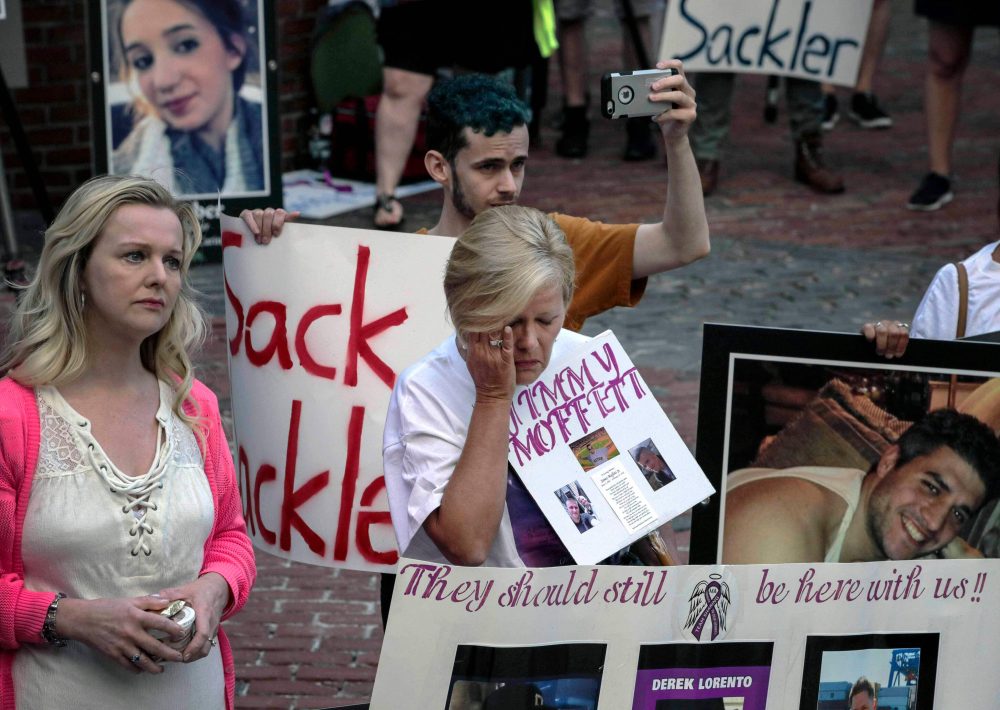
Nevertheless, some victims and relatives continue challenging the agreement, arguing both the settlement and guilty plea fail to deliver adequate justice for a crisis connected to 900,000 American deaths since 1999.
Tuesday’s sentencing provides another opportunity for critics to present their concerns to the court.
Susan Ousterman lost her son Tyler Cordiero at age 24 in 2020 following a fatal overdose involving fentanyl after years struggling with heroin and other opioids. She coordinated other bereaved families to submit victim impact statements before sentencing.
Her goal was convincing the judge to reject the plea agreement and encouraging the Justice Department to pursue individual criminal charges, including against Sackler family members.
“It shouldn’t be going to states and municipalities,” Ousterman stated, highlighting that some governments haven’t utilized received funds while others have spent money on initiatives barely connected to fighting the drug crisis. “They’re not using that money effectively.”