
CAPE CANAVERAL, Fla. — For the first time in over five decades, humans are preparing to journey to the moon again.
NASA’s Artemis II mission represents a modern echo of the Apollo era, planning to launch four crew members on a lunar voyage that will take them thousands of miles past the moon before returning home. The astronauts will travel beyond the moon’s far side, make a sweeping turn, and head directly back to Earth. This won’t include lunar orbit or surface exploration — instead, it’s designed as a rapid round trip taking under 10 days.
While NASA has promised future missions will leave new footprints on the moon’s surface, several preparatory flights must happen first. The scheduled test mission featuring astronauts Reid Wiseman, Victor Glover, Christina Koch and Jeremy Hansen marks the initial phase of NASA’s plan to establish a permanent lunar presence.
This historic flight will achieve several firsts for lunar travel: the first woman, first Black astronaut, and first international crew member to venture to the moon.
Koch currently holds the record for the longest single space mission completed by a woman. Her 328-day stay at the International Space Station from 2019 to 2020 included participation in the first spacewalk conducted entirely by women.
Glover, who served as a Navy test pilot, became the first Black astronaut to serve a long-duration mission aboard the space station during 2020 and 2021. He also flew on one of SpaceX’s early crewed missions.
Hansen, representing the Canadian Space Agency, brings fighter pilot experience but will be making his first space journey. Leading the crew is Wiseman, a former Navy captain who completed a space station mission in 2014 and later directed NASA’s astronaut program. The crew members are all between 47 and 50 years old.
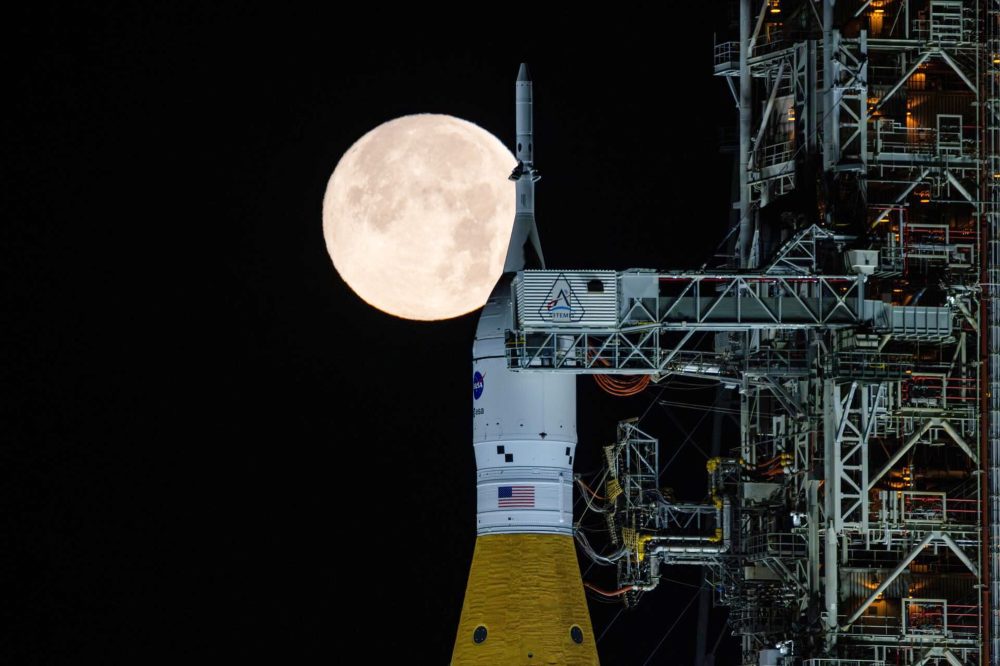
The mission will use NASA’s new Space Launch System rocket, measuring 322 feet tall. Though shorter than the Apollo program’s Saturn V, it generates more thrust at launch due to its attached solid rocket boosters. The crew will ride in the Orion spacecraft mounted on top.
Built using repurposed space shuttle engines and components, the SLS burns liquid hydrogen fuel like the shuttle program did. Hydrogen fuel leaks caused delays for both the shuttle program and the first unmanned SLS test in 2022. More than three years later, Artemis II experienced similar hydrogen leaks during a February fueling test, causing the mission to miss its initial launch window. Additional helium system problems pushed the launch target to April.
Following launch, the crew will spend their first 25 hours in a high, elliptical Earth orbit. They’ll practice spacecraft maneuvering by using the discarded upper rocket stage as a target, piloting their Orion capsule around it to prepare for future lunar docking operations. Rather than using sophisticated sensors, they’ll rely on visual navigation, staying at least 33 feet away from the stage.
“Sometimes simple stuff is the best,” Wiseman said.
If everything proceeds smoothly, Orion’s main engine will propel the crew toward the moon, located approximately 244,000 miles from Earth. This trajectory, known as a free-return path and famously used by Apollo 13, uses gravitational forces from both the moon and Earth to minimize fuel requirements.
On the sixth day of flight, Orion will reach its most distant point from Earth, traveling 5,000 miles beyond the moon’s far side. This will break Apollo 13’s distance record, making the Artemis II crew the most remote human travelers in history. After passing behind the moon, the astronauts will begin their direct journey home, splashing down on the tenth day — exactly nine days, one hour and 46 minutes after launch.
The Artemis II crew expects to observe previously unseen areas of the moon’s far side, with the lunar surface appearing roughly the size of a basketball held at arm’s length during their closest approach in the approximately six-hour flyby. They’ve been studying detailed maps and satellite imagery of the lunar far side and expect to take extensive photographs. NASA geologist Kelsey Young will serve as their lunar advisor, monitoring the flyby from Mission Control in Houston.
“The moon is like such a unifying thing,” she said. “What we’re doing with this mission is going to bring that a little closer to everybody around the world.”
Along with professional photography equipment, the crew will bring the newest smartphones. NASA’s administrator Jared Isaacman included smartphones in the mission specifically for capturing “inspiring” images.
While NASA and commercial companies have concentrated on reaching the moon’s near side — the hemisphere that always faces Earth — only China has successfully landed spacecraft on the far side. This makes the astronauts’ observations of the lunar far side particularly important for NASA’s scientific goals.
Similar to the Apollo missions, Artemis will conclude with a Pacific Ocean splashdown.
Mission planners will closely monitor Orion’s heat shield as the capsule reenters Earth’s atmosphere. This component sustained the most damage during the 2022 unmanned test flight, with burned sections breaking away. While the heat shield design is being modified for future missions, Artemis II will use the original configuration.
NASA plans to reduce heat exposure during reentry by shortening the capsule’s atmospheric descent time. Navy recovery vessels will wait off San Diego’s coast as Orion descends by parachute into the ocean.