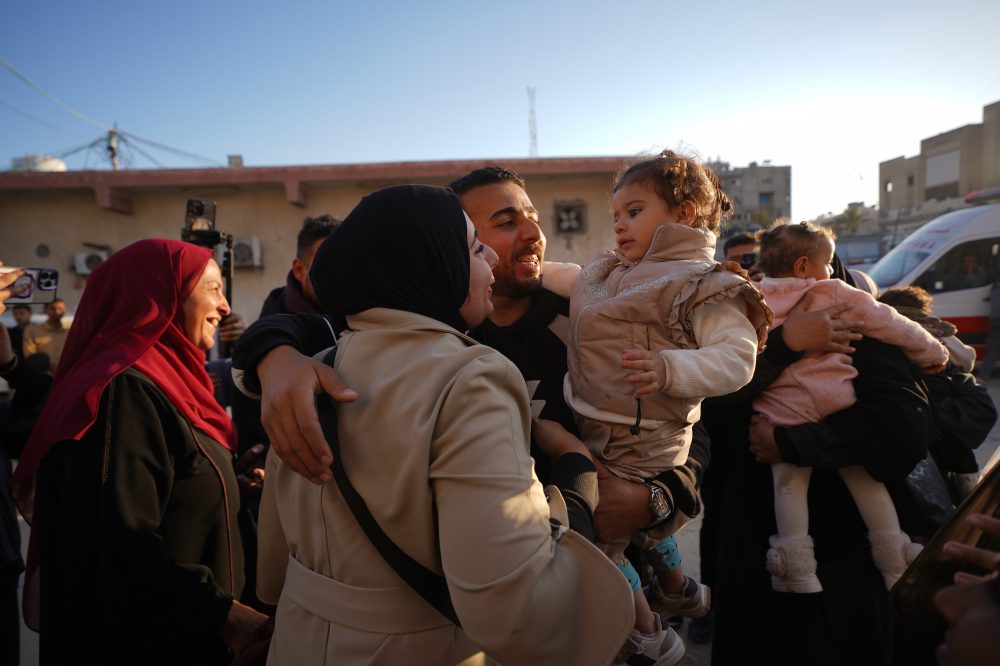

DEIR AL-BALAH, Gaza Strip — Samer Lulu’s face lit up with joy as he lifted his oldest daughter Kinda into his arms for the first time in over two years. The emotional reunion came Monday when eleven Palestinian toddlers returned to Gaza after being evacuated as critically ill newborns.
Kinda and other premature babies were rescued from Shifa Hospital’s neonatal intensive care unit in November 2023 when power failures shut down the life-sustaining incubators. The facility, Gaza’s largest medical center, lost electricity during the early stages of the Israel-Hamas war as Israeli forces surrounded and later entered the complex.
The fragile infants faced life-threatening conditions due to their premature births — they had delicate skin, dangerously low birth weights, and required continuous medical attention to survive. When the power went out, medical staff wrapped them in blankets and placed them together to share body heat after removing them from the non-functioning incubators.
Medical personnel were treating 50 premature infants during the conflict’s opening week, according to doctors who spoke with The Associated Press at that time. Of those, 31 babies survived the initial month and were transported to safety. On Monday, eleven of these children returned home, accompanied by some of the caregivers who had evacuated with them to Egypt.
Mohammad Zaqout, a hospital administrator, explained before the evacuation that electrical outages prevented Shifa from purifying water, creating a chain reaction of medical emergencies for the newborns, including digestive issues, blood infections, and dangerously low body temperatures. Medical staff reported that three infants died before the evacuation could take place.
Sundus Al-Kurd shared with The Associated Press that she initially feared her daughter had perished in the months following the emergency evacuation to Egypt. She was reunited with Bissan, now 2 and a half years old, during Monday’s homecoming.
While the children’s return brought rare happiness to Lulu and other families, concerns about what lies ahead overshadowed their celebrations. Describing Monday as the most significant day of his existence, Lulu acknowledged that anxiety about the future dampened his joy.
“Our feelings are mixed with pain because of the reality we live in,” he shared with The Associated Press outside Nasser Hospital in Khan Younis. “We hope that the future of our children will not be filled with the tragedy or suffering they faced at the beginning of their lives.”
These vulnerable infants became early representations of civilian casualties in Gaza following Israel’s military response launched October 8, 2023, one day after Hamas-led fighters carried out a devastating assault that killed over 1,200 people in Israel and resulted in 250 hostages being taken.
Israeli officials claimed that the attackers used medical facilities as military headquarters, accusations that both hospital administrators and Hamas rejected. During the war’s early phase, medical professionals and civilians seeking shelter in hospitals described continuous bombardment and rapidly worsening conditions.
The Red Crescent and World Health Organization coordinated the evacuation of Shifa’s neonatal intensive care unit in November 2023 as Israeli forces advanced into northern Gaza and surrounded the medical complex.
“Most cases in the neonatal unit depend on electricity, and most of them depend on artificial respiration. In the event of a power outage, a disaster will occur within five minutes, and all cases dependent on ventilators will inevitably die due to the power outage,” Naser Bulbul from Shifa’s neonatal unit explained at the time as medical staff worked frantically to keep the babies alive.
These children were part of a broader group of Palestinians returning to Gaza from Egypt through the partially reopened Rafah crossing, where they were transported to Nasser Hospital for family reunions. Parents held their sons and daughters close and comforted them as they cried while crowds gathered to witness the emotional scenes.
The border crossing resumed limited operations for Palestinian returnees in February, though passage has remained restricted, including a complete closure during the early weeks of tensions with Iran.
An Israeli government representative confirmed that the 11 toddlers and seven accompanying caregivers were allowed to return with assistance from UNICEF, the U.N. children’s organization. The official requested anonymity as they lacked authorization to speak publicly.
The whereabouts of most children from the original group of 31 evacuees from November 2023 remains unknown, though medical staff reported that four died after reaching Egypt in critical condition. Some parents told The Associated Press they still have no information about what happened to their newborns after the evacuation.
Two-year-old Ibrahim Bader was reunited with his father and grandmother, but not his mother, who died from illness in December 2023 after most Gaza hospitals had ceased operations or reduced services, according to his father Jabr Bader.
Ibrahim, Kinda, and the other children are coming back to a Gaza dramatically changed by more than two years of warfare. Israel’s military campaign has resulted in over 72,000 Palestinian deaths, according to local health officials, and forced most residents to flee their homes repeatedly. Communities lie in rubble, parts of the territory experienced severe food shortages last year, and attacks and gunfire have persisted beyond the October ceasefire agreement between Israel and Hamas.
Although several Gaza hospitals stopped functioning during the conflict, some have resumed limited operations, though power outages, fuel shortages, and supply problems continue to threaten services, requiring backup generators and endangering medical procedures. Gaza’s Health Ministry, which tracks victim ages, has documented thousands of children among the casualties. The ministry, operating under Hamas governance, keeps comprehensive casualty records that U.N. agencies and independent analysts consider generally credible.
Ahmed al-Farra, a physician in Nasser Hospital’s children’s department, described the family reunions as an emotional moment, “filled with many messages — sadness, and the joy of being reunited with their loved ones.”