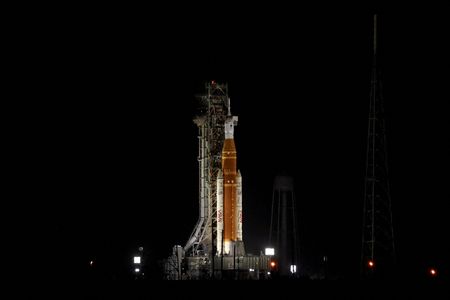

NASA officials have given the green light for a historic space mission that could launch as early as Wednesday evening, sending four astronauts on humanity’s first lunar voyage in more than 50 years.
The space agency’s mission directors approved Monday the launch of the Artemis II mission, which will carry its crew aboard a massive 322-foot Space Launch System rocket from Kennedy Space Center in Florida. Liftoff is scheduled for no earlier than 6:24 p.m. Eastern Time on Wednesday.
The launch pad sits adjacent to where Apollo astronauts began their final moon journey more than five decades ago, marking a symbolic return to lunar exploration for the United States.
Four crew members will make the journey: NASA astronauts Christina Koch, Victor Glover, and Reid Wiseman, along with Canadian astronaut Jeremy Hansen. The team arrived in Florida from Houston last Friday and completed a mandatory two-week isolation period before spending quality time with family members at Kennedy Space Center’s astronaut beach house over the weekend.
Launch director Charlie Blackwell-Thompson expressed confidence about the mission’s readiness during Monday’s briefing with reporters. “Certainly all indications are right now, we are in excellent, excellent shape as we get into count,” Blackwell-Thompson stated.
Meteorologists predict favorable conditions for Wednesday’s planned departure, with only a 20% probability of weather issues during the two-hour launch opportunity. Should conditions deteriorate and force a postponement, NASA has backup dates available through April 6, with the next launch window opening April 30.
The mission faced earlier delays, originally targeting February 6 and later March 6, before engineers discovered a troublesome hydrogen leak that required returning the rocket to its assembly facility for repairs.
This ambitious journey will take the astronauts approximately 252,000 miles from Earth during their winding 10-day path around the moon and back home. This distance surpasses the current human spaceflight record of roughly 248,000 miles, established by Apollo 13’s three-person crew in 1970 when an oxygen tank explosion forced mission controllers to abort their planned lunar landing.
No human beings have ventured beyond Earth’s orbit since the conclusion of the Apollo program in 1972.
NASA previously conducted the first Artemis mission in 2022, sending the dome-shaped Orion spacecraft on an unmanned test flight along a similar lunar route.
The upcoming Artemis II mission represents a more challenging evaluation of both the Orion capsule and the Space Launch System rocket. Crew members will evaluate essential life-support equipment, crew controls, and communication systems during their flight. Additionally, astronauts will assume manual control of Orion approximately three hours after launch to assess its handling and steering capabilities, providing crucial backup options if automated systems malfunction.
Lockheed Martin manufactures the Orion spacecraft, while Boeing and Northrop Grumman have overseen Space Launch System development since 2010. The program has drawn criticism for escalating expenses, with launch costs estimated between $2 billion and $4 billion per mission.
Meanwhile, Elon Musk’s SpaceX and Jeff Bezos’ Blue Origin are competing to create lunar landing vehicles that NASA will utilize for future astronaut moon landings.
This mission serves as a crucial early phase in NASA’s multi-billion-dollar Artemis initiative, which aims to establish a permanent human presence at the moon’s south pole. The agency is working aggressively to achieve its first crewed lunar landing through the Artemis IV mission by 2028, hoping to beat China’s projected timeline of around 2030.
Originally, Artemis III was designated as the program’s initial astronaut moon landing mission, but new NASA Administrator Jared Isaacman announced in February the addition of an extra test mission before attempting the landing.