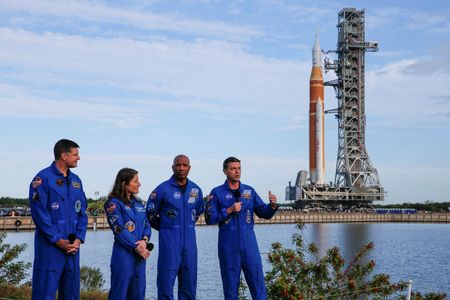

Four space explorers touched down in Florida on Friday, beginning their last phase of training before embarking on humanity’s first lunar voyage in more than half a century.
The crew includes three NASA astronauts – Reid Wiseman, Victor Glover, and Christina Koch – plus Canadian space agency astronaut Jeremy Hansen. They’re scheduled to blast off from Kennedy Space Center no earlier than April 1st, launching atop NASA’s massive Space Launch System rocket while secured inside the Orion spacecraft designed for deep space human travel. Their approximately 10-day journey will take them on a fast-paced orbit around the Moon before returning to Earth.
The Space Launch System’s main stage comes from Boeing, while Northrop Grumman manufactures the rocket’s solid fuel boosters and Lockheed Martin creates the Orion vehicle.
This marks the inaugural human flight for NASA’s expensive Artemis initiative. Though the crew won’t land on the lunar surface, they’ll venture further from our planet than any humans before them, putting Orion’s life support equipment, guidance systems, communication tools, and heat protection through rigorous testing.
Since their selection in 2023, the four-person team has dedicated over two years to mission training. They’ve been in mandatory pre-launch isolation at NASA’s Johnson Space Center in Houston starting March 18th and will now transfer to NASA’s Astronaut Crew Quarters in Florida before liftoff.
Glover, serving as the mission’s pilot, will make history as the first Black astronaut to journey toward the Moon. Koch will break barriers as the first woman to travel there, while Hansen becomes the first international astronaut to venture beyond Earth’s orbit toward lunar territory.
Three of the four crew members have prior space experience, with Hansen being the exception. Mission commander Wiseman shared with media last year that his team stands ready for any situation they might encounter.
“When we get off the planet, we might come right back home, we might spend three or four days around Earth, we might go to the Moon – that’s where we want to go,” Wiseman stated. “But it is a test mission, and we’re ready for every scenario.”
Wiseman, age 50, accumulated 165 days living on the International Space Station during a 2014 expedition launched via Russian Soyuz rocket. The former Navy test pilot previously held the position of NASA’s chief astronaut before his Artemis II commander appointment.
At 49, Glover completed 168 days in orbit starting in 2020 as pilot for NASA’s Crew-1 mission, marking the first regular ISS mission using SpaceX’s Crew Dragon vehicle. His NASA career followed extensive Navy service flying over 40 different aircraft types, including combat tours and test pilot assignments.
Koch, 47, established a milestone in 2019 for the longest uninterrupted space mission completed by a woman, remaining aboard the ISS for 328 days. With background training in electrical engineering and physics, she worked as a NASA engineer and conducted lengthy research expeditions in Antarctica.
Hansen, 50, will experience his first space journey, having joined the Canadian astronaut corps in 2009. His participation represents the enduring partnership between the United States and Canada in human space exploration, including Canada’s robotic technology contributions to the ISS.
NASA has outlined additional Artemis missions for coming years as the agency pursues permanent human lunar habitation and eventual crewed expeditions to Mars.