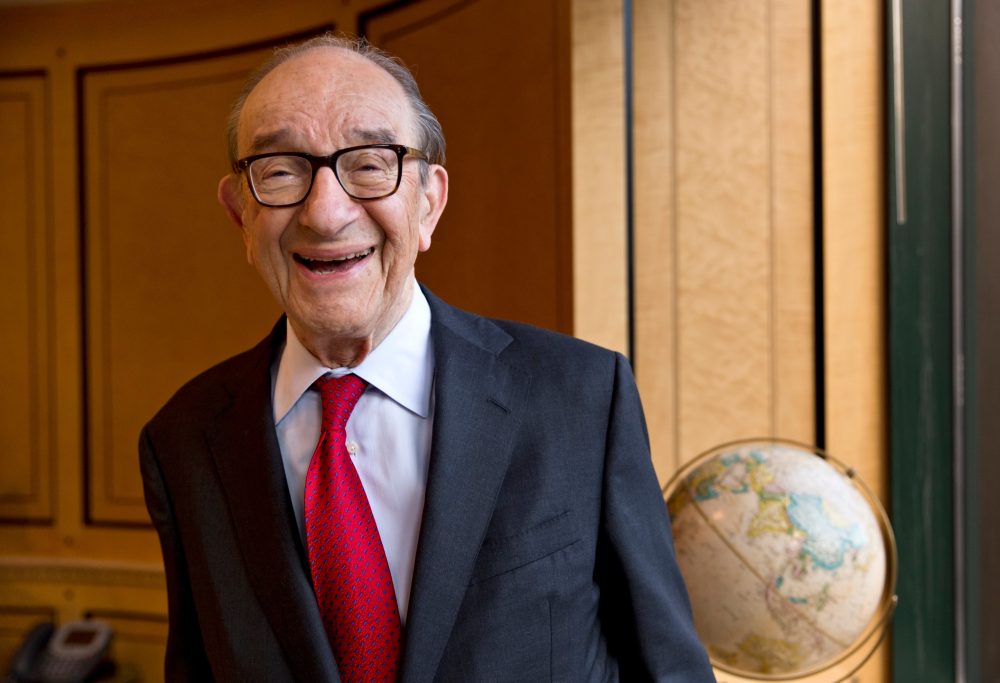

WASHINGTON (AP) — Alan Greenspan, the former chairman of the U.S. Federal Reserve, has passed away at the age of 100.
Greenspan died Monday after suffering complications from Parkinson’s Disease, according to his wife of 29 years, NBC News correspondent Andrea Mitchell.
Mitchell shared a heartfelt tribute to her late husband, saying: “To me he was my husband, who shaped my life from our very first date in 1984. He had ‘irrational exuberance’ for baseball, the Washington Commanders, tennis, golf, and music, especially jazz. He will be remembered for his brilliance and his kindness. Being his life partner was the joy of my life.”
During his roughly 18 and a half years leading the Fed, Greenspan oversaw a remarkable period of American economic growth and prosperity — though that era came to a catastrophic end in 2008, two years after he had already departed the central bank.
At the height of his influence, Greenspan was revered worldwide. By the time he stepped down in 2006, he had earned the nicknames “Oracle” and “Maestro” — titles that reflected the near-mythical status he held among investors, policymakers, and economists alike.
His reputation, however, took a severe hit when the U.S. housing market collapsed, triggering a global financial crisis that pushed the American banking system to the brink and plunged the country into its worst economic downturn since the 1930s. Many critics pointed to Greenspan’s loose monetary policies and his strong belief in minimally regulated financial markets as key factors that allowed the crisis to develop.
Greenspan himself eventually conceded his error. “I made a mistake,” he admitted, acknowledging that he had wrongly assumed the nation’s banks — whose health is foundational to the entire financial system — were capable of policing themselves.
Before the crisis tarnished his legacy, Greenspan had been celebrated for presiding over a 10-year economic expansion that began in March 1991 — at the time, the longest sustained boom in American history. During that stretch, the national unemployment rate briefly dipped below 4% for the first time since 1970, and inflation remained surprisingly tame despite the economy’s rapid growth.
Greenspan’s every word was scrutinized for hints about the direction of interest rates and the economy. That intense focus on his communications even spawned what became known as the “Briefcase Indicator” — the idea that a bulging briefcase heading into a Fed meeting signaled potential policy changes, since Greenspan would bring charts and research to make his case.
In one of his most memorable moments, Greenspan rattled global financial markets on December 5, 1996, with just two words — “irrational exuberance” — suggesting that soaring stock prices had climbed dangerously high.
Aware of his enormous influence on markets, Greenspan often spoke in deliberately vague terms. He once quipped to a puzzled congressional committee: “I know you believe you understand what you think I said, but I am not sure you realize that what you heard is not what I meant.”
Greenspan was born in the Washington Heights section of Manhattan, where as a young child he was known as a math prodigy whom his mother would show off to guests. “I was a prop at parties,” he recalled in a 2007 interview with PBS NewsHour.
He briefly attended the Juilliard School before dropping out to work as a professional musician in his teens, playing clarinet and saxophone alongside future jazz legend Stan Getz. That experience, he later said, convinced him to pursue a different career path.
Greenspan went on to study economics at New York University, eventually earning his doctorate there. For nearly three decades, he operated an economic consulting firm. In the 1950s, he became a follower of libertarian philosopher Ayn Rand, who gave him the nickname “Undertaker” because of his dark wardrobe and reserved demeanor. When Greenspan was sworn in as President Gerald Ford’s chief economic adviser in 1974, Rand was present at the ceremony.
President Ronald Reagan chose Greenspan to lead the Federal Reserve in 1987, and he faced an immediate test. Just two months into his tenure, on October 19, 1987 — a day that became known as “Black Monday” — the stock market suffered the worst single-day percentage drop in U.S. history, with the Dow Jones Industrial Average losing 22.6% of its value.
Greenspan responded by assuring Wall Street that the Fed would inject as much money into the financial system as necessary to restore stability. The markets recovered, and the broader economy came through the crash without lasting damage.
His crisis management was tested again in 1997 and 1998, when a financial meltdown in Asia threatened to drag down economies around the world. Under his leadership, the Fed arranged emergency loans to Thailand and worked to persuade U.S. banks to extend short-term loans to a struggling South Korea.
On the personal side, Greenspan made headlines for his romantic life as well. He had dated television journalist Barbara Walters while serving as an adviser to President Gerald Ford. He later married Andrea Mitchell of NBC News following a 12-year courtship. The couple had no children.
According to a biography of Greenspan titled “The Man Who Knew” by Sebastian Mallaby, when President Ford came across a newspaper item about Greenspan and Walters, he cut it out and sent it to his chief of staff, Dick Cheney, with a note reading: “I don’t believe it.”
Throughout his career, Greenspan remained a firm believer that financial markets could largely oversee themselves. Working alongside officials from President Bill Clinton’s White House, he helped block efforts by Brooksley Born — the nation’s top commodities regulator — to impose federal oversight on the largely unregulated market for over-the-counter derivatives in the late 1990s. Those financial instruments allowed speculators to place bets on everything from oil prices to high-risk mortgages.
History ultimately sided with Born. The low interest rates Greenspan had maintained helped inflate a dangerous housing bubble, while the financial deregulation he championed allowed banks and financial firms to accumulate enormous hidden risks. Reckless bets on derivatives helped bring down insurance giant American International Group, which ultimately required a $180 billion taxpayer bailout.
The Financial Crisis Inquiry Commission, tasked by Congress with examining the collapse, concluded: “More than 30 years of deregulation and reliance on self-regulation by financial institutions, championed by former Federal Reserve chairman Alan Greenspan and others … had stripped away key safeguards, which could have helped avoid catastrophe.”
After stepping down as Fed chairman in 2006 — just a few months before his 80th birthday — Greenspan remained active. He launched his own consulting firm, Greenspan Associates, advising Wall Street clients and commanding significant speaking fees. He authored his memoir and two additional books on economics, and continued to appear on television news programs to share his views on current economic conditions well into his 90s.
In January 2026, Greenspan added his name to a statement criticizing the Trump administration’s investigation of Fed Chair Jerome Powell, calling it “an unprecedented attempt to use prosecutorial attacks to undermine” the Federal Reserve’s independence. The statement, also signed by two other former Fed chairs and five former Treasury secretaries, warned the investigation would carry “highly negative consequences for inflation.”
Greenspan’s time leading the Federal Reserve — from August 1987 through January 2006 — fell just five months short of the longest chairmanship in the institution’s history, a record held by William McChesney Martin, who served from 1951 until early 1970.
In his 2013 book “The Map and the Territory,” Greenspan pushed back against critics who held him largely responsible for the 2008 financial meltdown, arguing that conventional economic forecasting tools were simply not equipped to anticipate the kind of irrational risk-taking that fuels catastrophic market bubbles.
“Bubbles go up very slowly as euphoria builds,” he told The Associated Press in a 2013 interview. “Then fear hits, and it comes down very sharply. When I started to look at that, I was sort of intellectually shocked.”