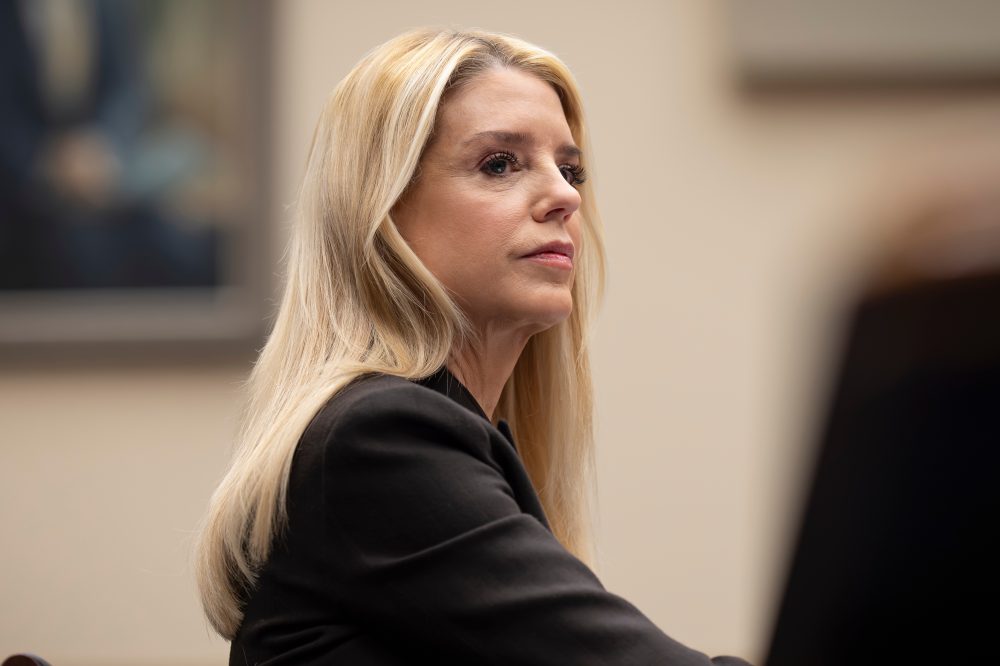

WASHINGTON — Former Attorney General Pam Bondi appeared before House lawmakers Friday for closed-door questioning regarding Jeffrey Epstein’s sexual abuse cases, marking a significant moment that puts renewed focus on the administration’s mishandled release of Epstein-related documents.
In prior public hearings, Bondi displayed a confrontational stance when questioned by legislators about the Epstein matter. Whether she will maintain that same demeanor Friday remains uncertain, given that she no longer leads the Justice Department. The questioning session is taking place privately.
The recorded interview provides legislators an opportunity to seek details about how the administration handled Epstein documents and related issues, including the imprisonment of his former associate and girlfriend, Ghislaine Maxwell. The Justice Department transferred Maxwell to a Texas prison facility last August.
“I think she absolutely could clear up many missing pieces if she wanted to,” said Rep. Yassamin Ansari, an Arizona Democrat on the House Oversight Committee. “Now it’s a question of whether or not she is willing to be transparent.”
Legislators are seeking information about prosecutorial decisions regarding Epstein’s associates, how the Justice Department managed the congressional requirement to release Epstein documents, and whether President Donald Trump played a role in the proceedings.
Bondi, who disclosed this week that she is receiving treatment for thyroid cancer, has remained connected to Trump’s circle despite leaving her position in early April.
This week, Trump named her to a White House artificial intelligence panel, and Justice Department officials, including Harmeet Dhillon, who leads the department’s Civil Rights Division, will accompany Bondi Friday as her legal representation.
Democrats characterize this arrangement as creating a conflict of interest.
A Justice Department spokesperson explained that officials were present to assist lawmakers in understanding the department’s procedures for releasing case documents.
Bondi has been at the center of the political controversy surrounding Epstein, first creating expectations for complete disclosure of the Epstein documents, then reversing course. This change prompted congressional action to mandate the release through legislation.
Bondi encountered additional criticism when the Justice Department delayed releasing the files and subsequently included personal details of potential victims. During congressional hearings, she has maintained that she was attempting to comply with legal requirements.
The House Oversight Committee has been pursuing a comprehensive Epstein investigation covering multiple presidential terms.
The committee issued a subpoena to Bondi in March through a bipartisan vote, but she attempted to avoid compliance by arranging a private meeting with lawmakers that month. This strategy only increased tensions between Bondi and committee Democrats.
Bondi’s exit from the Justice Department also created uncertainty about enforcing the congressional subpoena. Following Democratic committee members’ push for a civil contempt resolution against Bondi, she consented to participate in a transcribed interview instead of a sworn deposition.
Oversight panel Democrats have opposed this arrangement, arguing it permits Bondi to refuse answering questions. They have also urged the Republican committee chair, Rep. James Comer, to videotape the session.
“A failure to film and release a video of Ms. Bondi’s testimony would present a grave injustice to the American people and survivors of Epstein’s crimes,” the committee’s top Democrat, Rep. Robert Garcia, wrote to Comer.
Comer explained he is permitting Bondi to participate in a transcribed interview rather than a deposition as encouragement for cooperation. Previously, he enforced subpoenas on former President Bill Clinton and former Secretary of State Hillary Clinton when they resisted demands. Both of their depositions were video-recorded.
Nevertheless, Comer stated Bondi could face prosecution for providing false information to Congress. He indicated the committee would publish a transcript of the interview.
“Hopefully that will be good enough,” he said.