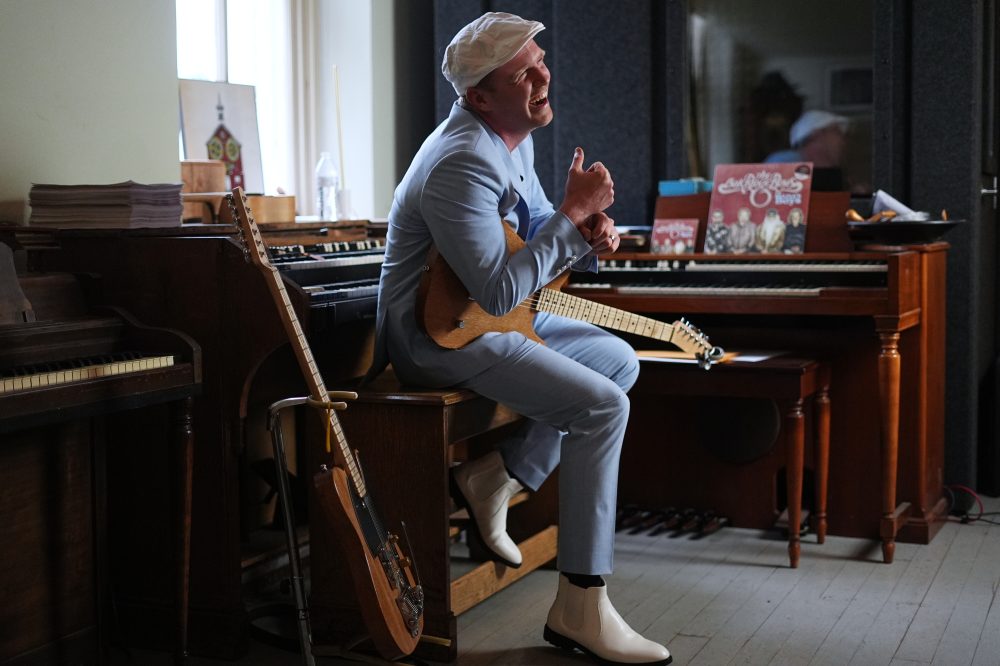

MCCOYSVILLE, Pa. — Conrad Fisher’s path through music has led him from his Amish heritage in Pennsylvania to Nashville’s music scene and back home again. Now the singer-songwriter creates videos and recordings featuring artists from Amish and Mennonite backgrounds, reaching audiences far beyond their traditional religious circles.
This past weekend, Fisher performed at a former Presbyterian church he purchased at a bargain price and transformed into a performance venue and recording facility called Ragamuffin Hall, located in rural McCoysville, Pennsylvania.
Fisher shared the stage with Ben and Rose Stoltzfus, a husband-and-wife duo whose Amish heritage and harmonious vocals have attracted millions of YouTube viewers. The sold-out performances served as preparation for upcoming shows at significantly larger venues across Pennsylvania and Indiana.
“Ragamuffin Hall is supposed to be a place where those weird things that’ll get you ostracized everywhere else, we’re like, ‘Oh, no, that’s a gift. And here’s how you use it,’” Fisher explained.
Fisher’s parents both came from Amish families, though his father later joined a Mennonite church as a young man. The Mennonite congregations Fisher attended during childhood rarely incorporated musical instruments into their services.
Despite this, his father enjoyed Johnny Cash and didn’t monitor Fisher’s MP3 player too closely. Fisher’s musical awakening came when his brother returned from a camping trip with a compilation CD featuring Chuck Berry, Buddy Holly, the Everly Brothers and the Beach Boys.
“It blew my mind, right?” recalled Fisher, who is now 31. He began studying keyboards before expanding to guitar, bass and drums, eventually learning music production “mostly because I was dead set on making a living with music.”
“My buddies would be like, ‘Hey, I wrote a song for my girlfriend. Can you do a track?’ And I’m like, sure,” he said.
As a young adult, Fisher relocated to Tennessee and spent three years working within the songwriting industry — the Oak Ridge Boys even recorded one of his compositions. However, the touring lifestyle didn’t appeal to him, especially performing at bars.
“There’s drinking and carrying on,” Fisher noted. “It’s just not me. I’m not a prude, but I just don’t enjoy that scene.”
Fisher prioritizes his wife and three children while remaining committed to his Mennonite faith — his pastor once questioned why he didn’t simply start a woodworking business and launch a prison ministry. His music production work eventually became successful enough that he could leave carpentry behind three years ago.
In 2022, Fisher discovered an old brick church several miles from his residence was available for purchase. After presenting his concept for converting it into a music incubator, the sellers agreed to a below-market price.
Musicians now regularly visit Ragamuffin Hall, primarily to record “clean country music” and traditional bluegrass with strong gospel influences. Fisher has worked with various acts including an Amish steel guitarist who performed with his son’s group, a musician who traveled hours from Missouri, and an Amish band from Ohio.
During last Saturday’s performance, Fisher mixed his original compositions with songs popularized by Waylon Jennings, Alison Krauss and Don Williams. Following his five-piece band’s opening set, they remained on stage to accompany Ben and Rose. Fisher performed using an electric guitar crafted from a beam salvaged during his church renovation project.
The predominantly white afternoon audience consisted mainly of older attendees, including several musicians’ relatives. The venue’s lower level offered Ragamuffin Hall merchandise alongside $3 homemade whoopie pies, a popular Pennsylvania Dutch treat.
While the isolated culture and simple lifestyle of conservative Anabaptist communities aren’t typically linked with music, Amish sacred music spans five centuries. Their 900-page hymnal — the “Ausbund” — was partially written by imprisoned Anabaptists in 16th-century Germany and remains in use today.
Fisher’s Amish background and fluency in Pennsylvania Dutch, the dialect spoken by Old Order Amish, helps him connect with similar musicians.
However, Amish church music traditionally involves only group singing without instruments or individual performers. The community typically discourages public performances and other displays considered prideful.
“There’s a lot of great talent in that community that goes undeveloped because,” Fisher explained, using a Pennsylvania German expression, “that’s just, ‘we don’t do that,’ you know.”
This type of criticism emerged in February after Fisher posted an energetic live performance of “Swing Low, Sweet Chariot” on YouTube. Fisher felt compelled to address the backlash.
“I’m a believer, I’m a man of faith, and I’m not ashamed of that,” he responded in a video message. “But I do play a lot of different kinds of music, just like, you know, if you’re a shed builder you build sheds for all kinds of people, not just churches and schools.”
Elam Stoltzfus, who directs the Nicholas Stoltzfus Homestead in Wyomissing, Pennsylvania, described attending a charity fundraiser where Ben and Rose performed as “one of the shocks of my life.” (Stoltzfus is a widespread surname among the Amish.) The event featured bright lighting, a video display, barbecued chicken and vendors selling merchandise, CDs and books.
Stoltzfus, whose family departed the Old Order in the mid-1960s when he was 10, noted the gathering was filled with Mennonite and Amish attendees. While they didn’t dance, they did applaud.
“I was thrilled to see this happen, because I knew this was a paradigm shift,” he said. “When I was a teenager, it would never have happened.”
Amos Raber from Goshen, Indiana, also grew up in a traditional “horse and buggy” Amish household and identified as Amish until age 22. Today, he supports his family through concert performances and income from what he reports are millions of monthly clicks across YouTube, Spotify, Apple Music and Facebook.
Raber has observed Amish youth increasingly gathering with guitars to sing in recent decades. Yet they still face restrictions on public performances.
“Most times, if you see someone who’s really Amish doing that kind of thing, they’re probably not going to be Amish long,” Raber explained. Since beginning their recording and performing career, Ben and Rose have departed their Amish church and joined a different Christian denomination. They declined to comment for this story.
LeRoy Stoltzfus, a singer-songwriter living near Lancaster, was 13 when his family left the Amish church. He said recent changes in the Lancaster Amish settlement have made it easier for people to leave without losing family and friend connections, avoiding the traditional practice of “shunning” that has long intrigued outsiders.
After years playing guitar as a church worship leader and completing four years at a Colorado Bible college, he now earns his living as a musician, combining concerts with online advertising revenue and recordings for a fan base that includes many current and former Amish people.
“Ever since I can remember I wanted to be a star,” LeRoy Stoltzfus said. “But the older I got, I realized it wasn’t about me — it was about putting out music and helping people.”
Justin Hiltner, a Nashville banjo player and songwriter who serves as managing editor of the roots music blog “The Bluegrass Situation,” said he was impressed with the music’s quality after investigating it. He also sensed that Ben and Rose, Conrad Fisher and others are creating a musical community.
“This is clearly not just insular music that’s just facing other Amish folks or other Mennonite folks,” Hiltner observed. “Clearly it’s ‘broken containment’ here.”
Hiltner described the music — and Fisher’s videos — as “really compelling.”
“To kind of an outsider, this is the performance of American essentialism, the rural American ideal, right?” Hiltner said. “I did hear a level of talent that’s very clearly pushing and pulling these folks towards bringing their music to a wider audience.”
Religiously conservative musicians can distribute their recordings through a network of bookstores throughout the United States and Canada. At Ken’s Educational Joys in Ephrata, Pennsylvania, CD collections are displayed alongside floor-to-ceiling Bible selections.
Owner Lydell Zimmerman said his top music sellers are a cappella recordings, but he’s observed that Ben and Rose have developed a strong following.
“I think their presence as an Amish couple singing online is what brought people’s attention to them,” Zimmerman noted.
Ben and Rose came to Fisher’s studio when Ben’s brother, a Lancaster friend of Fisher’s, scheduled a recording session there.
Fisher immediately recognized Ben and Rose’s talent. Using Fisher’s production expertise, they’ve accumulated over 30 million YouTube video views. Eventually, Fisher suggested live performances and the couple agreed.
“I started recording when I was 14,” Fisher said. “If you would have told me two years ago that what’s going to put me on the map or boost my business in a big way, it’s going to be an Old Order Amish couple, I would have laughed at you.”