
NEW YORK — Forensic handwriting specialists have determined that two notes connected to Jeffrey Epstein’s final weeks in jail were written by the same individual, according to an analysis conducted for The Associated Press.
The conclusion comes after three document examination experts studied both notes and identified matching characteristics including letter formation, spacing patterns, capitalization style, and distinctive punctuation marks.
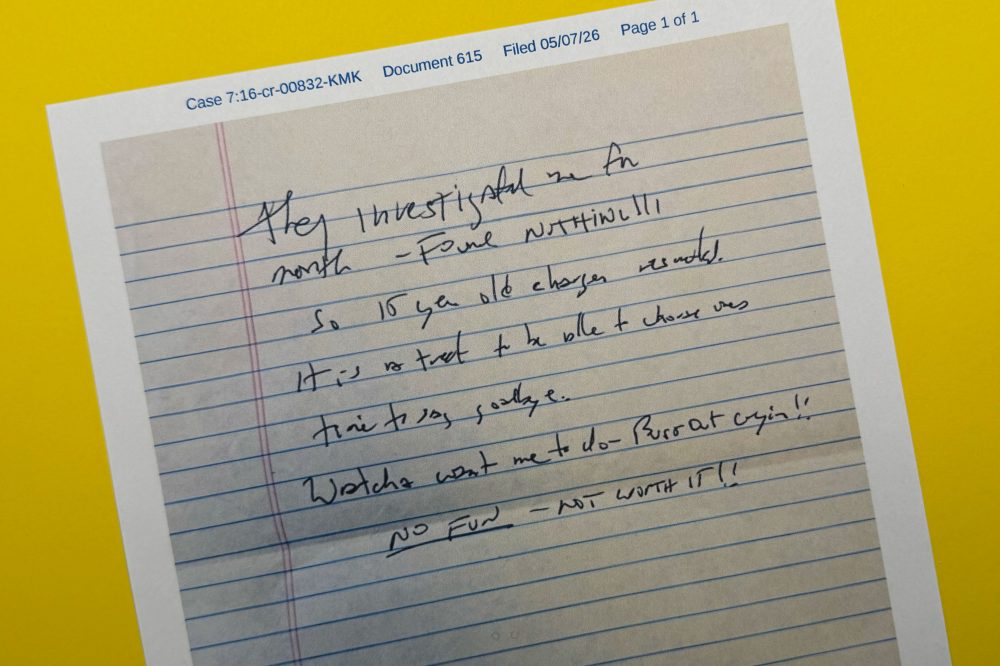
One note, just released to the public this week, contains the text: “They investigated me for month — found nothing!!!” and references choosing the “time to say goodbye.” The second note, which has been available publicly for several years, lists complaints about jail conditions including showers, food quality, and “Giant Bugs.”
Although experts cannot definitively confirm Epstein authored the writings, the notes reflect his deteriorating mental state before his death and mirror complaints he made to jail staff about conditions at the deteriorating Metropolitan Correctional Center in Manhattan, a stark contrast to his previously luxurious lifestyle. The notes also contain language he had previously used.
Both writings, created with pen on notepad paper, feature the underlined words “NO FUN” and conclude with double exclamation marks — the initial mark in each showing similar curved characteristics. Each note begins with larger text that gradually decreases in size, and successive lines drift away from the left margin.
“These are the kinds of things that would suggest that we’re dealing with the same writer,” said Thomas Vastrick, the president of the American Society of Questioned Document Examiners.
“They are written by the same person,” said Bart Baggett, who founded the forensic analysis firm Handwriting Experts Inc. and has testified in court as an expert witness more than 130 times.
“Both of those documents have the same author,” said Grace Warmbier, who worked for a decade for the New York City Police Department performing document examinations and handwriting analysis.
The experts acknowledged they cannot definitively attribute the notes to Epstein, partly because confirmed samples of his handwriting are scarce among the millions of pages in recently released Justice Department records about the deceased financier.
Warmbier and Vastrick also examined writing samples from former cellmate Nicholas Tartaglione, including portions of a 2019 letter he sent to the New York Daily News denying involvement in Epstein’s death.
Warmbier eliminated Tartaglione as the author, citing “significant dissimilarities between his handwriting and the handwriting in question.”
Vastrick noted that Tartaglione’s writing samples showed “a wide range of variation from one to another” and contained some similarities requiring additional examination.
“At this point, I certainly would not eliminate him as a potential writer,” Vastrick said. “I don’t at the same time want to suggest that he is the writer.”
The first note remained largely unknown until Tartaglione discussed it on writer Jessica Reed Kraus’ podcast last summer. This revelation interested New York Times reporters, who successfully petitioned a judge Wednesday to unseal the note from an unrelated case.
Tartaglione, a former police officer now serving life imprisonment for four murders, claims he found the note in a book within his cell after guards discovered Epstein on July 23, 2019, on the floor with bedsheet material around his neck. Following this incident, Epstein was placed under suicide watch and relocated to another cell. He was alone when found dead on August 10, 2019.
Epstein and Tartaglione were cellmates for approximately two weeks, starting shortly after Epstein’s July 6, 2019 arrest on sex trafficking charges and ending with the suspected suicide attempt. Both men were awaiting trial.
Justice Department records show Tartaglione informed his attorney about the note four days after the July 23 incident. No evidence suggests jail officials or Epstein’s legal team were notified.
The note was subsequently submitted as evidence in Tartaglione’s criminal proceedings and sealed during a dispute over his legal representation. Government reports examining Epstein’s death circumstances never mentioned it, nor did it appear in Justice Department files. The second note, discovered after Epstein’s death, was featured on CBS’ “60 Minutes” in 2020 and appears in official files.
Beyond handwriting analysis, the notes’ language may provide authorship clues. The note Tartaglione claims to have found includes: “Watcha want me to do — Bust out cryin!!”
Epstein had previously used this phrase, mimicking dialogue from a 1931 “Little Rascals” film, in three emails included in Justice Department files, including one sent to his brother four months before his incarceration.
If you or someone you know needs help, the national suicide and crisis lifeline is available by calling or texting 988. Online chat is also available at 988lifeline.org.