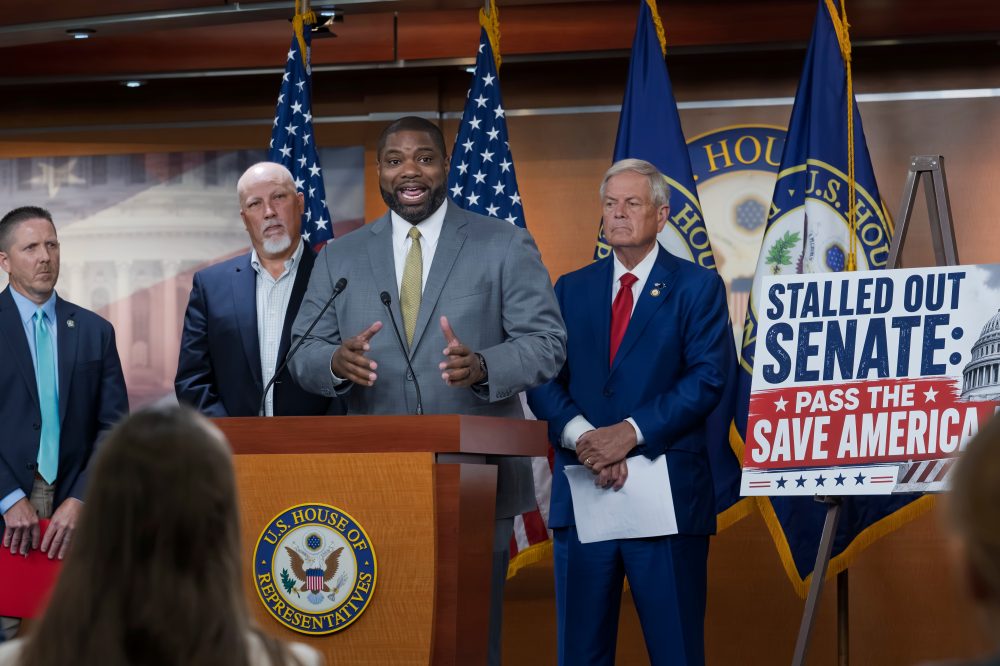

WASHINGTON (AP) — Byron Donalds, a Republican member of Congress who is also campaigning to become Florida’s next governor, unveiled legislation Monday aimed at making sure the rapid expansion of artificial intelligence data centers doesn’t push up electricity and water bills for everyday Americans.
Under his proposal, which would need to pass Congress to take effect, data centers would be required to secure all of their electricity and water from private sources — not from the public power grid or municipal water systems. The approach mirrors a voluntary initiative already put forward by President Donald Trump.
“If you talk to these guys who are building these data centers, if it means that they have to pick up the utility costs, they’re more than willing to do it,” Donalds told The Associated Press. “It’s in their interest to make sure that we can construct these centers, and I think the number one way you address and mitigate the concerns that people are having is to just ensure their utility bills aren’t going up in the process.”
The bill is drawing attention in part because Donalds has received backing from pro-AI political action committees and from Trump himself. It arrives at a time when data centers are being built at a furious pace across the country to keep up with surging demand for AI technology. The major tech companies fueling the AI boom have become some of the most valuable businesses in the world, and the Trump administration has closely aligned itself with those industry leaders.
Several of those large tech companies have already agreed with the Trump administration to cover the costs of building new power sources themselves, rather than passing the expense on to homeowners. However, given how rapidly demand is expected to grow, questions remain about whether that voluntary commitment can be legally enforced.
The breakneck speed of data center construction and the enormous stakes involved have sparked growing unease among the public. In Florida alone, more than 20 counties and municipalities have voted against allowing major data centers to be built, while others have put a halt on new construction for at least a year. Residents and local officials frequently point to worries about rising utility costs, disruptions to their communities, and environmental harm as key reasons for the pushback.
“These companies have been a step behind and didn’t realize how quickly the ground was shifting under their feet,” said Republican strategist Matt Gorman. He noted that both progressive climate activists and conservative populists have latched onto the data center issue, putting pressure on tech companies to “tell a better story” and respond to concerns from across the political spectrum.
“This is a full-court effort here,” Gorman added. “If you don’t tell that story, you’re going to have it mandated on you from lawmakers of both parties.”
Donalds is seeking to replace Florida Gov. Ron DeSantis, a fellow Republican who signed a law in May requiring large data centers to cover their own energy and water expenses in full. If elected governor, Donalds said he would focus on making data centers more efficient and steering them away from heavily populated areas.
“We just want to make sure that if they do get built, they’re being built efficiently while protecting ratepayers and protecting Florida’s water,” Donalds said. “The real public policy question for the country and for states is how are we going to generate baseload power for future energy demands, whether it’s for hyperscale data centers or for anything else.”
Donalds faces competition in the governor’s race. James Fishback, a far-right Republican candidate, has built much of his primary challenge to Donalds around opposition to data centers. On the Democratic side, David Jolly, a former congressman and the leading Democratic candidate for governor, recently called for a complete halt to data center construction in the state.
Travis Fisher, a fellow at the Cato Institute, explained that publicly traded companies typically push hard to access public utilities at the best available rates. He said any willingness by tech firms to take on greater energy and water costs is a direct result of the political heat they’re feeling.
“They are very afraid that they’re going to, I’d say, lose their social license to operate, as if they’re basically going to get run out of town or banned,” Fisher said.