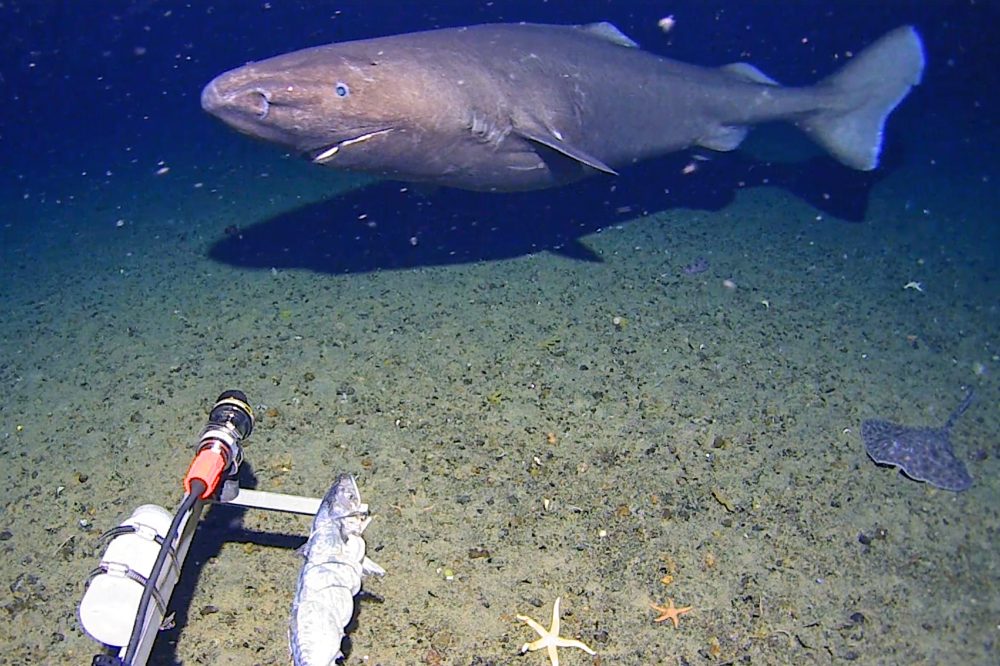

Scientists have made a groundbreaking discovery in Antarctica’s icy waters, capturing the first-ever footage of a shark swimming in the continent’s frigid depths.
The massive sleeper shark, measuring an estimated 10 to 13 feet in length, was filmed gliding slowly across the ocean floor in waters so deep that sunlight never reaches them, according to researcher Alan Jamieson who announced the discovery this week.
“We went down there not expecting to see sharks because there’s a general rule of thumb that you don’t get sharks in Antarctica,” Jamieson explained.
“And it’s not even a little one either. It’s a hunk of a shark. These things are tanks,” he continued.
The remarkable footage was recorded in January 2025 by equipment from the Minderoo-UWA Deep-Sea Research Centre, which studies marine life in the world’s deepest ocean regions. The camera was positioned near the South Shetland Islands close to the Antarctic Peninsula, well within the boundaries of the Southern Ocean below the 60-degree south latitude marker.
The shark was swimming at a depth of 490 meters (1,608 feet) where water temperatures hovered at a bone-chilling 1.27 degrees Celsius (34.29 degrees Fahrenheit).
During the encounter, a skate – a shark relative resembling a stingray – remained motionless on the seafloor, apparently unbothered by the passing predator. Unlike the shark, skates were already known to inhabit these southern waters.
Jamieson, who leads the University of Western Australia-based research facility, stated he could locate no previous documentation of sharks in Antarctic waters.
Charles Darwin University conservation biologist Peter Kyne, who wasn’t involved in the research, confirmed that no shark had ever been documented this far south before.
While climate change and warming oceans might be pushing sharks toward the Southern Hemisphere’s colder regions, Kyne noted that limited data exists on species migration patterns near Antarctica due to the area’s isolation.
The sluggish sleeper sharks may have inhabited Antarctic waters for extended periods without detection, he suggested.
“This is great. The shark was in the right place, the camera was in the right place and they got this great footage,” Kyne commented. “It’s quite significant.”
According to Jamieson, sleeper shark populations in Antarctic waters are probably scarce and challenging for humans to spot.
The filmed shark stayed at approximately 500 meters (1,640 feet) depth along a sloping seabed that dropped into much deeper waters. The animal remained at this level because it represents the warmest layer among several water strata extending to the surface, Jamieson explained.
The Antarctic Ocean features heavy layering, or stratification, extending down about 1,000 meters (3,280 feet) due to contrasting water properties – denser, colder water from below doesn’t easily blend with fresh water flowing from melting ice above.
Jamieson believes additional Antarctic sharks inhabit similar depths, surviving on dead whales, giant squids, and other marine animals that sink to the ocean floor after dying.
Very few research cameras operate at these specific depths in Antarctic waters, and those that do can only function during the Southern Hemisphere’s summer season from December to February.
“The other 75% of the year, no one’s looking at all. And so this is why, I think, we occasionally come across these surprises,” Jamieson noted.